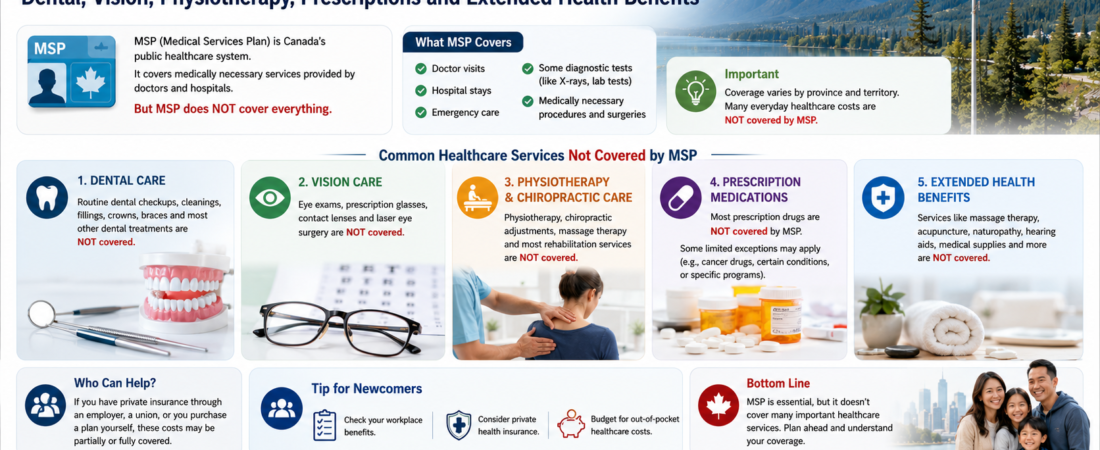
When people first hear about Canada’s healthcare system, one sentence comes up again and again:
“Healthcare is free in Canada.”
After living in British Columbia and using the healthcare system, I learned that this statement needs an important explanation.
Yes, many medically necessary doctor and hospital services are covered through provincial public health insurance.
In British Columbia, that insurance is called the Medical Services Plan, or MSP.
But having MSP does not mean that every health-related expense disappears.
You can visit a doctor without paying directly for an insured appointment, walk out of the clinic, and then discover that the prescription at the pharmacy costs money.
You can go to a dentist and receive a bill.
You can book physiotherapy and be asked how you plan to pay.
You can buy glasses and realize that MSP generally does not simply pay for the entire purchase.
That can be confusing for newcomers.
I think one of the easiest ways to understand the Canadian system is this:
Public healthcare and complete healthcare coverage are not the same thing.
This article focuses on the parts of everyday healthcare that can still cost money in British Columbia, including dental care, vision care, physiotherapy, massage therapy, chiropractic care, prescription drugs, ambulance services, medical devices and extended health insurance.
It also explains why employer benefits and government programs can become so important.
1. MSP Covers Important Care — But Not Everything
In Part 1, I explained that MSP is the foundation of British Columbia’s public healthcare system.
For eligible B.C. residents, MSP covers many medically necessary physician and hospital services.
That can include things such as:
- Doctor visits
- Specialist visits when medically necessary
- Certain diagnostic tests
- Medically necessary hospital treatment
- Some surgical care
But MSP is not designed to pay for every service connected to health.
This distinction becomes very important in everyday life.
You might think:
“If healthcare is publicly funded, why am I paying for this?”
Usually, the answer is that the service is outside the core MSP benefit package or only covered in specific circumstances.
That is why understanding MSP coverage matters just as much as having MSP itself.
2. Dental Care: One of the Biggest Surprises for Newcomers
Dental care is probably one of the clearest examples.
A newcomer may assume:
“If I have MSP, my dentist should also be covered.”
Generally, routine dental care is not part of basic MSP coverage.
That can include services such as:
- Dental examinations
- Cleaning
- X-rays
- Fillings
- Root canal treatment
- Crowns
- Bridges
- Dentures
- Orthodontic treatment
There are limited situations where medically necessary oral or dental surgery performed in a hospital may fall within the public system.
But that is very different from ordinary dental care at a dental office.
3. Dental Bills Can Become Expensive Quickly
Dental care can become one of the larger out-of-pocket healthcare expenses for families.
A simple cleaning may be manageable.
But if a dentist discovers multiple cavities, recommends a crown, or identifies a problem requiring a root canal, the total cost can rise quickly.
That is why I think newcomers should ask about price before agreeing to significant dental treatment.
Questions worth asking include:
“How much will this treatment cost?”
“Does my insurance cover it?”
“How much will I have to pay myself?”
“Can you submit a pre-treatment estimate to my insurance company?”
Understanding the cost before treatment can prevent unpleasant surprises later.
4. The Canadian Dental Care Plan
Canada now also has the Canadian Dental Care Plan, or CDCP.
As of the 2026–2027 benefit year, eligible Canadian residents can apply.
To qualify, applicants generally must meet all four main requirements:
- They do not have access to private dental insurance
- They have filed the required Canadian tax return
- Their adjusted family net income is below $90,000
- They are Canadian residents for tax purposes
The amount paid by the program can vary according to family income, and patients may still have to pay co-payments or additional provider charges in some circumstances.
This is important because the CDCP does not mean every dental procedure becomes completely free.
Always ask the dental office what amount may remain your responsibility.
5. Eye Exams and Glasses Are Another Area of Confusion
Vision care is another service that can surprise newcomers.
People often assume that because eyesight is related to health, regular eye exams and glasses must automatically be covered by MSP.
That is not always the case.
Coverage can depend on:
- Your age
- Your medical condition
- Whether the examination is medically necessary
- Whether you qualify for specific assistance programs
Routine eye exams for many healthy adults may not be fully covered by MSP.
And even when an eye examination is covered, that does not automatically mean MSP will pay for:
- Eyeglass frames
- Lenses
- Contact lenses
- Lens upgrades
- Prescription sunglasses
These costs may be paid personally or through extended health benefits.
6. Medically Necessary Eye Care Is Different From Routine Vision Care
This distinction is important.
A routine eye examination is different from seeing an ophthalmologist because of a medical eye problem.
If your doctor refers you to a medical specialist because of an eye disease or serious medical concern, that specialist care may fall within MSP coverage when it is medically necessary.
On the other hand, choosing new eyeglasses because your prescription has changed is usually part of regular vision care.
This is another example of why the phrase:
“Healthcare is free”
does not tell the entire story.
7. Physiotherapy Can Be Very Helpful — But It May Cost Money
Physiotherapy is commonly used for:
- Back pain
- Neck pain
- Sports injuries
- Rehabilitation after surgery
- Joint problems
- Muscle injuries
- Mobility issues
It can be extremely useful.
But standard MSP coverage does not mean everyone can attend unlimited physiotherapy sessions without cost.
Some B.C. residents who qualify for MSP Supplementary Benefits may receive limited financial assistance toward certain services.
These supplementary services can include areas such as physiotherapy, chiropractic care, massage therapy and other eligible practitioner services under specific rules.
However, the government contribution may not equal the practitioner’s full fee.
That means the patient may still have to pay the difference.
8. Why Extended Health Insurance Matters for Physiotherapy
This is where employer insurance becomes important.
Many workplace benefit plans provide annual coverage for services such as:
- Physiotherapy
- Massage therapy
- Chiropractic care
- Acupuncture
- Psychology or counselling
- Podiatry
The exact amount depends entirely on the employer and insurance policy.
One plan might provide a certain annual maximum.
Another may reimburse a percentage of each visit.
Another may require a doctor’s referral.
Another may have no coverage at all.
So simply hearing:
“My job has benefits.”
is not enough.
You need to read the actual benefit booklet.
9. Massage Therapy Is Usually Not Unlimited MSP Coverage
Registered Massage Therapy, often called RMT, is popular in British Columbia.
People may use massage therapy for:
- Muscle tension
- Back discomfort
- Neck pain
- Recovery from activity
- Certain injury-related problems
But routine massage therapy is not generally something most MSP beneficiaries can simply use without cost.
Some people who qualify for supplementary benefits may receive limited assistance.
Many other people pay themselves or use employer extended health insurance.
This is why an RMT clinic will often ask for your insurance information.
10. Chiropractic Care Works in a Similar Way
Chiropractic treatment is another area where public and private coverage can overlap.
Some eligible residents may qualify for limited MSP supplementary assistance.
Others rely mainly on private extended health insurance.
Again, the important point is:
MSP coverage does not automatically mean the entire chiropractic bill will be paid.
Always check both your MSP eligibility and your private benefit limits.
11. Prescription Drugs Are Not Automatically Free
This is one of the most important things newcomers should understand.
Imagine this situation.
You visit your family doctor.
The appointment is an insured MSP service.
You pay nothing directly for the doctor’s visit.
Then the doctor gives you a prescription.
You go to the pharmacy.
The pharmacist tells you the price.
You may immediately wonder:
“Why do I have to pay? I thought healthcare was free.”
The reason is that physician services and prescription-drug coverage are separate parts of the healthcare system.
12. Fair PharmaCare Can Help With Prescription Costs
British Columbia has Fair PharmaCare, an income-based program that can help eligible families with the cost of certain prescription drugs, pharmacy services and medical supplies.
The amount of assistance generally depends on family income.
Lower-income families may receive more assistance.
Fair PharmaCare is free to register for, and eligibility is connected with MSP enrolment and income information from the Canada Revenue Agency.
This is why newcomers should learn about PharmaCare separately from MSP.
Having MSP alone does not necessarily mean every prescription will cost nothing.
13. Employer Drug Coverage Can Be Extremely Valuable
Many employer extended health plans also include prescription-drug coverage.
This can significantly reduce pharmacy expenses.
For example, depending on the policy, an insurance plan might pay a percentage of the cost of an eligible drug.
The patient pays the remainder.
Some employers also coordinate their coverage with Fair PharmaCare.
In fact, some employer benefit plans encourage or require employees to register for Fair PharmaCare.
This is a good example of how public and private healthcare programs can work together.
14. Ambulances Are Not Necessarily Free
This surprises many newcomers too.
Calling 9-1-1 in a medical emergency is absolutely appropriate when needed.
But an ambulance ride is not necessarily a zero-cost service simply because you have MSP.
British Columbia subsidizes ambulance services, but eligible MSP-covered residents can still receive an ambulance fee.
Official B.C. information has historically listed a subsidized fee for MSP-covered residents rather than making every ambulance transport completely free.
Fees can change, so always check the current BC Emergency Health Services information rather than relying on an old amount.
Most importantly:
Do not avoid calling 9-1-1 in a true emergency because you are worried about the ambulance fee.
Your safety comes first.
15. Medical Devices and Supplies Can Also Cost Money
Another category people sometimes overlook is medical equipment.
Depending on your situation, you may need things such as:
- Orthotics
- Braces
- Compression garments
- Mobility aids
- Certain diabetic supplies
- Medical equipment
- Specialized shoes
- Other health-related devices
Some of these may be covered under PharmaCare, an employer benefit plan or another government program.
Others may require partial or full out-of-pocket payment.
The exact coverage can be quite specific.
Never assume a medical device is covered simply because a doctor recommended it.
Check first.
16. Why Employer Extended Health Benefits Are So Important
Before living in Canada, I did not fully understand why people paid so much attention to workplace benefits.
After learning more about the healthcare system, it made much more sense.
MSP provides the basic public foundation.
But extended health benefits can fill many of the gaps.
A good employer plan may include some coverage for:
- Dental care
- Prescription drugs
- Vision care
- Physiotherapy
- Massage therapy
- Chiropractic care
- Psychology
- Medical equipment
- Travel medical insurance
That can make a significant difference to a family’s annual healthcare expenses.
17. A Higher Salary Is Not the Only Thing to Compare in a Job Offer
This is something I think newcomers sometimes overlook.
Imagine two jobs.
Job A pays slightly more money but provides almost no extended health benefits.
Job B pays slightly less but provides strong family dental, prescription and paramedical coverage.
Depending on your family’s healthcare needs, Job B could actually have very significant financial value.
So when comparing employment offers, do not only ask:
“What is the hourly wage?”
Also ask:
“What benefits are included?”
18. Important Questions to Ask About Employer Benefits
When you receive an employer benefit package, check:
- When coverage begins
- Whether there is a waiting period
- Whether spouses are covered
- Whether children are covered
- Dental reimbursement percentages
- Annual dental maximums
- Vision-care limits
- Prescription-drug coverage
- Physiotherapy limits
- Massage therapy limits
- Chiropractic limits
- Whether referrals are required
- Whether claims can be submitted directly
A plan can sound excellent until you discover the annual maximum is very small.
Read the details.
19. What If You Do Not Have Employer Benefits?
Not everyone has extended health insurance through work.
This may include:
- Self-employed workers
- Some part-time employees
- Contract workers
- Newcomers between jobs
- People working for small employers
- Some temporary residents
In that situation, people may consider purchasing private health insurance.
Private policies vary widely.
Some focus mainly on:
- Prescription drugs
- Dental care
- Vision care
- Paramedical services
- Travel coverage
Before purchasing a policy, compare:
- Monthly premium
- Deductible
- Reimbursement percentage
- Annual maximum
- Exclusions
- Waiting periods
- Pre-existing-condition rules
Do not assume that paying for insurance guarantees unlimited coverage.
20. Sometimes Paying Yourself May Be Cheaper Than Insurance
Private insurance is not automatically the best financial choice for everyone.
Imagine paying a large monthly premium for a policy but rarely using dental, vision or physiotherapy services.
In some situations, the total annual premiums may be higher than the medical expenses you would have paid yourself.
For another family with regular prescriptions, children’s dental care and frequent physiotherapy, insurance may be extremely valuable.
The correct choice depends on your needs.
This is why comparing actual costs matters.
21. Government Programs Can Fill Some Gaps
One of the important things I learned is that MSP is not the only government healthcare program.
Depending on eligibility, B.C. and federal programs may provide assistance with certain services.
Examples can include:
- Fair PharmaCare
- Canadian Dental Care Plan
- MSP Supplementary Benefits
- Programs for children
- Disability-related health assistance
- Income-based benefits
- Seniors’ programs
The eligibility requirements can be different for every program.
That means hearing:
“MSP doesn’t cover it.”
should not always be the end of your research.
There may be another program that applies.
22. Do Not Assume Dental, Vision or Physiotherapy Is Automatically Covered
One practical rule has saved me a lot of confusion:
Ask before receiving the service.
When booking an appointment, ask:
“Is this covered by MSP?”
“Do you direct bill my insurance?”
“How much will I have to pay?”
“Do I need a referral?”
“Is there an annual insurance limit?”
These questions are completely normal.
It is much easier to ask before treatment than to be surprised by the bill afterward.
23. Direct Billing Can Make Life Easier
Many clinics and dental offices can submit insurance claims directly to your extended health insurance company.
This is called direct billing.
For example, imagine your physiotherapy visit costs $100 and your insurance covers $80.
If the clinic supports direct billing, the insurer may pay its portion directly and you pay only the remaining amount.
Without direct billing, you may need to pay the entire bill first and then submit the receipt yourself.
Neither method is necessarily better, but direct billing can be more convenient.
24. Always Keep Your Receipts
This is another small but important habit.
Keep receipts from:
- Dentists
- Pharmacies
- Physiotherapists
- Massage therapists
- Chiropractors
- Optometrists
- Medical-device suppliers
You may need them for:
- Insurance claims
- Health spending accounts
- Tax purposes
- Coordination of benefits
- Reimbursement requests
Electronic copies are useful too.
25. If Both Spouses Have Insurance, Check Coordination of Benefits
Families sometimes have more than one extended health plan.
For example, one spouse may have insurance through their employer and the other spouse may also have workplace benefits.
In some situations, the two plans can coordinate coverage.
This is known as:
Coordination of Benefits.
It can sometimes reduce the amount the family pays out of pocket.
The rules depend on the insurers, so ask your insurance provider how claims should be submitted.
26. One MSP Lesson I Learned: Do Not Forget About Renewal and Status Updates
There is another practical MSP issue that I think newcomers and temporary residents should understand.
Your immigration status and MSP information need to remain current.
This is particularly important for people whose:
- Work permit is renewed
- Study permit is renewed
- Immigration status changes
- Family immigration documents change
B.C. allows people to update or confirm their status in Canada through the MSP Account Change Request system.
Supporting documents can include current immigration documents such as work permits and study permits.
27. My Experience With Online MSP Renewal and Follow-Up
Online services are convenient.
In many cases, submitting an MSP update online is probably the easiest option.
But one thing I learned from experience is that after submitting an important MSP renewal or immigration-status update online, I do not like to simply assume that everything has been completed.
Sometimes processing may take time.
Sometimes additional information may be required.
And sometimes you may simply be unsure whether all of your uploaded documents were properly received and connected to your MSP account.
The B.C. government currently advises that online MSP account-change requests may take up to 21 business days to be reviewed and processed. After submission, a reference number should be provided.
My advice is:
Save that reference number.
Do not close the page and forget about it.
28. Why Visiting Service BC Can Be Helpful
From my own experience, when an MSP renewal or status update does not appear to be progressing properly, speaking with someone directly can be very helpful.
Service BC staff can assist people with a variety of MSP issues, and MSP applications can also be made in person at Service BC locations.
For people living in the Vancouver area, this means that if an online submission seems delayed, incomplete or confusing, it may be worth checking whether a nearby Service BC location can help with your situation.
Personally, I find this especially reassuring when immigration documents are involved.
Instead of repeatedly wondering:
“Did they receive my new permit?”
“Was the document uploaded properly?”
“Is my MSP still active?”
you can bring the relevant documents and ask for assistance.
29. I Would Not Say Online Renewal Is Unreliable — But I Always Follow Up
I would not say that online MSP renewal or account updates are a bad system.
For many people, they work perfectly well.
I also would not assume that every delay means something has been lost.
But healthcare coverage is important enough that I think follow-up is worth the effort.
My personal rule is:
Submit online if it is convenient, save proof of the submission, and follow up if the update is taking longer than expected or something does not look right.
If necessary, contacting Health Insurance BC or seeking assistance through Service BC can help clarify the situation.
30. Documents I Recommend Keeping Together
For MSP renewals or immigration-status updates, I think it is useful to keep copies of:
- Current work permits
- Study permits
- Relevant immigration documents
- Previous permits
- IRCC approval letters
- Online submission confirmations
- MSP reference numbers
- Health Insurance BC letters
- BC Services Card information
Keeping everything together can save a lot of stress.
This is especially important for temporary residents whose immigration documents have expiry dates.
31. Why This Matters More Than You Think
When everyone is healthy, healthcare paperwork can feel like something you can deal with later.
Then someone becomes sick.
Suddenly you want to know immediately:
“Is my MSP active?”
That is not the moment when you want to discover that an update was never completed.
That experience taught me to take renewals, expiry dates and confirmation seriously.
A few minutes spent checking your coverage can prevent a much more stressful situation later.
32. MSP, Extended Health Insurance and Government Programs Work Together
After living in Canada, I eventually stopped thinking about healthcare coverage as one single system.
It is more useful to think of it as several layers.
Layer 1: MSP
Covers many medically necessary physician and hospital services.
Layer 2: PharmaCare and Other Government Programs
May help with prescription drugs, dental care or other eligible healthcare expenses.
Layer 3: Employer Extended Health Benefits
May cover dental, vision, prescriptions and paramedical services.
Layer 4: Private Insurance
Can fill additional gaps for people without employer coverage.
Layer 5: Out-of-Pocket Payment
Some costs remain the patient’s responsibility.
Once I understood these layers, Canadian healthcare made much more sense.
33. What I Wish I Had Known Earlier
Before living in Canada, I heard:
“Healthcare is free.”
After living here, I would describe it differently.
I would say:
“Canada provides very important public healthcare coverage, but you still need to understand what is insured and what is not.”
That one sentence would have saved me a lot of confusion.
I would also tell newcomers:
Learn about MSP.
Register for PharmaCare if eligible.
Understand your employer benefits.
Check your dental and vision coverage.
Ask about treatment costs.
Keep your receipts.
Watch your insurance maximums.
And if your immigration status changes, make sure your MSP information is updated too.
Final Thoughts: “Free Healthcare” Is Only the Beginning of the Story
Canada’s public healthcare system provides something extremely valuable.
If you need medically necessary physician care or hospital treatment and you are eligible for provincial coverage, you are protected from many of the enormous medical bills that can occur in other healthcare systems.
That should not be underestimated.
But everyday healthcare expenses still exist.
Dental care can cost money.
Glasses can cost money.
Physiotherapy can cost money.
Massage therapy can cost money.
Prescriptions can cost money.
Ambulances can sometimes involve fees.
Medical equipment can cost money.
That is why extended health benefits Canada, PharmaCare, the Canadian Dental Care Plan and other programs matter.
The system becomes much easier to understand once you stop asking:
“Is healthcare free?”
and start asking:
“Which part of my healthcare is covered, and by which program?”
That is the question I wish I had understood much earlier.
And one final lesson from my own experience is this:
Do not ignore MSP renewal or immigration-status updates.
Online services are convenient, but save your confirmation information and check that the update has actually been completed.
If something seems delayed or unclear, follow up.
And when appropriate, getting help directly through Service BC can make the process much less confusing.
When healthcare is involved, a little organization and follow-up can make a very big difference.