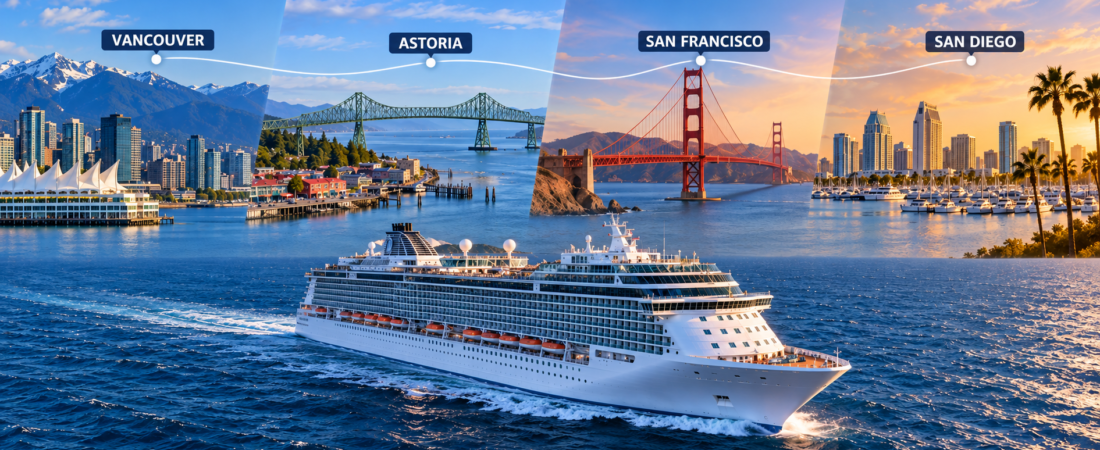
A cruise from Vancouver to San Diego offers a very different experience from a typical round-trip vacation.
Instead of flying directly from Canada to Southern California, passengers board a ship at Vancouver’s Canada Place cruise terminal and travel south along the Pacific Coast. Depending on the itinerary, the cruise may visit ports such as Astoria and San Francisco before arriving in San Diego.
These sailings are usually offered when a cruise ship finishes its Alaska season and moves south for warmer-weather itineraries. They are often described as Pacific Coastal cruises or repositioning cruises.
One current example is Royal Caribbean’s seven-night Pacific Coastal itinerary aboard Serenade of the Seas. The published route travels from Vancouver to Astoria, San Francisco and San Diego, with several sea days between the ports. The itinerary is listed as a one-way cruise, so passengers must plan what they will do after arriving in California.
This guide explains the route, the overall travel experience and the most important details to understand before booking.
Cruise dates, prices, arrival times and ports can change. Always confirm the final itinerary and travel-document requirements directly with the cruise line before purchasing transportation or accommodation.
What Is a Vancouver-to-San Diego Cruise?
A Vancouver-to-San Diego cruise is generally a one-way Pacific Coast sailing.
Passengers embark in Vancouver, British Columbia, but do not return to the same port. The cruise ends in San Diego, California, which means travellers need a separate plan for returning home or continuing their vacation.
This is different from a closed-loop cruise that begins and ends in Vancouver.
The one-way format creates several possibilities:
- Fly from San Diego back to Vancouver.
- Spend several days visiting San Diego before flying home.
- Travel north by train, bus or rental car.
- Take another cruise from San Diego to Mexico.
- Continue through the Panama Canal to Florida.
- Combine two consecutive cruises into one extended vacation.
The best option depends on the available cruise schedule, airfare, total vacation time and the passenger’s immigration documents.
A Typical Seven-Night Route
Royal Caribbean currently lists the following seven-night itinerary aboard Serenade of the Seas:
| Day | Destination | Main experience |
|---|---|---|
| Day 1 | Vancouver, British Columbia | Embarkation and departure |
| Day 2 | At sea | Scenic sailing and onboard activities |
| Day 3 | Astoria, Oregon | Columbia River history and coastal scenery |
| Day 4 | At sea | Southbound Pacific sailing |
| Day 5 | San Francisco, California | Waterfront attractions and city sightseeing |
| Day 6 | At sea | Final full day aboard the ship |
| Day 7 | At sea or sailing south | Schedule depends on the published departure |
| Day 8 | San Diego, California | Disembarkation |
The official route identifies Vancouver, Astoria, San Francisco and San Diego as the principal ports. Exact arrival and departure times should be checked on the booking page because port schedules can be adjusted for weather, safety or operational reasons.
The cruise covers a large section of the Pacific Coast while giving passengers several full days to enjoy the ship.
View the current Royal Caribbean Vancouver-to-San Diego itinerary
Starting the Cruise in Vancouver
The journey begins at Canada Place, Vancouver’s main cruise terminal.
Canada Place is located on the downtown waterfront near Waterfront Station. Passengers staying in downtown Vancouver can often reach the terminal by taxi, rideshare service or public transit without renting a car.
When a ship leaves Vancouver, passengers may see:
- The Canada Place sails
- Burrard Inlet
- Stanley Park
- The North Shore Mountains
- Lions Gate Bridge
- West Vancouver
- Cargo ships and floatplanes in the harbour
The departure is one of the most scenic parts of the trip. If the weather is clear, the upper outdoor decks provide excellent views as the ship travels out of Burrard Inlet and toward the Pacific Coast.
When Should Passengers Arrive?
Passengers who already live in Metro Vancouver may be able to travel to Canada Place on embarkation day. However, anyone arriving from another city should consider staying in Vancouver for at least one night before the cruise.
A delayed flight on embarkation day can result in missing the ship. Cruise ships normally do not wait for passengers whose independent transportation arrives late.
After completing online check-in, the cruise line provides an assigned arrival window. Passengers should follow that time rather than arriving extremely early and waiting outside the terminal.
Day at Sea: Travelling South Along the Pacific Coast
Sea days are an important part of this itinerary.
Unlike a port-intensive cruise with a different destination every morning, a Pacific Coastal cruise gives passengers time to relax between Astoria, San Francisco and San Diego.
On Serenade of the Seas, Royal Caribbean lists facilities such as:
- An adults-only Solarium
- Swimming pools
- A rock-climbing wall
- A nine-hole miniature golf course
- Live entertainment
- Main dining and buffet restaurants
- Specialty restaurants
- Bars and lounges
- Spa treatments
- Youth activities
Some restaurants, drinks, internet packages, spa services and other activities cost extra. These expenses should be included when estimating the total vacation budget.
Explore Serenade of the Seas and its onboard facilities
Will the Ocean Be Rough?
The Pacific Ocean can sometimes feel rougher than protected passages near Vancouver or Southeast Alaska.
Conditions vary according to wind, storms, ocean swell and the location of the ship. Travellers who are sensitive to motion may want to:
- Select a cabin near the middle of the ship.
- Choose a cabin on a lower passenger deck.
- Bring an appropriate motion-sickness remedy.
- Avoid excessive alcohol during rough conditions.
- Spend time where they can see the horizon.
- Ask a doctor or pharmacist about medication before travelling.
No cabin location can eliminate movement completely, but a lower, midship cabin usually experiences less noticeable motion than a cabin located high and far forward.
First Port: Astoria, Oregon
Astoria sits near the mouth of the Columbia River in northern Oregon.
It is smaller and quieter than San Francisco, but its maritime setting makes it a natural stop on a Pacific Coastal cruise. The city is known for its riverfront, historic buildings and views across the Columbia River.
Popular places and activities may include:
- Astoria Riverwalk
- Columbia River Maritime Museum
- Astoria Column
- Downtown Astoria
- Historic homes
- Local seafood restaurants
- Views of the Astoria–Megler Bridge
- Fort Clatsop and Lewis and Clark history
The amount that passengers can see depends on the ship’s arrival time and the length of the port visit.
Those who prefer a relaxed day can explore the riverfront and downtown area. Travellers hoping to visit locations farther from the port should compare an organized shore excursion with local transportation options.
Because port times may change, passengers should return to the ship well before the published all-aboard time.
Second Port: San Francisco, California
San Francisco is usually the largest city visited during this journey.
Approaching the city by ship can be a memorable experience, especially when weather conditions allow passengers to see the Golden Gate Bridge, Alcatraz Island and the city skyline.
Popular attractions include:
- Fisherman’s Wharf
- Pier 39
- Golden Gate Bridge
- Alcatraz Island
- Chinatown
- Lombard Street
- Ferry Building
- Cable cars
- Union Square
- The Embarcadero
Passengers should avoid trying to visit too many distant attractions during a limited port call. San Francisco’s hills, traffic and waiting times can make travel slower than expected.
A simple waterfront itinerary may be the most practical choice for a first visit. Travellers interested in Alcatraz should check availability well in advance because admission can sell out.
A separate article in this series will explain how to plan both the Astoria and San Francisco port days.
Arriving in San Diego
San Diego is the final destination rather than a temporary port visit.
After breakfast on the final morning, passengers leave the ship, collect their luggage and complete the required arrival procedures. They cannot normally remain aboard for the day unless they have booked an eligible consecutive cruise.
San Diego’s cruise terminals are located near the downtown waterfront. The location is convenient for several attractions, hotels and transportation services.
Places passengers may visit before returning home include:
- USS Midway Museum
- Waterfront Park
- Seaport Village
- Balboa Park
- San Diego Zoo
- Coronado
- Old Town San Diego
- La Jolla
- Little Italy
- Sunset Cliffs
Travellers flying home on disembarkation day should allow enough time between leaving the ship and the flight. Disembarkation, baggage collection, immigration procedures and traffic can take longer than expected.
It is generally more relaxing to stay in San Diego for at least one night, especially when the airfare difference is small.
Is This Cruise Available Throughout the Year?
Usually not.
Vancouver-to-California cruises are commonly connected to the seasonal movement of cruise ships. Ships operate Alaska cruises during the warmer months and may then reposition to California, Mexico, the Caribbean or another winter market.
As a result:
- Departures may be limited to one or only a few dates.
- The same itinerary may not operate every year.
- Ships and ports can change from season to season.
- One departure can sell out faster than a regular repeating itinerary.
- A return cruise from San Diego to Vancouver may not be available immediately.
Travellers should not assume that this route operates every week. It is important to search using flexible dates and terms such as “Pacific Coastal,” “repositioning cruise” and “Vancouver to San Diego.”
Who Is This Cruise Best For?
This itinerary may be a good choice for:
- Vancouver residents who can reach the departure port easily
- Couples looking for a relaxing autumn vacation
- Travellers who prefer sea days to a highly port-intensive schedule
- Passengers who want to visit San Francisco and San Diego
- Retirees or flexible travellers who can extend the journey
- People interested in a back-to-back cruise
- Travellers who want to avoid flying at the beginning of their vacation
It may be less suitable for:
- Travellers who need to return to Vancouver immediately
- Passengers who dislike one-way transportation planning
- People prone to severe motion sickness
- Families unable to travel during the limited repositioning season
- Travellers who prefer warm weather throughout the entire cruise
- Anyone without the documents required to enter the United States
Weather and Packing Considerations
The climate can change significantly during this journey.
Vancouver and Astoria may be cool or rainy, while San Francisco can be windy and San Diego is generally warmer. Even when Southern California is sunny, mornings and evenings near the water may feel cool.
Useful items include:
- A waterproof outer layer
- A light sweater or fleece
- Comfortable walking shoes
- Casual clothing for sea days
- A warmer outfit for outdoor decks
- Sunscreen
- Sunglasses
- A small day bag
- Motion-sickness supplies
- Travel documents and printed backup copies
Layered clothing is usually more practical than packing only heavy winter clothes or summer clothes.
Important Travel-Document Considerations
This itinerary begins in Canada and ends in the United States. It is therefore an international one-way cruise, not a domestic trip.
Document requirements depend on citizenship, immigration status, the ports visited and the passenger’s situation. A Canadian permanent resident, Canadian citizen, U.S. citizen, visitor, work-permit holder or citizen of another country may face different requirements.
Passengers should verify:
- Passport validity
- U.S. entry authorization or visa requirements
- Canadian documents needed for returning to Vancouver
- Requirements for every country on a connecting cruise
- Whether an ESTA is appropriate for their nationality
- Conditions attached to their Canadian immigration status
A Canadian work permit or visitor record is not a passport and does not automatically authorize entry into the United States.
Do not rely only on informal online discussions. Confirm requirements with the cruise line and the relevant government authorities before paying for non-refundable travel.
What Happens After San Diego?
This is one of the most interesting parts of planning a one-way cruise.
Option 1: Fly Back to Vancouver
Flying is normally the quickest return method. Passengers can compare nonstop and connecting flights from San Diego International Airport to Vancouver International Airport.
The total cost should include:
- Airfare
- Checked-baggage charges
- Transportation to the airport
- A possible hotel stay
- Meals after leaving the ship
Option 2: Stay in San Diego
Adding two or three nights gives travellers time to enjoy the city without rushing directly from the ship to the airport.
This option can also provide more flexibility if flights are expensive on disembarkation day.
Option 3: Continue to Mexico
San Diego offers cruises to destinations such as Ensenada, Cabo San Lucas and La Paz. Some itineraries return to San Diego, making it possible to combine a Pacific Coastal cruise with a Mexican Riviera vacation.
Royal Caribbean, for example, lists a seven-night round-trip itinerary visiting Ensenada, Cabo San Lucas and La Paz aboard Serenade of the Seas.
View an example San Diego-to-Mexico itinerary
Option 4: Continue Through the Panama Canal
A much longer alternative is to travel from San Diego through the Panama Canal to Florida.
One published Royal Caribbean itinerary sails from San Diego to Tampa aboard Serenade of the Seas. The route includes Puerto Vallarta, Puerto Quetzal, Puntarenas, the Panama Canal, Cartagena and George Town in Grand Cayman before arriving in Tampa.
View the San Diego-to-Tampa Panama Canal itinerary
If the dates and ship align, the Vancouver-to-San Diego and San Diego-to-Tampa sailings may be booked as consecutive cruises. However, they are normally separate reservations, and passengers must confirm the transition process with the cruise line.
The fifth article in this series will compare these continuation options in detail.
Is a Vancouver-to-San Diego Cruise Worth It?
A Vancouver-to-San Diego cruise can be an excellent alternative to flying, particularly for Metro Vancouver residents.
The greatest advantages are the convenient local departure, several relaxing sea days and the chance to visit multiple Pacific Coast cities during one trip. The biggest disadvantage is that the cruise ends far from Vancouver.
The fare alone does not show the complete cost. Before booking, travellers should calculate the cruise fare, taxes, gratuities, onboard expenses, transportation home and any hotel stays.
This route offers the most value when the one-way format is treated as part of the adventure rather than an inconvenience.
Frequently Asked Questions
Is there a direct cruise from Vancouver to San Diego?
Yes. Seasonal Pacific Coastal and repositioning cruises can sail one way from Vancouver to San Diego. Availability is limited and may vary by year.
How long does the cruise take?
A current Royal Caribbean example is seven nights. Other cruise lines or seasons may offer different lengths and port combinations.
Which ports does the cruise visit?
The published Serenade of the Seas itinerary includes Astoria, Oregon, and San Francisco, California, before arriving in San Diego.
Does the cruise return to Vancouver?
No. This is a one-way itinerary. Passengers must arrange a flight, land transportation or another cruise after arriving in San Diego.
Is food included in the cruise fare?
Meals in designated complimentary dining venues are generally included. Specialty restaurants, certain drinks, internet service, spa treatments and some activities may cost extra.
Do passengers need a passport?
International cruise passengers should travel with the documents required for their citizenship and immigration status. Because the voyage begins in Canada and ends in the United States, passengers should verify the rules directly with the cruise line and government authorities.
Can I remain on the same ship and take another cruise?
Possibly. If the ship has another sailing from San Diego and cabins are available, passengers may book a back-to-back cruise. The two cruises may still require separate reservations and arrival procedures.
Can I use the same cabin on both cruises?
Only if the same cabin is available for both reservations and the cruise line confirms the arrangement. Otherwise, the passenger may need to change cabins in San Diego.
Is autumn weather cold on this route?
Vancouver and Astoria can be cool and wet, while San Francisco is often windy. San Diego is usually warmer. Layered clothing and a waterproof jacket are recommended.
Is this cruise suitable for children?
It can be, especially for families who enjoy onboard activities and relaxed sea days. Parents should still consider the school calendar, weather and the cost of returning to Vancouver.
When should I book?
Because repositioning cruises may operate only once or a few times per season, travellers should begin checking as soon as the desired sailing is released. Before paying a non-refundable deposit, compare the total price and confirm the return plan.
Continue This Series
Part 2: How to Book a Vancouver to San Diego Cruise: Tickets, Cabins and Total Cost
The next guide explains where to purchase the cruise, how to compare Canadian and U.S. prices, which cabin type to choose and which additional charges should be added to the advertised fare.