Before moving to Canada, I thought I had a fairly good idea of what life here would be like.
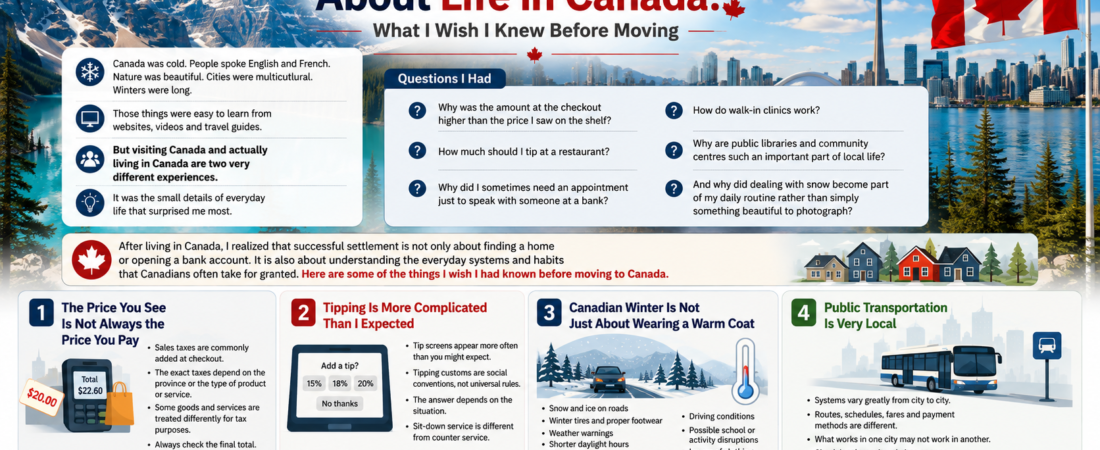
Canada was cold. People spoke English and French. Nature was beautiful. Cities were multicultural. Winters were long.
Those things were easy to learn from websites, videos and travel guides.
But visiting Canada and actually living in Canada are two very different experiences.
It was the small details of everyday life that surprised me most.
Why was the amount at the checkout higher than the price I saw on the shelf?
How much should I tip at a restaurant?
Why did I sometimes need an appointment just to speak with someone at a bank?
How do walk-in clinics work?
Why are public libraries and community centres such an important part of local life?
And why did dealing with snow become part of my daily routine rather than simply something beautiful to photograph?
After living in Canada, I realized that successful settlement is not only about finding a home or opening a bank account.
It is also about understanding the everyday systems and habits that Canadians often take for granted.
Here are some of the things I wish I had known before moving to Canada.
1. The Price You See Is Not Always the Price You Pay
What I expected
Before living in Canada, I naturally assumed that if something was marked $20, I would pay $20.
What surprised me
That is often not what happens.
In Canada, sales taxes are commonly added at checkout rather than included in the displayed price.
The exact taxes depend on the province or territory and the type of product or service.
That means an item marked $20 can cost more when you actually pay.
At first, this can be confusing.
When buying several items, the difference between the shelf-price total and the final amount can become noticeable.
What I wish I knew
When budgeting in Canada, do not always treat the displayed price as your final cost.
This is particularly useful to remember when buying:
- Electronics
- Clothing
- Furniture
- Restaurant meals
- Household products
- Services
Some goods and services are treated differently for tax purposes, so the safest habit is simply to check the final total.
It sounds like a tiny adjustment, but it becomes part of everyday life in Canada very quickly.
2. Tipping Is More Complicated Than I Expected
What I expected
I knew people tipped at restaurants in Canada.
What I did not fully understand was how frequently I would encounter a tip screen.
What surprised me
Tips are common in many sit-down restaurants and personal-service situations.
Payment terminals may present several percentage options before you complete the transaction.
For a newcomer unfamiliar with Canadian culture, this can feel surprisingly stressful.
You may find yourself thinking:
Do I have to tip here?
The answer depends on the situation.
Tipping customs are social conventions rather than a single universal rule that applies to every transaction.
What I wish I knew
Do not panic when a payment terminal displays tip options.
Take a moment to read the screen.
A sit-down restaurant with table service is different from simply purchasing an item at a counter.
Understanding that distinction made everyday transactions much more comfortable for me.
3. Canadian Winter Is Not Just About Wearing a Warm Coat
Before moving to Canada, I understood one thing very clearly:
Canada is cold.
What I did not fully understand was how winter affects ordinary routines.
What I imagined
I imagined snow-covered houses, beautiful mountains, Christmas lights and children playing outside.
All of those things exist.
But winter is also practical.
You may need to think about:
- Snow and ice on roads
- Winter tires
- Frozen sidewalks
- Weather warnings
- Shorter daylight hours
- Appropriate footwear
- Layers of clothing
- Clearing snow
- Driving conditions
- School or activity disruptions during severe weather
I learned that the question is not simply:
“Is it cold today?”
A more useful question is:
“What are the conditions like today?”
Temperature, wind, snow, ice and road conditions can all matter.
Not Every Part of Canada Has the Same Winter
This is another misconception I had before understanding Canada better.
Canada is enormous.
Winter on the Pacific Coast is not the same as winter in the Prairies, Ontario, Quebec, Atlantic Canada or the North.
Even within one province, conditions can vary dramatically.
The lesson I learned is simple:
Never prepare for “Canadian weather.” Prepare for the weather where you actually live.
4. Public Transportation Is Very Local
Before moving, it is easy to think of public transportation as one Canadian system.
In reality, transportation is organized regionally.
The transit card, fare system and rules you use in one city may not apply in another.
For newcomers, learning the local system is one of those small settlement tasks that makes daily life much easier.
You need to learn things such as:
- Which transit card or payment method is used
- Whether you need to tap when entering or exiting
- How transfers work
- Whether buses accept cash
- Monthly-pass options
- Student or youth fares
- How late transit operates
Apps and online trip planners make this considerably easier, but I still recommend learning the basic rules rather than relying completely on your phone.
5. Owning a Car Can Change Your Canadian Experience
Public transportation can work very well in some urban areas.
But Canada is a very large country, and many suburban or rural communities are designed around driving.
This became more obvious to me after living here.
A destination that looks close on a map may not be convenient by public transportation.
This becomes particularly important when you want to:
- Visit provincial or national parks
- Go camping
- Travel between smaller communities
- Buy large amounts of groceries
- Take children to different activities
- Explore areas outside major transit networks
At the same time, owning a vehicle brings additional expenses.
Insurance, fuel, maintenance, parking and seasonal requirements can significantly increase your monthly budget.
So one question I think newcomers should ask before choosing a neighbourhood is:
“Can I realistically live here without a car?”
That question can be just as important as the monthly rent.
6. Banking Can Be More Appointment-Based Than Expected
Opening a Canadian bank account is one of the first tasks many newcomers complete.
What surprised me was how useful appointments can be for more complicated banking needs.
For simple transactions, online banking, mobile apps and ATMs handle a lot.
But if you need help with something more involved, making an appointment can save time.
This might include:
- Opening certain accounts
- Discussing credit products
- Mortgage questions
- Investment products
- Financial planning
- Complicated account issues
Credit History Matters
This is another important lesson for newcomers.
You may arrive in Canada with savings, employment experience and a strong financial history elsewhere.
But Canadian lenders may still look closely at your Canadian credit history.
Building credit responsibly therefore becomes an important part of establishing yourself financially.
Paying bills on time and understanding how Canadian credit products work can become important later when applying for loans, credit cards or mortgages.
7. Healthcare Does Not Always Work the Way Newcomers Expect
Canadian healthcare is probably one of the subjects about which newcomers hear the most before arriving.
But the actual experience can still be surprising.
Canada has publicly funded provincial and territorial healthcare systems, but that does not mean every medical service is automatically free in every situation.
Coverage and eligibility depend on your province or territory and personal circumstances.
Prescription drugs, dental care, vision care and other services may have different coverage arrangements.
Finding Care Can Also Be Different
Depending on where you live, healthcare may involve:
- A family doctor
- Nurse practitioners
- Walk-in clinics
- Urgent and primary care centres
- Pharmacists
- Emergency departments
- Virtual care options
One thing I wish I understood earlier was that an emergency department should not be treated as the default solution for every medical problem.
Learning where to go for different levels of care is an important part of settling in Canada.
And because healthcare systems differ between provinces, newcomers should check the official information for the province where they live.
8. Community Centres Are Much More Useful Than I Expected
This was one of the pleasant surprises of living in Canada.
Before moving here, I did not realize how useful a local community centre could be.
Depending on the municipality, community and recreation centres may offer:
- Swimming pools
- Fitness facilities
- Basketball courts
- Badminton
- Skating
- Children’s programs
- Youth programs
- Seniors’ programs
- Art classes
- Camps
- Fitness classes
- Community events
For families especially, these facilities can become part of everyday life.
They can also be useful for newcomers because they provide opportunities to participate in the local community without needing expensive private memberships for every activity.
My advice is simple:
After moving into a new neighbourhood, search for your nearest community or recreation centre.
You may be surprised by what is available.
9. Public Libraries Are Not Just Places to Borrow Books
This was another thing I came to appreciate more after living in Canada.
A Canadian public library can provide much more than shelves of books.
Services vary by library system, but they may include:
- E-books
- Audiobooks
- Computers
- Wi-Fi
- Printing
- Study areas
- Children’s programs
- Language-learning resources
- Workshops
- Community events
- Online learning resources
For a newcomer, a library can be particularly valuable.
It can provide a quiet place to study English, help children develop reading habits and connect families with local programs.
Some resources that would otherwise cost money may be available through a library membership.
So one of my recommendations after moving to Canada is to get a local library card and actually explore what it includes.
Do not assume it is only for borrowing books.
10. School Culture Can Feel Different
Families moving to Canada with children may notice cultural differences at school.
Of course, schools vary by province, district and individual school, so there is no single “Canadian school experience.”
However, parents may notice greater emphasis on areas such as:
- Participation
- Communication
- Projects
- Extracurricular activities
- Volunteering
- Sports
- Clubs
- Independence
- Community involvement
For families coming from education systems that focus heavily on examinations and private tutoring, this can require an adjustment.
I learned that understanding school life involves more than checking grades.
Reading school emails, following the calendar, attending meetings when appropriate and learning about extracurricular opportunities can all help parents understand what is happening.
Communication Matters
School communication can arrive through several channels.
Parents may receive:
- Emails
- Newsletters
- Online portal notifications
- Permission forms
- School district announcements
- Teacher messages
It is easy to miss something important if you do not check regularly.
For newcomer parents, building the habit of reading school communications can make life much easier.
11. Recycling Can Be Surprisingly Detailed
Before moving, “recycling” sounded simple.
Put recyclable things into a recycling bin.
In practice, it can be more complicated.
Rules can differ depending on where you live and whether you are in a detached house, apartment or condominium.
You may need to separate different types of materials, and not everything that looks recyclable necessarily belongs in the same container.
There may also be separate systems for:
- Food scraps
- Containers
- Paper
- Glass
- Garbage
- Electronics
- Batteries
- Refund-deposit beverage containers
What I Learned
Do not guess.
Check the instructions provided by your municipality, building or local recycling program.
Once you understand the system, it becomes routine.
But during the first few weeks, it can definitely feel like another small Canadian puzzle to solve.
12. Neighbour Relationships Can Feel Friendly but Private
This is difficult to describe because every neighbourhood is different.
But one thing newcomers may notice is a balance between friendliness and personal space.
People may smile, say hello, hold a door open or have a short conversation.
At the same time, respecting privacy and boundaries is generally important.
You do not necessarily need to become close friends with everyone living around you.
A simple:
“Hi, how are you?”
can be perfectly normal.
Over time, relationships may develop naturally through children, schools, neighbourhood events, community activities or simply seeing the same people regularly.
I learned not to confuse privacy with unfriendliness.
Sometimes being a good neighbour simply means being polite, considerate and respectful of other people’s space.
13. Small Talk Is Actually Useful
When English is not your first language, small talk can initially feel unnecessary or even uncomfortable.
Someone says:
“Beautiful day, isn’t it?”
And you may wonder what you are supposed to say next.
But small talk is an important social tool.
Conversations about weather, weekends, traffic, sports or local events can make everyday interactions warmer.
You do not need advanced English.
Simple responses work perfectly well.
For me, these tiny conversations became part of feeling more comfortable living in an English-speaking environment.
They were also opportunities to practice English naturally rather than treating English only as something to study.
14. Distances Are Bigger Than They Look
Canada is the second-largest country in the world by land area.
But knowing that fact and experiencing Canadian distances are very different things.
A trip that appears straightforward on a map can involve many hours of driving.
This is especially important when planning road trips.
For example, visiting Vancouver does not mean Banff is just a quick side trip.
Toronto and Vancouver are not neighbouring tourist destinations.
Even travelling within the same province can involve significant distances.
My Road-Trip Lesson
Do not create an itinerary based only on the number of kilometres.
Consider:
- Actual driving time
- Fuel stops
- Meals
- Rest breaks
- Weather
- Mountain roads
- Construction
- Children
- Seasonal conditions
Sometimes adding one overnight stop can transform an exhausting drive into an enjoyable part of the vacation.
15. Sales and Coupons Are Worth Checking
Another everyday habit I developed was checking promotions more carefully.
Groceries and restaurant meals can become expensive, particularly for a family.
But Canadian supermarkets and restaurant chains frequently run promotions.
Depending on the business, savings may be available through:
- Weekly flyers
- Loyalty programs
- Mobile apps
- Digital coupons
- Points
- Limited-time promotions
- Buy-one-get-one offers
I learned that paying the regular price every time is not always necessary.
Before ordering from a restaurant chain or doing a large grocery shop, checking the current offers can sometimes make a noticeable difference.
The key is not buying something simply because it is discounted.
A discount only saves money if you actually needed the product.
16. Canada Is Multicultural in Everyday Life
I knew Canada was multicultural before arriving.
But living here made the idea much more concrete.
In larger metropolitan areas especially, it is normal to hear multiple languages, encounter food from many countries and meet people whose families came from different parts of the world.
This can make settlement easier in some ways.
You do not necessarily have to abandon your own food or traditions to participate in Canadian society.
At the same time, living in such a diverse environment teaches you to become comfortable with differences.
For me, this became one of the most interesting parts of life in Canada.
17. Government Paperwork Becomes Part of Life
This is something travel videos rarely show.
Moving to another country involves paperwork.
Depending on your circumstances, you may need to deal with different federal, provincial and municipal systems.
Documents can involve immigration status, taxes, healthcare, benefits, schools, driver’s licences and other services.
One practical lesson I learned is:
Keep important documents organized.
Save copies of:
- Applications
- Approval letters
- Important emails
- Identification documents
- Tax documents
- School documents
- Government correspondence
Also pay attention to expiration dates.
Waiting until the last minute can create unnecessary stress.
18. You Do Not Learn Canada in One Month
This may be the biggest thing I wish I had known.
When you first arrive, everything can require thought.
Which grocery store should I use?
How does the bus work?
Where do I go when I am sick?
How do I register my children for an activity?
What goes into this recycling bin?
Do I tip here?
How does this banking system work?
Individually, none of these questions seems particularly difficult.
But when they all happen at once, adjusting to a new country can feel overwhelming.
Then something changes.
The things that once required research become habits.
You know which grocery store you prefer.
You understand your neighbourhood.
You know how transit works.
You know where the library is.
You understand school emails.
You recognize the road signs.
You know what you need before winter arrives.
Slowly, Canada stops feeling like a place you are trying to understand.
It starts feeling like everyday life.
What I Would Tell Someone Moving to Canada Today
If I could speak to myself before moving to Canada, I would not try to explain every rule.
I would say:
Give yourself time.
Learn one system at a time.
Get your essential documents organized.
Learn your local transportation system.
Visit your community centre and public library.
Understand your provincial healthcare system.
Read school communications carefully if you have children.
Check the weather before travelling.
Ask questions when you do not understand something.
And do not expect yourself to understand an entire country immediately.
Canada is too large and too diverse for that anyway.
The experience of living in Vancouver is different from living in Calgary, Toronto, Montréal, Halifax or a small town.
Your own version of Canada will gradually develop from your neighbourhood, workplace, school, friends and daily routines.
Final Thoughts: Visiting Canada and Living in Canada Are Different
Before moving here, Canada was mostly an image in my mind.
Mountains.
Snow.
Lakes.
Vancouver.
Toronto.
Niagara Falls.
The Canadian Rockies.
Those are still wonderful parts of the country.
But after actually living here, Canada means something different to me.
It is checking the weather before leaving home.
It is learning what goes into which recycling bin.
It is discovering that the checkout total is higher because tax was added.
It is figuring out when to tip.
It is receiving another school email.
It is visiting a community centre.
It is borrowing something from the library.
It is learning how healthcare, banking and government services work.
These ordinary things rarely appear in beautiful travel photographs.
But they are what turn a destination into a place where people actually live.
If you are moving to Canada, you do not need to know everything before you arrive.
Research the important things, prepare your documents and understand the basics.
Then give yourself permission to learn the rest through experience.
Because some of the most important things about Canadian culture cannot be completely understood from a guidebook.
You learn them by living here.
And eventually, the things that once surprised you simply become part of your normal day.