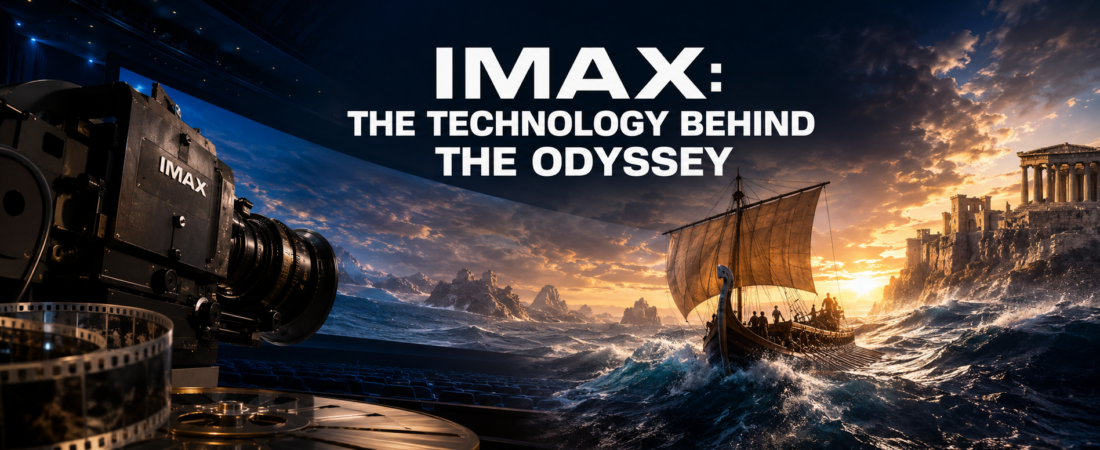
Yes, IMAX is a Canadian company. Founded in 1967, IMAX Corporation grew from an experimental large-screen cinema idea into one of the world’s most recognized film-technology brands. Christopher Nolan’s The Odyssey, shot entirely with IMAX film cameras, provides a recent example of how the company works directly with filmmakers as well as cinemas.
Many moviegoers associate IMAX with an unusually large screen and a more expensive ticket. However, IMAX is not simply a screen format or a special auditorium inside a multiplex.
It is an entertainment technology company that develops cameras, projection systems, sound technology, image-processing methods and theatre specifications. To understand why The Odyssey was photographed entirely with IMAX film cameras, it helps to look first at the company behind the format.
Information in this article was checked on September 4, 2026. Screening formats and schedules may change.
1. IMAX Is a Canadian Entertainment Technology Company
IMAX Corporation was founded in Canada in 1967. The company lists its Canadian corporate office at 2525 Speakman Drive in Mississauga, Ontario, and also maintains important operations in locations including New York and London. IMAX Investor Relations
Although IMAX works closely with Hollywood studios, it is not primarily a conventional movie studio. Its core business involves developing and supplying technology used to produce and present films.
The IMAX system may include:
- Large-format film cameras
- Digital and film projection equipment
- Large cinema screens
- Auditorium design
- Specialized sound systems
- Image remastering technology
- Technical support for filmmakers and theatres
Most IMAX theatres are operated by cinema chains or independent exhibitors rather than IMAX Corporation itself. The theatre operator installs or leases an IMAX system and uses the company’s brand and technical standards.
This business model explains why IMAX can be both a technology company and an important participant in the global movie industry.
2. How Did IMAX Begin?
The origins of IMAX are connected to experiments with multi-screen and large-format cinema during the 1960s. Filmmakers and engineers were exploring ways to create images that filled more of the viewer’s field of vision.
IMAX was established in 1967 and developed a system capable of projecting an exceptionally large film frame with a single projector. Instead of dividing a picture across several screens, the technology created one large and continuous image.
The company’s early systems were often installed in museums, science centres and specialized venues. IMAX presentations became known for documentaries about nature, space, science and travel because these subjects benefited from enormous screens and highly detailed images.
Over time, IMAX moved further into commercial cinemas. Its technology began to be used for major Hollywood releases, transforming the brand from a specialized documentary format into a global premium-cinema platform.
Today, audiences may see the IMAX name attached to documentaries, action films, animation and movies created specifically with IMAX-certified or IMAX film cameras.
3. What Does IMAX Actually Do?
IMAX operates between film production and theatrical exhibition. It works with filmmakers before and during production, processes movies for its presentation systems and supplies technology to participating theatres.
IMAX cameras
IMAX supports large-format cameras used to capture images with a high level of detail. These include traditional IMAX film cameras and digital cameras certified for IMAX productions.
A movie advertised as “Filmed for IMAX” does not necessarily use the same equipment as a movie shot on IMAX film. The wording matters because productions can use different cameras, aspect ratios and mastering processes.
Projection technology
IMAX theatres may use 70mm film, xenon digital projection or laser projection. The projector must place a bright, stable image across a very large screen, which presents different challenges from those found in a smaller auditorium.
Sound systems
IMAX also designs and calibrates sound systems for its theatres. Speaker placement, auditorium acoustics and audio mixing all contribute to the experience.
The goal is not simply to make everything louder. A well-designed system should preserve clear dialogue, directional effects and differences between quiet and powerful moments.
Digital remastering
Many movies shown in IMAX were not filmed entirely with IMAX cameras. The company can prepare these titles through its proprietary Digital Media Remastering process, usually called IMAX DMR.
The process adapts image and sound for IMAX presentation. It can include adjustments to grain, noise, colour, brightness and other visual characteristics so that the material remains suitable for a much larger screen. The IMAX Experience
4. How Does IMAX Film Work?
Standard 35mm film runs vertically through a movie camera and normally uses four perforations for each frame. Perforations are the small holes along the edges of film that allow it to move accurately through the camera or projector.
IMAX film uses a much larger image area. The camera negative is 65mm wide, and the film travels horizontally, allowing each frame to extend across 15 perforations. This is why the system is often described as 15-perf 65mm during filming.
For traditional film projection, prints are made on 70mm film. The exhibition format is therefore known as 15/70 IMAX or IMAX 70mm.
Kodak’s filmmaking reference guide confirms that IMAX productions use 65mm and 70mm film with a horizontal, 15-perforation image. IMAX has stated that its 15/70 film frame is nearly ten times larger than a conventional four-perforation 35mm frame. Kodak Essential Reference Guide for Filmmakers, IMAX Corporation
A larger film negative can preserve very fine details in faces, costumes and landscapes. It also produces the grain structure, highlight response and colour character associated with motion-picture film.
However, IMAX film is not automatically the best tool for every production. The cameras, film stock, processing and projection requirements make the format expensive and technically demanding. Digital cameras are often smaller, quieter and more flexible in difficult lighting conditions.
5. Why Does the IMAX Aspect Ratio Matter?
Many standard widescreen movies are presented at an aspect ratio of approximately 2.39:1. This creates a wide, narrow image.
Purpose-built IMAX theatres may support the much taller 1.43:1 aspect ratio. When a movie contains footage composed for that format, viewers can see substantially more image above and below the conventional widescreen area.
Other IMAX auditoriums commonly use screens closer to 1.90:1. These theatres can still provide an expanded image, but they cannot necessarily display the full height available in a 1.43:1 presentation.
This is one reason two theatres carrying the IMAX name may deliver noticeably different experiences. Screen dimensions, projector type and supported aspect ratio must all be considered.
6. Why Christopher Nolan Has Become Closely Associated With IMAX
Christopher Nolan has helped make IMAX film familiar to mainstream movie audiences. Rather than treating the format only as a way to show a finished movie, he has incorporated its cameras into the production process.
Nolan and cinematographer Hoyte van Hoytema have used large-format film to capture architecture, landscapes, physical sets and close views of actors. Movies such as Interstellar, Dunkirk, Tenet and Oppenheimer combined IMAX photography with other formats.
This collaboration has also encouraged technical development. A filmmaker may want the detail and scale of IMAX film while needing cameras that are easier to use for dialogue, confined sets and mobile filming.
The Odyssey marks a particularly important stage in this relationship because the complete feature was photographed with IMAX film cameras.
7. How The Odyssey Demonstrates IMAX Technology
Christopher Nolan’s The Odyssey opened on July 17, 2026. Based on Homer’s ancient Greek epic, the movie follows Odysseus as he tries to return home after the Trojan War.
The cast includes Matt Damon as Odysseus, along with Tom Holland, Anne Hathaway, Zendaya, Robert Pattinson and Lupita Nyong’o. The film was produced through Nolan and Emma Thomas’s Syncopy and distributed by Universal Pictures.
Universal officially describes The Odyssey as being “shot entirely with IMAX film cameras.” It is the first feature film to use the format for every scene rather than combining IMAX film with another principal capture format. Universal Pictures
This achievement required more than loading film into an existing camera. NBCUniversal’s production coverage describes the movie as using newly developed IMAX film technology across international locations. NBCUniversal
The project demonstrates an important part of IMAX’s identity. The company is not limited to installing screens after a movie has been completed. It can collaborate with filmmakers while developing cameras and preparing the final theatrical presentation.
8. Did Nolan Make The Odyssey Without CGI?
Claims that Nolan never uses CGI should be treated cautiously. It is more accurate to say that he prefers to photograph real elements whenever practical and avoids using computer-generated imagery as the automatic solution for every visual problem.
Nolan is known for emphasizing locations, constructed sets, physical props, stunt work and effects performed in front of the camera. These elements give actors something tangible to interact with and allow cameras to record genuine light, texture, weather and movement.
That does not prove that every image in The Odyssey was completed without digital assistance. Modern filmmaking may require compositing, equipment removal, image cleanup and other forms of post-production.
CGI and VFX are also not identical terms. CGI refers to imagery created by computers, while visual effects constitute a broader category that can combine filmed material, practical techniques and digital processing.
Therefore, the most reliable description is that The Odyssey emphasizes real-world photography and practical production while still using appropriate post-production tools. “Shot entirely on IMAX film” identifies its capture format; it does not mean that no computer was involved after filming.
9. Why The Odyssey Is an Appropriate IMAX Film
Homer’s narrative includes long voyages, dangerous seas, war and encounters with mythological forces. These subjects give the filmmakers opportunities to use the scale and detail of large-format photography.
An IMAX image can preserve both a vast landscape and small details within it. The tall frame can also emphasize vertical elements such as cliffs, ships, architecture and the human figure surrounded by nature.
Sound contributes another layer. Waves, wind, movement, dialogue and large action sequences can surround the audience without relying only on volume.
The result depends on the particular theatre. An IMAX 70mm print shown on a full-size 1.43:1 screen provides the closest match to the film’s original capture format. Digital IMAX remains more widely available and can still deliver a large, bright image with IMAX sound.
10. IMAX 70mm, Digital IMAX and Regular Theatres Compared
| Feature | Regular theatre | Digital IMAX | IMAX 70mm |
|---|---|---|---|
| Projection | Standard digital | IMAX digital or laser | Physical 15/70 film |
| Screen | Usually smaller | Size varies | Usually very large |
| Aspect ratio | Commonly 2.39:1 or 1.85:1 | Often up to 1.90:1; some laser venues support 1.43:1 | Can support 1.43:1 |
| Image quality | Depends on equipment | Bright digital image | Large film frame with film texture |
| Sound | Depends on theatre | IMAX-calibrated system | IMAX-calibrated system |
| Availability | Very common | Available in many cities | Limited locations |
| Price | Usually lowest | Premium ticket | Often highest |
| Best suited to | Budget and convenience | Accessible premium viewing | Large-format film enthusiasts |
The term “IMAX” alone does not confirm that a theatre uses a 70mm film projector. Moviegoers should look for the specific wording “IMAX 70mm Film” on the official listing.
IMAX published a separate list of theatres presenting The Odyssey on IMAX 70mm film. Other IMAX locations received digital presentations. IMAX 70mm Information
11. Is an IMAX Ticket Worth the Additional Cost?
An IMAX 70mm ticket may be worthwhile for viewers who are interested in cinematography, film projection and expanded composition. It presents the strongest connection between the format used during production and the format seen in the theatre.
Digital IMAX offers a practical middle option. It is available in more locations and combines a larger screen with IMAX image processing and sound.
A regular theatre remains a valid choice. It shows the same complete story and may be preferable when ticket price, distance, accessibility or seat selection is more important.
Before booking, check the projector type, screen ratio and exact format on the theatre’s official website. Current showtimes can change, especially several weeks after a movie’s release.
Frequently Asked Questions About IMAX and The Odyssey
Is IMAX a Canadian company?
Yes. IMAX Corporation was founded in Canada in 1967. It maintains a principal corporate office in Mississauga, Ontario, as well as operations in other international cities.
Does IMAX own all IMAX theatres?
No. Most locations are operated by cinema chains, museums or independent exhibitors. IMAX supplies or licenses its technology, systems and brand under commercial agreements.
What does IMAX Corporation produce?
IMAX develops large-format cameras, film and digital projection systems, sound systems, image-remastering technology and theatre solutions. It also works with filmmakers and studios to prepare movies for its cinema network.
Was The Odyssey filmed entirely with IMAX cameras?
Yes. Universal Pictures confirms that The Odyssey was shot entirely with IMAX film cameras. It was the first full-length feature to use IMAX film cameras for every scene.
Was The Odyssey filmed on 65mm or 70mm film?
The original photography uses 65mm IMAX negative film. Traditional theatrical prints are produced on 70mm film, which is why the projection format is called IMAX 70mm or 15/70.
Did Christopher Nolan use no CGI in The Odyssey?
It should not be described as a completely CGI-free movie without specific production evidence. Nolan prioritizes locations, sets and physical effects, but visual-effects work can still be used for compositing, cleanup and enhancement.
Are all IMAX theatres the same?
No. IMAX theatres can differ in screen size, aspect ratio and projection technology. Some use xenon digital projection, some use laser systems, and only selected venues can project IMAX 70mm film.
What is the best format for watching The Odyssey?
IMAX 70mm on a 1.43:1 screen offers the closest match to the movie’s original large-format photography. Digital IMAX is a more accessible premium alternative, while a regular theatre remains suitable for viewers focused on cost and convenience.
Where should I sit in an IMAX theatre?
A central seat near the middle or slightly behind the middle is generally a comfortable choice. Sitting too close to a very large screen can require frequent eye and head movement.
Is digital IMAX still worth watching?
Yes. A good IMAX laser presentation can provide strong brightness, contrast, screen size and sound. The quality depends on the specific auditorium rather than the IMAX name alone.
Final Thoughts
IMAX is more than the name printed above a large cinema screen. It is a Canadian technology company that has spent decades developing an integrated approach to film capture, image processing, projection, sound and theatre design.
Christopher Nolan’s The Odyssey brings these different areas together. By photographing the entire movie with IMAX film cameras, the production shows how IMAX can influence a film from the moment an image is recorded to the moment it reaches a theatre screen.
IMAX 70mm provides the most direct version of that experience, but it is not the only reasonable choice. Digital IMAX and regular cinemas serve different audiences, budgets and locations. Understanding the company and its technology allows viewers to choose based on real differences rather than the logo alone.