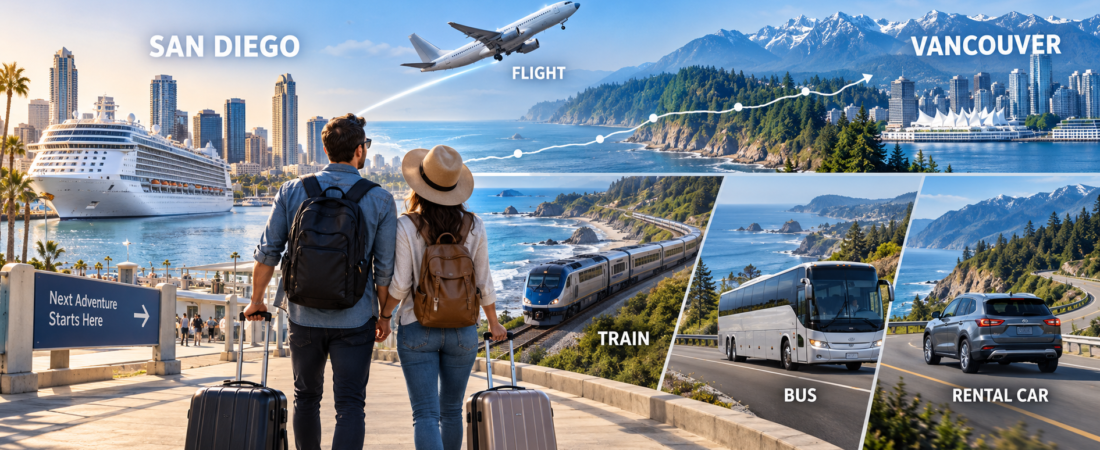
A one-way cruise from Vancouver to San Diego creates an important question: how will passengers get back home?
Unlike a round-trip cruise, the ship does not immediately return passengers to Vancouver. After disembarking in San Diego, travellers must arrange their own transportation or continue on another cruise.
Flying is normally the fastest and most practical choice. However, trains, buses and rental cars may appeal to travellers who want to extend the journey along the West Coast.
This guide compares the principal return options by travel time, convenience, luggage, price and border requirements.
Air, train and bus schedules can change before the cruise. Confirm all departure times directly with the transportation provider before purchasing a non-refundable ticket.
Quick Comparison of the Return Options
| Method | Approximate travel experience | Best for | Main disadvantage |
|---|---|---|---|
| Nonstop flight | About three hours in the air | Fastest return | Fares and schedules vary |
| Connecting flight | Longer than nonstop | More schedule choices | Missed-connection risk |
| Train | Multi-day journey with connections | Scenic travel | Very long travel time |
| Long-distance bus | Usually multiple segments | Budget travellers | Long and tiring |
| Rental car | Multi-day road trip | Flexible sightseeing | High one-way fee and border restrictions |
| Northbound cruise | Rare seasonal option | Cruise enthusiasts | Usually does not match the arrival date |
For most Vancouver residents, the best choices are:
- A nonstop or one-stop flight home
- A short San Diego stay followed by a flight
- A train or road trip only when the journey itself is part of the vacation
Option 1: Fly from San Diego to Vancouver
Flying is generally the simplest way to return.
The route uses:
- SAN: San Diego International Airport
- YVR: Vancouver International Airport
Nonstop service between San Diego and Vancouver has been offered by Air Canada, while other airlines may provide seasonal nonstop flights or connecting itineraries. Airline schedules change, so travellers should search their exact date rather than assuming that a daily nonstop flight will be available.
Check San Diego International Airport’s airline and destination information
A nonstop flight normally takes approximately three hours in the air. Total travel time is longer after adding transportation to the airport, check-in, security screening, boarding and Canadian border processing at Vancouver.
How Far Is the Cruise Port from San Diego Airport?
San Diego’s cruise terminals and airport are relatively close geographically.
The main cruise facilities are located along North Harbor Drive near downtown, while San Diego International Airport is also near the waterfront.
Under normal traffic conditions, a taxi or rideshare trip may be relatively short. However, passengers should not choose an early flight simply because the airport appears close on a map.
Possible delays include:
- Late arrival of the ship
- Customs or immigration processing
- Disembarkation groups
- Waiting for checked luggage
- A crowded cruise terminal
- Road traffic
- Airline check-in lines
- Airport security
- International flight document checks
Distance is only one part of the calculation.
How Early Can Passengers Leave the Ship?
Cruise ships often arrive early in the morning, but passengers cannot leave immediately when the ship reaches the dock.
The ship must first complete arrival and clearance procedures. Passengers are then called according to assigned disembarkation groups.
Travellers normally choose between:
Self-Assist Disembarkation
Passengers carry all their own luggage off the ship.
This is usually the earliest disembarkation option. It may be useful for travellers with an earlier flight, but each person must be capable of managing every bag without assistance.
Regular Disembarkation
Passengers leave large bags outside their cabin on the final evening. The cruise line transfers the luggage to the terminal, where passengers collect it after leaving the ship.
This is easier for travellers with heavy luggage but may take longer.
Neither option guarantees an exact exit time.
What Is a Safe Flight Time?
For an international flight from San Diego to Vancouver, a flight departing in the early morning is generally too risky on disembarkation day.
A practical approach is to look for a departure around 1:00 p.m. or later, unless the cruise line specifically provides a different minimum recommended time for that sailing.
This recommendation creates room for:
- Ship clearance
- Disembarkation
- Luggage collection
- Transportation to the airport
- International check-in
- Security screening
- Unexpected delays
A noon flight may sometimes work because the airport is nearby, but it provides less protection if the ship arrives late.
The safest options are:
- Book a mid-afternoon flight.
- Book an evening flight.
- Stay one night in San Diego and fly the next day.
The cruise line’s official minimum flight-time guidance for the sailing should take priority over a general recommendation.
Should You Stay in San Diego for One Night?
Staying overnight can turn a stressful travel day into an enjoyable extension of the vacation.
Advantages include:
- No rush during disembarkation
- More flight choices the following day
- Time to explore San Diego
- Reduced risk of missing the flight
- Time to reorganize luggage
- A more relaxed transition from the ship
Possible disadvantages include:
- Hotel cost
- Meals
- Transportation
- An extra vacation day
- Luggage storage before hotel check-in
Passengers may be able to leave luggage at a hotel before the room is ready, but this should be confirmed in advance.
What Can You Do During an Extra Day in San Diego?
Convenient attractions include:
- USS Midway Museum
- Seaport Village
- Waterfront Park
- Little Italy
- Balboa Park
- San Diego Zoo
- Old Town San Diego
- Coronado
- La Jolla Cove
- Sunset Cliffs
Travellers staying only one night should choose attractions based on hotel location and flight time.
A downtown or waterfront hotel may be convenient for the cruise terminal, airport and nearby sightseeing.
Nonstop Flight or Connecting Flight?
A nonstop flight is usually preferable because it reduces travel time and eliminates a connection.
However, a one-stop flight may offer:
- A lower fare
- A more convenient departure time
- Better award availability
- Additional airline choices
Common connecting airports may include major West Coast or western North American hubs, depending on the airline.
When comparing the two options, consider:
| Factor | Nonstop flight | Connecting flight |
|---|---|---|
| Travel time | Shorter | Longer |
| Missed-connection risk | None | Possible |
| Luggage handling | Simpler | Additional transfer |
| Schedule choices | Limited | Usually greater |
| Price | Sometimes higher | May be lower |
| Ease after a cruise | Better | More tiring |
A small saving may not justify several additional hours of travel after a seven-night cruise.
Checked-Baggage Costs
The lowest airline fare may not include checked baggage.
Compare the total cost after adding:
- First checked bag
- Second checked bag
- Seat selection
- Carry-on restrictions
- Fare-change conditions
- Meals
- Airport transportation
Cruise passengers often travel with more luggage than passengers taking a short flight. A fare that includes checked baggage may provide better value than the cheapest basic fare.
Check whether the credit card used to purchase the flight provides free bags or travel protection.
Booking the Return Flight
The safest order is:
- Confirm the cruise departure and arrival dates.
- Verify the scheduled San Diego arrival time.
- Check the cruise line’s flight-time recommendation.
- Compare nonstop and connecting flights.
- Review baggage costs.
- Check cancellation and change conditions.
- Confirm Canadian re-entry documents.
- Purchase the flight.
- Monitor schedule changes before travelling.
When buying flights far in advance, airlines may adjust departure times. Recheck the reservation regularly.
Option 2: Travel by Train
A train journey from San Diego to Vancouver is possible, but it is not a single direct ride.
The trip normally requires several route segments:
- Pacific Surfliner: San Diego to Los Angeles
- Coast Starlight: Los Angeles to Seattle
- Amtrak Cascades: Seattle to Vancouver, British Columbia
Amtrak identifies these as separate West Coast routes:
- Pacific Surfliner connects San Diego and Los Angeles.
- Coast Starlight travels between Los Angeles and Seattle.
- Amtrak Cascades connects Seattle with Vancouver.
View Amtrak’s official route list
The entire journey can take multiple days, depending on the schedules and connection times.
San Diego to Los Angeles on the Pacific Surfliner
The Pacific Surfliner follows the Southern California coast and connects San Diego with Orange County and Los Angeles.
Amtrak currently describes it as a 351-mile route serving destinations including:
- San Diego
- Anaheim
- Los Angeles
- Ventura
- Santa Barbara
- San Luis Obispo
Explore the Pacific Surfliner route
The San Diego Santa Fe Depot is located downtown and is reasonably convenient from the cruise-terminal area.
This first section can be an enjoyable coastal trip and is much easier than the full journey to Vancouver.
Los Angeles to Seattle on the Coast Starlight
The Coast Starlight is the longest portion of the rail journey.
It travels between Los Angeles and Seattle through parts of:
- California
- Oregon
- Washington
The route includes views of the Pacific Coast, agricultural valleys, forests and the Cascade Mountains. Coach seats and private sleeping accommodations may be available.
Explore the Coast Starlight route
A private room provides more comfort but can cost substantially more than a coach seat or airline ticket.
Passengers should carefully check the connection between the Pacific Surfliner and Coast Starlight. A missed connection could require a hotel stay in Los Angeles.
Seattle to Vancouver on Amtrak Cascades
The final rail section travels from Seattle to Vancouver.
The train crosses the international border, and passengers must meet Canadian entry requirements. Border processing can affect the schedule.
Amtrak Cascades serves the Pacific Northwest corridor between Vancouver, Seattle, Portland and Eugene.
The Vancouver terminus is Pacific Central Station, located near Main Street–Science World Station.
From Pacific Central Station, passengers can continue to other parts of Metro Vancouver by:
- SkyTrain
- Local bus
- Taxi
- Rideshare service
- Private pickup
Is the Train Cheaper Than Flying?
Not necessarily.
A coach ticket may be economical, but the complete trip can include:
- Three train segments
- Meals
- A hotel during a long connection
- Checked-luggage arrangements
- A sleeping accommodation
- Local transportation
A private room on the Coast Starlight can make the trip comfortable, but the total may exceed the price of a flight.
Train travel should be chosen primarily for the experience, not because it is guaranteed to be the cheapest return method.
Who Should Consider the Train?
The train may suit passengers who:
- Have several extra vacation days
- Enjoy scenic rail travel
- Do not want to fly
- Can manage multiple connections
- Want to stop in Los Angeles, Portland or Seattle
- Prefer a slow return journey
It may not suit passengers who:
- Need to return quickly
- Have limited mobility and heavy luggage
- Prefer a simple itinerary
- Cannot accommodate delays
- Have school or work commitments immediately after the cruise
Option 3: Return by Long-Distance Bus
Long-distance bus travel can be less expensive than flying on some dates, but a direct San Diego-to-Vancouver service should not be expected.
The journey may require transfers in cities such as:
- Los Angeles
- Sacramento
- Portland
- Seattle
- Bellingham
Operators, stations and schedules can change. Some routes may combine buses and trains.
Before booking, check:
- Total journey time
- Number of transfers
- Overnight travel
- Station safety and opening hours
- Luggage allowance
- Border procedures
- Missed-connection protection
- Refund and change rules
A low fare can become less attractive when the journey requires 30 hours or more, multiple transfers and an overnight station wait.
Bus travel is best for flexible budget travellers with limited luggage.
Option 4: Rent a Car and Drive to Vancouver
Driving allows travellers to turn the return trip into a West Coast road journey.
A direct road trip covers a very long distance and normally requires multiple days. A practical route may include:
- San Diego
- Los Angeles
- Central or Northern California
- Oregon
- Washington
- Vancouver
Possible stops include:
- Santa Barbara
- San Luis Obispo
- Monterey
- San Francisco
- Redwood National and State Parks
- Portland
- Seattle
The route and travel time depend on whether travellers use the faster inland highway or spend more time along the coast.
The One-Way Rental Problem
The largest difficulty is returning a U.S.-rented vehicle in Canada.
Not every rental company allows:
- Cross-border travel
- International one-way rentals
- Drop-off at a Canadian location
- The selected vehicle class to leave the United States
Even when permitted, the rental may include a large one-way drop charge.
Before reserving, obtain written confirmation of:
- Permission to enter Canada
- Permission to return the car in Vancouver
- Insurance coverage in both countries
- One-way fee
- Mileage allowance
- Additional-driver fee
- Fuel policy
- Roadside assistance
- Required border documents
Do not assume that permission to drive temporarily into Canada also means permission to leave the vehicle there.
Estimated Road-Trip Expenses
A road trip budget should include:
- Rental rate
- One-way drop fee
- Insurance
- Fuel
- Hotels
- Parking
- Tolls
- Meals
- Additional-driver fee
- Attraction admission
- Transportation from the Vancouver rental location
For two passengers, flying may still be less expensive. For a family or group, the comparison can be different, but the international drop fee remains an important factor.
Option 5: Drive to Seattle and Continue Without the Rental Car
If an international one-way rental is unavailable, another possibility is to return the vehicle in Seattle.
Travellers can then continue to Vancouver using:
- Amtrak Cascades
- Intercity bus
- A separate flight
- Private transportation
This avoids dropping the car in Canada, but it adds another transfer and may require a Seattle hotel.
Verify that the U.S. one-way rental from San Diego to Seattle is allowed and confirm its drop fee.
Option 6: Take Another Cruise North
Some travellers hope to leave Vancouver by ship and return on another ship from San Diego.
This is theoretically possible, but matching sailings are uncommon.
Vancouver-to-California cruises usually operate when ships reposition south after the Alaska season. Northbound repositioning cruises generally operate in another season when ships return toward Vancouver or Alaska.
Therefore, a northbound cruise may:
- Depart weeks or months later
- Leave from Los Angeles instead of San Diego
- End in Vancouver or Seattle
- Use a different cruise line
- Require an extended stay in California
Passengers should not book the southbound cruise while assuming that a convenient northbound return sailing will appear later.
For most travellers, returning by air is more realistic.
Could You Continue Cruising Instead of Returning?
Yes. San Diego is also a departure point for cruises to Mexico and, on selected dates, longer repositioning voyages.
Possible choices include:
- Ensenada
- Cabo San Lucas
- La Paz
- Mexican Riviera
- Panama Canal
- Caribbean via Florida
A published Royal Caribbean itinerary, for example, continues from San Diego through the Panama Canal to Tampa, Florida.
This option does not return passengers to Vancouver, but it can turn the original seven-night cruise into a much longer journey.
The fifth article in this series explains these continuation options.
Canadian Border and Re-Entry Documents
Passengers returning to Vancouver are entering Canada after international travel.
Document requirements depend on citizenship and immigration status.
Possible documents include:
- Canadian passport
- Permanent resident card
- Foreign passport
- Canadian visa, when required
- Electronic Travel Authorization, when applicable
- Work permit
- Study permit
- Visitor record
- Other immigration documents
A work permit, study permit or visitor record is not a travel document by itself. It does not replace a passport, visa or other authorization required for entry.
Foreign nationals living temporarily in Canada should verify that they can re-enter Canada before taking the cruise.
The Government of Canada provides official information about the documents required to enter the country.
Check Canadian entry-document requirements
Declaring Purchases When Returning to Canada
Travellers must make an accurate customs declaration when returning.
Items that may need to be declared include:
- Purchases
- Gifts
- Alcohol
- Tobacco
- Food
- Plants
- Animal products
- Currency or monetary instruments totalling CAN$10,000 or more
Cannabis should not be transported across the Canadian border without the required permit or exemption, even when it was legally purchased in another jurisdiction.
Review CBSA information for returning travellers
Keep receipts for purchases made during the cruise and in the United States.
Which Return Method Is Best?
Best for Most Travellers: Flight
A nonstop or one-stop flight is the fastest and easiest method. It is especially practical for Vancouver residents returning to work, school or family commitments.
Best for a Relaxed Vacation: San Diego Stay Plus Flight
Spend one to three nights in San Diego and fly home afterward. This reduces disembarkation-day pressure.
Best for Scenery: Train
Use the Pacific Surfliner, Coast Starlight and Amtrak Cascades as a multi-day rail vacation.
Best for Flexibility: Road Trip
Rent a car only after confirming cross-border and one-way return conditions in writing.
Best for a Very Long Adventure: Another Cruise
Continue to Mexico or through the Panama Canal before eventually flying home from another city.
Recommended Plan for Vancouver Residents
For most passengers living in Metro Vancouver, a practical plan is:
- Complete the Vancouver-to-San Diego cruise.
- Leave the ship without rushing.
- Stay in San Diego for one or two nights.
- Visit the waterfront, Balboa Park or another major attraction.
- Take a nonstop or one-stop flight from SAN to YVR.
- Complete Canadian entry and customs procedures.
- Travel from YVR to home by car, taxi, rideshare or public transit.
This plan balances convenience, sightseeing and schedule protection.
Return-Transportation Checklist
Before leaving Vancouver, confirm:
- Cruise arrival date
- Scheduled San Diego arrival time
- Flight or transportation reservation
- Airline terminal
- Checked-baggage allowance
- Hotel reservation, if applicable
- Transfer from the cruise terminal
- Canadian re-entry documents
- Travel insurance
- Currency and credit cards
- Customs declaration responsibilities
- Backup plan for delays
Store electronic and printed copies of important confirmations.
Frequently Asked Questions
What is the easiest way to return from San Diego to Vancouver?
Flying is normally the easiest and fastest option.
Are there nonstop flights from San Diego to Vancouver?
Nonstop service has been offered on the SAN–YVR route, including Air Canada service. Exact airlines, days and frequency can change, so search the specific travel date.
How long is the nonstop flight?
The flight is generally around three hours, although actual flight time varies.
How close is San Diego Airport to the cruise terminal?
The airport is close to downtown and the waterfront cruise terminals. Driving time can be short, but traffic and disembarkation delays must still be considered.
Can I book a 9:00 a.m. flight after leaving the ship?
That would normally be too early and carries a high risk of missing the flight.
What flight time is safer?
A departure around 1:00 p.m. or later is a more cautious choice for an international flight. Follow the cruise line’s minimum recommended time for the sailing.
Can I carry my own luggage off the ship?
Yes, if self-assist disembarkation is offered and you can manage all bags without help.
Should I stay overnight in San Diego?
An overnight stay is recommended for travellers who want to avoid rushing or spend time exploring the city.
Is there a direct train from San Diego to Vancouver?
No. A typical route requires the Pacific Surfliner to Los Angeles, Coast Starlight to Seattle and Amtrak Cascades to Vancouver.
How long does the train journey take?
It is a multi-day journey once travel and connection times are included.
Is the train cheaper than flying?
Not always. Meals, hotels, connecting tickets and a sleeping room can make rail travel more expensive.
Is there a direct bus from San Diego to Vancouver?
A simple nonstop service should not be assumed. Most bus itineraries require several transfers.
Can I rent a car in San Diego and return it in Vancouver?
Some companies or locations may permit it, but many do not. International one-way fees can be very high. Written confirmation is essential.
Can I return the rental car in Seattle instead?
This may be easier. From Seattle, travellers can continue to Vancouver by train, bus or air.
Is there a cruise from San Diego back to Vancouver?
Northbound repositioning cruises may exist, but their dates often do not match the southbound cruise. They may also depart from another California port.
Do Canadian residents need documents to return?
Yes. Requirements depend on citizenship and immigration status. A passport and any required Canadian visa or residency document should be verified before departure.
Does a Canadian visitor record guarantee re-entry?
No. A visitor record shows authorized status inside Canada but is not a passport, visa or travel authorization.
Do I have to declare items bought during the trip?
Yes. Travellers must accurately declare applicable purchases, gifts, food, alcohol, tobacco and other regulated items when returning to Canada.
Continue This Series
Part 1: Vancouver to San Diego Cruise Guide: Route, Ports and What to Expect
Part 2: How to Book a Vancouver to San Diego Cruise: Tickets, Cabins and Total Cost
Part 3: Astoria and San Francisco Cruise Port Guide: What to Do During Each Stop
Part 5: Where to Cruise After San Diego: Mexico, Panama Canal and Back-to-Back Options
The final article compares a round-trip Mexican Riviera cruise with the longer Panama Canal route to Tampa and explains how to book consecutive cruises.