Moving to Canada means dealing with many practical decisions at once. You need a place to live, a bank account, transportation, insurance, and often a new school or workplace.
But there are two services most people need almost immediately: a Canadian mobile phone plan and home internet.
Choosing them can be surprisingly confusing.
Canada has several major telecommunications companies, lower-cost mobile brands, prepaid and postpaid plans, Bring Your Own Device options, phone financing, home internet bundles, and seasonal promotions.
You can also buy a phone plan in many different places. You can go directly to a carrier store, order online, visit a multi-carrier retailer, or even shop for mobile plans at Costco.
Then there are major Canadian shopping periods such as Black Friday and Boxing Day, when wireless companies and retailers often compete aggressively for new customers.
So where should you start?
This guide explains how mobile phone and home internet services work in Canada, how to compare providers, where to sign up, and how newcomers can avoid paying more than necessary.
I will also share some of my own experience using mobile and home internet services while living in Canada.
Prices and promotions in this article were checked on August 30, 2026. Canadian telecom promotions change frequently, so always verify the current price and conditions with the provider or retailer before signing up.
Understanding Canada’s Mobile Phone Market
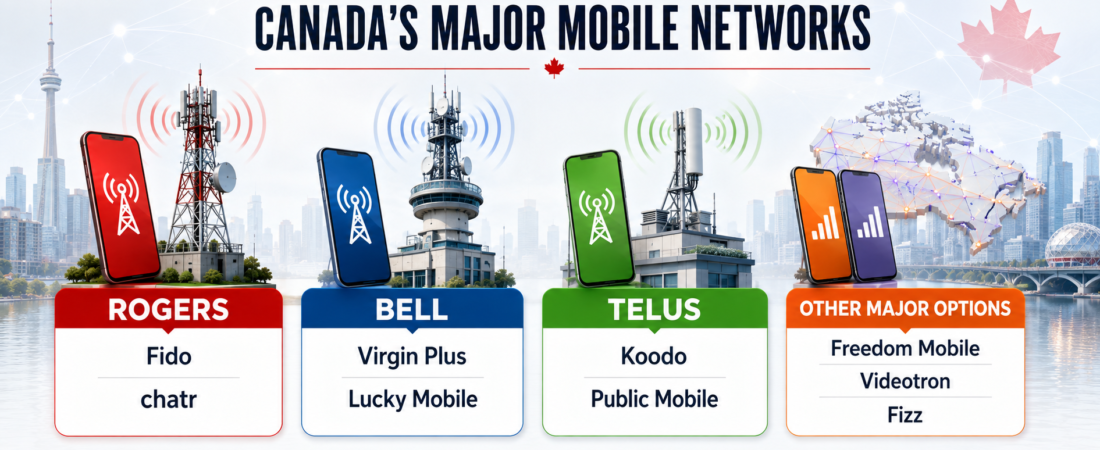
Canada has three large national telecom companies that newcomers will encounter frequently:
- Rogers
- Bell
- TELUS
But these are far from the only choices.
There are also brands and providers such as Fido, Koodo, Virgin Plus, Freedom Mobile, Public Mobile, Chatr, and Lucky Mobile.
This is where newcomers sometimes make their first mistake.
The biggest company is not automatically the best choice for every person.
A customer who travels frequently, finances expensive smartphones, or needs particular roaming features may have different priorities from a student who already owns an unlocked phone and simply wants inexpensive data.
The best way to approach Canada’s mobile market is therefore not:
“Which company is the best?”
Instead, ask:
“Which plan gives me the services I actually need at the lowest reasonable total cost?”
Major Carrier or Lower-Cost Provider?
Large carriers generally offer extensive plan selections, device financing, 5G services, roaming options, family discounts, and mobile-and-internet bundles.
For example, TELUS currently advertises 5G/5G+ plans, family discounts, Bring Your Own Phone options, device trade-ins and financing programs.
Bell similarly offers BYOD plans, 5G/5G+ service, multi-line savings and discounts that can depend on bundling internet and mobility.
Lower-cost providers can be particularly interesting for people who already own a good smartphone and do not need every premium feature.
Fido, for example, currently offers Canada-wide 5G plans and phone financing options. Its official website shows talk-and-text plans starting at $30 per month after the automatic-payment discount at the time this article was checked.
Freedom Mobile is another option worth comparing. Its current Back to School offers demonstrate just how much temporary promotions can affect Canadian wireless pricing: as of August 30, 2026, its official promotion page lists BYOD offers including 10GB for $35, 70GB for $40 and 125GB for $45 per month, with Digital Discount conditions applying.
Those numbers are useful examples, but they should not be treated as permanent prices.
That is one of the most important lessons about shopping for telecom services in Canada.
The price you find today may not be the price available next month.
My Experience Using Mobile Service in Canada
After living in Canada and actually dealing with these choices myself, I have learned that there is no reason to choose a provider based only on brand recognition.
I currently use Fido and Fuzzy for mobile service, and personally I have been quite satisfied with my experience.
For my everyday needs, the services have worked well for me.
However, I would not say that my providers are automatically the best choice for every newcomer.
Someone living in another province, travelling frequently between Canada and the United States, using much more mobile data, or living in an area with different network conditions could come to a completely different conclusion.
That is why my recommendation is simple:
Use personal recommendations as a starting point, not as the final decision.
Check the coverage, data allowance, monthly price and conditions yourself.
How Much Should a Phone Plan Cost in Canada?
There is no single answer.
Canadian mobile prices can depend on:
- Provider
- Province
- Amount of data
- 4G/5G access
- BYOD or phone financing
- Prepaid or postpaid service
- Number of lines
- Automatic-payment discounts
- Student eligibility
- Internet bundles
- Promotional credits
- Canada-US-Mexico usage
- Retail location
- Time of year
This is why comparing advertisements can be misleading.
For example, TELUS was advertising a student plan starting at $55 per month for 40GB when checked for this article, with conditions including pre-authorized payment.
Freedom’s current Back to School page, meanwhile, advertises different promotional BYOD prices, including the $35, $40 and $45 options mentioned above.
These are not direct apples-to-apples comparisons because the plans, eligibility requirements, network features and promotions differ.
The lesson is more important than the specific numbers:
Never compare phone plans using price alone.
BYOD: One of the First Options Newcomers Should Check
BYOD means Bring Your Own Device.
If you already have an unlocked smartphone that is compatible with Canadian networks, you may not need to purchase another phone.
This can be one of the simplest ways to control your telecommunications budget.
Instead of paying for both:
phone plan + new device financing
you may only need to pay for:
phone plan
Freedom, for example, specifically offers BYOD plans and provides a device-compatibility check. Its site also distinguishes prepaid service—which it describes as requiring no credit check or contract—from postpaid options.
This can be particularly useful for someone who has just arrived in Canada.
Before bringing a foreign phone onto a Canadian network, however, check whether the device is unlocked and compatible with the provider.
Buying a New Phone: Look Beyond “$0 Down”
Canadian wireless advertising frequently emphasizes the monthly device payment.
You might see advertisements such as:
$0 down
or
$5 per month
That does not mean the entire mobile service costs $5.
The advertised amount may represent only the device payment, while an eligible monthly wireless plan is also required.
Costco’s current wireless promotion page explicitly makes this distinction: its advertised monthly phone prices do not include the cost of the required monthly rate plan.
Before financing a phone, calculate:
Device payment × number of months + monthly plan × number of months + applicable fees and taxes
Also determine whether the phone is yours to keep at the end or whether the advertised price depends on returning the device.
A very low monthly device payment can look attractive until you calculate the full two-year cost.
Where Should You Buy a Phone Plan?
There are several good ways to purchase mobile service in Canada.
A carrier store can be useful if you want someone to explain plans, transfer your number, set up a SIM or eSIM, and help you purchase a device.
Buying online can be convenient and may sometimes reduce certain connection fees or provide online promotions. For example, TELUS currently advertises savings on its connection fee for some online mobility purchases.
Another option is a retailer that works with multiple carriers.
And this brings us to an option many newcomers do not initially consider:
Buying a Phone Plan at Costco Canada
Yes, you can shop for Canadian wireless service while visiting Costco.
Costco’s Canadian wireless kiosks are operated by WIRELESS etc., which says it is the exclusive operator of wireless kiosks inside Costco warehouses across Canada.
As of August 2026, its listed providers include:
- Rogers
- Bell
- Fido
- Virgin Plus
- Chatr Mobile
- Lucky Mobile
- SaskTel
Availability may vary, and this lineup can change.
This can be convenient because you can compare several providers in one place instead of visiting multiple carrier stores.
Costco also promotes member benefits on eligible activations.
At the time this article was checked, examples included Costco Shop Cards on select activations, complimentary phone setup and screen-protector installation, and other promotional benefits on eligible purchases.
There were also limited-time device and trade-in promotions running through August 31, 2026.
But there is an important warning:
Costco is worth checking, but do not automatically assume Costco will have the cheapest total price.
Before buying, compare the Costco offer against the carrier’s own website and other retailers.
A $100 or $200 gift card may sound attractive, but a different monthly plan could save more money over two years.
Always calculate the total.
Black Friday: One of the Best Times to Compare Phone Plans
If you do not need to change your mobile service immediately, Black Friday is an important period to watch.
Black Friday takes place in late November, and Canadian wireless providers and retailers frequently use this shopping period for promotions.
The deals can take different forms:
- Reduced monthly prices
- Additional data
- BYOD promotions
- Smartphone discounts
- Trade-in bonuses
- Bill credits
- Retail gift cards
- Activation incentives
But there is a very important distinction between saying that Black Friday is historically a major promotional period and claiming to know what the next Black Friday deal will be.
As of August 30, 2026 Black Friday telecom offers have not yet been announced across the market, so shoppers should not assume that a particular carrier will offer a specific price or amount of data.
A better strategy is to prepare.
In October or early November, write down:
Current plan: $___
Current data: GB
Current device payment: $
Contract/device balance: $___
Then compare those numbers when Black Friday promotions arrive.
That makes it much easier to recognize a genuinely good deal.
What About Boxing Day?
Boxing Day is December 26, and it remains another important Canadian shopping period.
Telecom promotions may appear around Boxing Day and Boxing Week, although the exact timing and offers vary by company and year.
People often ask:
Should I buy on Black Friday or wait for Boxing Day?
There is no guaranteed answer.
A Boxing Day promotion is not automatically better than a Black Friday promotion.
If you find an excellent plan on Black Friday that fits your needs, waiting solely because you assume Boxing Day will be cheaper can backfire.
Instead, compare:
Monthly price + data + device cost + credits + fees + contract conditions
not the name of the sale.
Don’t Forget Back-to-School Promotions
Black Friday and Boxing Day are not the only times to look.
August and September can also be interesting, particularly for students.
We can see that clearly right now in August 2026.
Fido is currently running student-oriented Back to School promotions, while Freedom is advertising specific Back to School and post-secondary offers.
This is another reason newcomers should avoid assuming that there is one permanently “cheap” provider.
The competitive landscape changes throughout the year.
Switching Providers Without Losing Your Phone Number
Many people hesitate to switch because they want to keep their existing Canadian phone number.
In many cases, your number can be transferred—or ported—to another provider.
The critical point is that you generally should not cancel the old service first and then try to transfer the number afterward.
Follow the new carrier’s number-transfer instructions and keep the existing service active during the process.
Also check whether you have:
- Remaining device financing
- Return-device obligations
- Contract commitments
- Outstanding account balances
Switching the monthly plan can be inexpensive while leaving an expensive device obligation behind.
PART TWO: Choosing Home Internet in Canada
Mobile service is only half the story.
Once you have a permanent place to live, you will probably also need home internet.
The major names you encounter depend partly on where you live.
Providers may include companies such as:
- Rogers
- Bell
- TELUS
- Freedom
- Regional providers
- Independent internet companies
Unlike mobile plans, however, home internet is particularly dependent on your exact address.
Do not choose an internet company before checking what service is actually available at your home.
My Experience With Rogers Home Internet
For home internet, my household currently uses Rogers.
My experience has been positive.
The connection has been fast and works well for our everyday household use. We can comfortably use the internet for browsing, streaming, studying, video calls and connecting multiple devices.
That matters in a modern household because internet usage is rarely limited to one computer.
At the same time, this is my personal experience rather than a claim that Rogers is the best internet provider everywhere in Canada.
Internet performance can depend on the technology available at a particular address, equipment, Wi-Fi conditions, building infrastructure and the service plan.
Someone living in another building—or another province—may have a very different experience.
Cable, Fibre and 5G Home Internet
Not all “internet” is delivered in the same way.
Depending on your address, services can include:
Fibre: Fibre-optic connections can provide very high speeds and, depending on the service, strong upload performance.
Cable: Widely used for residential broadband and capable of high download speeds.
DSL or legacy connections: Still relevant in some locations.
Fixed wireless/5G home internet: Internet delivered using a wireless network rather than a traditional wired connection to the home.
Rogers, for example, currently offers 5G Home Internet plans separately from its wired internet services. Its 5G Home Internet page currently shows month-to-month options with Wi-Fi gateway equipment and specified high-speed data allowances, after which reduced speeds apply.
This illustrates why the word “internet” alone is not enough when comparing plans.
Ask:
What technology am I getting?
How Much Internet Speed Does Your Family Need?
More speed is not automatically better value.
Think about how your household actually uses the internet.
Light User
Mostly:
- Websites
- Social media
- Occasional streaming
A relatively modest connection may be sufficient.
Average Family
Multiple family members may simultaneously use:
- Smartphones
- Laptops
- Tablets
- Smart TVs
- Streaming services
- Video calls
- Online learning
This requires more capacity.
Heavy-Use Household
You may want higher performance if several people regularly use:
- 4K streaming
- Large downloads
- Cloud backups
- Online gaming
- Remote work
- Multiple simultaneous video calls
But paying for the fastest available tier makes little sense if your household will never use that capacity.
Download Speed vs Upload Speed
Do not look only at the biggest number in the advertisement.
Download speed affects activities such as streaming movies, opening websites and downloading large files.
Upload speed matters when sending large files, backing up data to the cloud, livestreaming or participating in certain types of video communication.
Two internet plans advertised with similar download speeds may therefore provide different experiences.
How Home Internet Installation Usually Works
The first step is checking availability at your exact address.
Then the process generally looks like this:
- Enter your address on the provider’s website.
- Review the available internet technologies and plans.
- Choose the appropriate speed.
- Check whether self-installation or technician installation is available.
- Receive or collect the modem/router or gateway.
- Connect and activate the service.
- Set your Wi-Fi name and password.
- Test coverage throughout the home.
Installation can differ depending on whether you live in an apartment, condo, basement suite, townhouse or detached house.
Some buildings may already have infrastructure for certain providers, which can make installation easier.
Look Beyond the Promotional Internet Price
Suppose you see:
Internet: $60/month
Do not stop there.
Ask:
- Is $60 the regular price or promotional price?
- How long does the promotion last?
- What is the price afterward?
- Is there an activation fee?
- Is installation included?
- Is equipment included?
- Is there a contract?
- What happens if I cancel early?
- Are taxes extra?
- Does the advertised price require another service?
A more useful comparison is:
Total cost over 12 or 24 months.
That one calculation can completely change which plan looks cheapest.
Should You Bundle Mobile and Home Internet?
Major telecom companies often encourage customers to combine services.
Bundling can be useful because it may provide:
- Monthly discounts
- Promotional credits
- Simpler billing
- Additional services or benefits
Bell’s current offers provide a good example of why consumers need to read the conditions carefully. Some advertised mobility prices incorporate internet bundle, autopay or promotional credits.
A displayed price is therefore not necessarily available to everyone walking in the door.
And bundling is not automatically cheaper.
Sometimes:
lower-cost mobile provider + separate internet provider
may cost less than:
premium mobile + internet bundle
Calculate your entire household telecommunications bill.
Can You Buy Internet at Costco Too?
This is an interesting development for Costco shoppers.
As of August 2026, Costco Mobility’s Canadian site says TV and internet packages are now available at Costco.
Because availability and offers can differ by location and change over time, ask the wireless kiosk what is currently available for your address rather than assuming every Costco warehouse has the same internet offer.
This creates another useful comparison point:
Internet provider website → provider store → Costco offer
Again, compare the total cost and conditions.
10 Common Mistakes Newcomers Should Avoid
- Buying the plan with the most data without checking how much data you actually use.
- Financing an expensive smartphone without calculating its full two-year cost.
- Looking only at the promotional monthly price.
- Forgetting about connection, activation or setup charges.
- Assuming every promotion is available to every customer.
- Choosing home internet without checking availability at the exact address.
- Assuming Costco is automatically cheaper.
- Assuming Black Friday will always beat every other promotion.
- Cancelling your old mobile service too early when transferring a number.
- Paying for extremely fast home internet when your household does not need it.
My Practical Money-Saving Strategy for Newcomers
If I were comparing Canadian mobile and internet services from the beginning, I would use this process.
Step 1: Keep your current phone if possible.
Check whether your existing unlocked smartphone is compatible with Canadian networks.
Step 2: Start by comparing BYOD plans.
This makes it easier to understand what you are actually paying for mobile service.
Step 3: Compare major and lower-cost providers.
Do not limit yourself to Rogers, Bell and TELUS.
Step 4: Check coverage.
The cheapest plan is not good value if coverage does not work well where you spend your time.
Step 5: Check Costco as well as carrier stores and websites.
Costco may have member incentives, while a carrier may have an online-only promotion.
Step 6: Watch seasonal sales.
Back to School, Black Friday and Boxing Day are worth checking.
Step 7: Check internet availability using your exact address.
Do this before becoming attached to a particular plan.
Step 8: Calculate the total cost.
Compare 12- or 24-month costs instead of the headline monthly price.
Quick Comparison for Newcomers
| Option | May Be Good For | Potential Advantage | Check Carefully |
|---|---|---|---|
| Major carrier | People wanting broader service options | Devices, bundles, roaming | Monthly cost |
| Lower-cost provider | Budget-conscious users | Competitive plans | Features and coverage |
| BYOD | People who already own a phone | Avoid new-device financing | Compatibility |
| Prepaid | Some newcomers/light users | Simpler commitment | Data and features |
| Costco | Costco members | Member promotions may apply | Total plan cost |
| Black Friday | Flexible shoppers | Competitive seasonal deals | Conditions |
| Boxing Day | Holiday shoppers | Another sale period | Don’t assume it beats Black Friday |
| Internet bundle | Multi-service households | Possible discounts | Price after promotions |
Frequently Asked Questions
What is the cheapest way to get a phone plan in Canada?
There is no single cheapest option for everyone. If you already have a compatible unlocked smartphone, comparing BYOD plans from both major and lower-cost providers is a sensible place to start.
Is Costco cheaper for phone plans?
Sometimes Costco promotions can be attractive, particularly when Costco Shop Cards or member benefits are included. However, Costco should be treated as another place to compare rather than automatically the cheapest option. Current Costco promotions and benefits vary.
Is Black Friday a good time to switch phone providers?
It is an important period to watch because carriers and retailers commonly compete with seasonal promotions. Compare the total cost and plan features rather than switching only because something is labelled a Black Friday deal.
Is Boxing Day better than Black Friday?
Not necessarily. Promotions vary from year to year.
Can I keep my phone number when changing carriers?
Canadian mobile numbers can generally be transferred between providers when eligibility requirements are met. Follow your new provider’s transfer instructions rather than cancelling the existing service prematurely.
Should newcomers choose prepaid or postpaid?
It depends on the situation. Prepaid can offer simplicity and may avoid credit-check requirements, while postpaid plans may provide a wider selection of features, promotions and device-financing options.
How much home internet speed does a family need?
It depends more on simultaneous usage than simply the number of people. Streaming, gaming, video calls and large downloads can significantly increase household requirements.
Should I bundle mobile and internet?
Compare both possibilities. A bundle may provide discounts, but separate providers can sometimes produce a lower overall household bill.
Can international students get Canadian mobile plans?
Yes, but available plans, identification requirements, credit requirements and student promotions can vary by provider. Current student-specific promotions also demonstrate that it is worth checking offers during Back to School season.
Final Thoughts
Choosing mobile and home internet service in Canada becomes much easier once you stop looking for one universal “best provider.”
Instead, compare what matters to you:
Coverage → data → internet speed → monthly price → device cost → fees → promotional period → total cost
My own experience has been positive using Fido and Fuzzy for mobile service and Rogers for home internet, but that is only one household’s experience.
Your best option may be completely different.
For newcomers, international students and families, the smartest approach is to compare major carriers and lower-cost providers, check Costco and online promotions, consider BYOD, and pay special attention to Back to School, Black Friday and Boxing Day sales.
Most importantly, never let a large data allowance, a “$0 phone,” a gift card or an introductory internet price make the decision for you.
Calculate what you will actually pay.
That is usually the best way to find real value in Canada’s complicated telecommunications market.