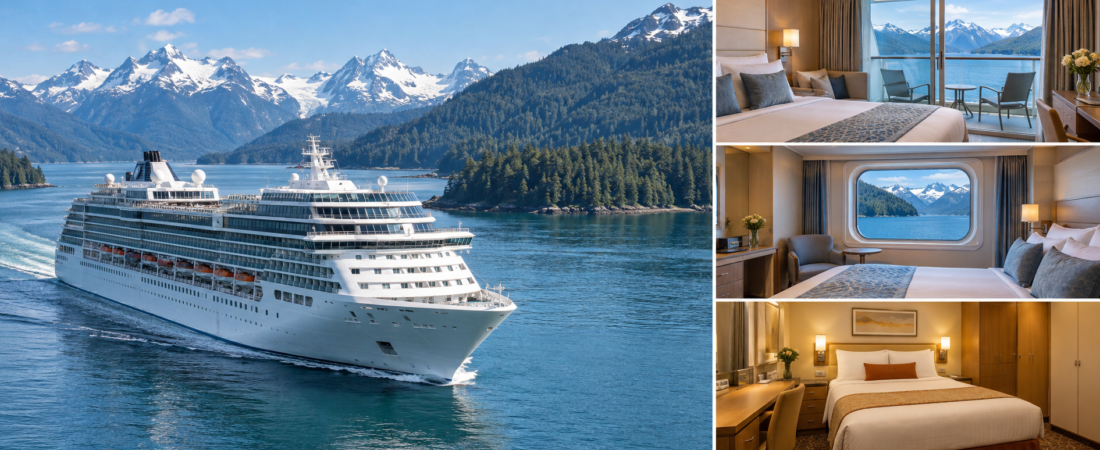
Choosing a cabin for a Vancouver to Alaska cruise involves more than deciding whether you want a window.
The cabin category affects the price, but its location can also influence noise, motion, convenience and the quality of your scenic experience. A balcony may provide private glacier views, while a carefully selected inside cabin can leave more money for whale watching, railway trips and other shore activities.
The best cabin is therefore not necessarily the most expensive one.
For travellers who value private scenery and expect to spend time in their room, a balcony can be worthwhile. For budget-conscious travellers who plan to use the ship’s public decks, an inside or ocean-view cabin may offer better overall value.
This guide compares the main cabin categories and explains the additional expenses that should be included when calculating the real cost of a Vancouver to Alaska cruise.
This article provides general planning information as of September 7, 2026. Cabin layouts, included services, gratuities, package prices and booking conditions vary by cruise line and ship. Check the current details before reserving or purchasing an add-on.
Why Cabin Choice Matters More in Alaska
On some cruises, the cabin is mainly a place to sleep. Alaska can be different because scenic sailing is an important part of the trip.
Passengers may see:
- Forested islands along the Inside Passage
- Snow-covered mountains
- Waterfalls and narrow channels
- Glaciers
- Seabirds
- Whales and other wildlife
- Small coastal communities
- Early-morning arrivals at Alaska ports
A private balcony allows passengers to step outside without travelling to a public deck. However, it does not guarantee that the best scenery or wildlife will appear on that side of the ship.
Public observation decks often provide a wider field of view and make it easier to move from one side of the vessel to the other. This means that passengers in inside or ocean-view cabins can still enjoy the major scenery.
Your decision should be based on how you expect to use the cabin—not simply on the assumption that every Alaska cruise requires a balcony.
The Four Main Cruise Cabin Categories
Cruise lines use different names, but most ships offer four general accommodation types:
- Inside or interior cabin
- Ocean-view cabin
- Balcony, verandah or veranda cabin
- Suite
Some ships also offer solo cabins, family rooms, spa cabins, connecting rooms and premium categories with additional services.
Holland America, for example, lists interior, ocean-view, verandah and suite accommodations among its main choices. Celebrity Cruises similarly offers inside, ocean-view, veranda and suite categories. Exact layouts and amenities depend on the individual ship. Review the cabin descriptions and deck plan rather than relying only on the category name.
Inside Cabin: Best for Keeping the Base Price Low
An inside cabin normally has no exterior window. It is generally one of the least expensive ways to join the same sailing and visit the same ports as passengers in higher categories.
Advantages of an Inside Cabin
- Usually lower initial fare
- Dark environment that can be helpful for sleeping
- More budget available for excursions and activities
- Suitable for passengers who spend little time in the room
- Access to the same major public areas as other standard-cabin guests
The dark room can be particularly helpful in Alaska, where daylight lasts well into the evening during parts of the summer.
Disadvantages of an Inside Cabin
- No natural light
- No private view
- It can be difficult to judge the weather before leaving the room
- The space may feel enclosed
- Less comfortable for travellers who spend substantial time in the cabin
Inside rooms are not automatically identical. Some may have different floor plans, bed arrangements or occupancy limits.
Who Should Choose an Inside Cabin?
An inside cabin may be a good choice for:
- Budget-conscious couples
- Active travellers who spend most of the day outside the room
- Passengers prioritizing expensive shore excursions
- Travellers who enjoy public observation decks
- People who sleep better in a very dark room
Before reserving, check the exact size, bed configuration and maximum number of occupants.
Ocean-View Cabin: Natural Light Without a Private Balcony
An ocean-view cabin includes a window or porthole. The window normally does not open, but it provides natural light and a visual connection with the outside.
Advantages of an Ocean-View Cabin
- Natural light
- Ability to check weather and scenery
- Often less expensive than a balcony
- Can feel more open than an inside room
- Useful for travellers who want a view but do not need private outdoor space
Disadvantages of an Ocean-View Cabin
- No direct access to fresh air
- The window may be small
- Some views may be obstructed
- Location can be on a lower deck
- The price difference from a balcony may occasionally be small
The phrase “ocean view” does not always mean a large, completely unobstructed window. Some cabins have portholes, while others may face lifeboats or structural equipment.
Look for terms such as:
- Obstructed view
- Partially obstructed view
- Porthole
- Picture window
- Forward-facing window
An obstructed ocean-view cabin can provide daylight at a lower price, but it may not deliver the wide scenic view shown in promotional photographs.
Balcony Cabin: Is It Worth the Upgrade in Alaska?
A balcony cabin—sometimes called a verandah or veranda cabin—includes a private outdoor area.
For many travellers, this is the most appealing category on an Alaska cruise because the scenery can be enjoyed directly from the room.
Advantages of a Balcony Cabin
- Private outdoor viewing space
- Convenient access to fresh air
- A quiet place to watch the coastline
- Useful during glacier-viewing days
- More pleasant for travellers who spend time in their room
- Easier to enjoy an early-morning port arrival
A balcony can be especially valuable for someone who dislikes crowded observation areas or has difficulty standing on a public deck for long periods.
Disadvantages of a Balcony Cabin
- Higher fare
- The weather may be too cold, windy or rainy for long use
- A balcony on one side cannot show scenery on the opposite side
- Furniture and usable space vary by ship
- Nearby balconies may reduce privacy
- Some balconies have obstructed or enclosed views
The value of a balcony depends on the price difference. If the upgrade is modest, it may improve the trip considerably. If it consumes the budget intended for excursions, an inside or ocean-view cabin may create a better overall vacation.
A Simple Balcony Decision Test
Ask these four questions:
- Will I use the balcony even in cool or wet weather?
- Do I prefer private viewing to public decks?
- Will I spend significant time in the cabin?
- Can I pay for the upgrade without removing important excursions?
If the answer to most of these questions is yes, a balcony may be worth considering.
Suite: More Space and Additional Benefits
Suites normally provide more interior space, an upgraded bathroom or seating area and a larger balcony. Depending on the cruise line and suite category, passengers may also receive priority services, special dining access or other benefits.
Advantages of a Suite
- More living and storage space
- Larger bathroom or seating area
- A larger balcony in many categories
- Greater comfort for longer trips
- Potential priority services and premium amenities
- Useful for families who need more room
Disadvantages of a Suite
- Considerably higher fare
- Higher daily gratuities may apply
- Some benefits may duplicate services you would not otherwise buy
- The least expensive suite may not include every premium benefit
Do not assume that every cabin using the word “suite” provides the same services. A mini-suite or junior suite can differ significantly from a full suite.
Compare the written list of benefits before paying for the upgrade.
Which Side of the Ship Is Better?
Travellers frequently ask whether they should choose the port or starboard side for an Alaska cruise.
There is no single correct answer for every itinerary.
On a round-trip cruise from Vancouver, the ship travels north and later returns south. Different sides may face the mainland or open water during different portions of the journey. Ships can also rotate during glacier viewing, although this is not guaranteed.
Weather, navigation, port assignments and itinerary changes can affect what passengers see.
Instead of choosing a cabin solely by side, consider:
- Whether the itinerary is round-trip or one-way
- The location of public observation decks
- The cabin’s position on the ship
- Potential obstructions
- Noise from surrounding facilities
- How easily you can move to another viewing area
For a one-way northbound or southbound cruise, the side of the ship may influence some coastal views. However, passengers should still use public decks for the broadest viewing opportunities.
Forward, Midship or Aft?
The cabin’s position from front to back can matter as much as its category.
| Ship location | Possible advantages | Possible disadvantages |
|---|---|---|
| Forward | Close to forward observation areas; dramatic arrival views | May experience more motion; possible noise from anchors or equipment |
| Midship | Convenient location; generally less movement | Can cost more; may be near elevators and busy corridors |
| Aft | Wake views in some cabins; close to rear dining or lounge areas | Long walk to forward facilities; possible vibration or engine-related noise |
Midship Cabins
Midship cabins are often preferred by passengers concerned about motion. They can also reduce walking time when facilities are distributed across the ship.
However, “midship” alone does not guarantee silence. A cabin near an elevator, stairway or crew service area may experience additional traffic.
Forward Cabins
Forward cabins may appeal to passengers who enjoy watching the ship enter ports. They can also be close to theatres or observation lounges on some vessels.
The front of the ship may experience more noticeable movement in rough water.
Aft Cabins
Some rear-facing balcony cabins have wide views over the ship’s wake. These rooms can be popular and may cost more than a standard balcony.
Possible concerns include vibration, soot, sound or a longer walk to forward venues. Conditions vary by ship.
Check What Is Above and Below the Cabin
A cabin that looks perfect on one deck plan may be located beneath a noisy venue.
Before booking, examine the deck immediately above and below the room.
Possible noise sources include:
- Pool decks
- Fitness centres
- Theatres
- Nightclubs
- Restaurants
- Kitchens
- Children’s facilities
- Elevators
- Laundry rooms
- Crew service areas
- Outdoor promenades
A room beneath the pool deck may hear chairs being moved early in the morning. A cabin above a theatre or music venue may experience evening noise.
For a quieter location, look for a cabin surrounded by other cabins above, below and on both sides.
What Is a Guarantee Cabin?
A guarantee cabin confirms at least a particular accommodation category, but the cruise line selects the specific room.
For example, a passenger might reserve a guaranteed balcony without choosing the exact deck or location. The assignment may be made close to departure.
Benefits of a Guarantee Cabin
- Potentially lower fare
- Possible assignment to a higher category
- Suitable for flexible travellers
- Access to a sold-out-looking category in some cases
Risks of a Guarantee Cabin
- Little or no control over location
- Possible obstructed view
- Cabin may be far forward or aft
- Travelling companions may be separated
- Assignment can occur shortly before departure
- An upgrade may not be the location you prefer
A higher category is not always a practical upgrade. A larger room beneath a noisy public deck may be less desirable than a smaller, quiet cabin.
A guarantee cabin is best for travellers who can honestly accept any room meeting the booking terms.
Families Should Check Occupancy, Not Just Room Size
A cabin that appears large enough may not be approved for the number of passengers travelling.
Cruise ship occupancy is controlled by available sleeping arrangements, safety regulations and lifeboat capacity. A room cannot necessarily accommodate a third or fourth guest simply because it has enough floor space.
Families should check:
- Maximum permitted occupancy
- Sofa-bed or upper-berth arrangement
- Bed configuration
- Storage space
- Bathroom layout
- Connecting-door availability
- Distance between multiple cabins
- Balcony safety considerations
- Whether a crib is available, when needed
When searching online, enter the correct number and ages of all passengers. Searching first for two adults and attempting to add children later may produce inaccurate availability.
For families with older children, two connecting or nearby cabins may sometimes be more comfortable than one larger room. Compare both the price and supervision requirements.
Accessible Cabins
Accessible cabins may include wider doorways, additional turning space, an adapted bathroom and other mobility features.
These cabins are limited and can be reserved early. Travellers who require accessibility features should contact the cruise line for details rather than relying only on a photograph or general category description.
Ask about:
- Doorway width
- Bathroom configuration
- Shower access
- Bed clearance
- Balcony access
- Emergency procedures
- Mobility-device storage
- Accessible transportation and shore excursions
Do not reserve an accessible cabin merely because it appears larger if no member of the party needs the features.
What Is Usually Included in the Cruise Fare?
The exact inclusions vary, but a standard cruise fare commonly covers:
- The cabin
- Main dining room meals
- Buffet meals
- Selected casual food
- Basic coffee, tea and water in designated areas
- Theatre performances
- Many onboard activities
- Pools and some fitness facilities
- Transportation between scheduled ports
Specialty dining, alcohol, certain drinks, internet, spa treatments, excursions and other services may cost extra.
Cruise lines also sell bundled fares. Holland America’s Have It All package, for example, can combine selected beverage, specialty-dining, Wi-Fi and shore-excursion benefits. Its inclusions and promotion terms should be checked for the specific reservation on the Holland America Have It All page.
A bundle is valuable only when you expect to use the included benefits.
Hidden Cost 1: Taxes, Fees and Port Expenses
An advertised cruise fare may not be the same as the amount shown at checkout.
Review whether the displayed price includes:
- Government taxes
- Port expenses
- Booking charges
- Currency conversion
- Charges for additional passengers
Compare the final total for the whole cabin, not only the per-person starting price.
Canadian travellers should verify whether the price is displayed in Canadian or U.S. dollars.
Hidden Cost 2: Daily Gratuities or Crew Appreciation
Many cruise lines add a daily gratuity or crew-appreciation charge to the onboard account unless it has been prepaid or included in the package.
The amount can vary by:
- Cruise line
- Cabin category
- Length of sailing
- Date of travel
- Package type
As of September 7, 2026, Holland America lists daily Crew Appreciation of US$18 per guest for non-suite cabins and US$20 per guest for suites. Celebrity Cruises lists different daily amounts according to cabin category, including US$19.50 per guest for inside, ocean-view and veranda cabins. These amounts can change, so confirm the current rate on the Holland America gratuity information page or the Celebrity Cruises gratuity page.
For a family, a per-person daily charge can become a significant part of the total cruise budget.
Hidden Cost 3: Shore Excursions
Shore excursions can be one of the largest additional expenses on an Alaska cruise.
Popular activities include:
- Whale watching
- Helicopter glacier landings
- Dog-sledding experiences
- The White Pass railway
- Wildlife tours
- Fishing trips
- Kayaking
- Guided hikes
- Cultural and historical tours
Passengers do not need to purchase a tour in every port. Walking tours, museums and self-guided sightseeing can reduce the budget.
However, travellers should not choose the cheapest cabin without reserving enough money for the experiences that motivated them to visit Alaska.
Hidden Cost 4: Beverages
Basic drinks may be included in designated dining areas, but many beverages cost extra.
Additional charges can apply to:
- Alcoholic drinks
- Specialty coffee
- Bottled water
- Fresh juice
- Soft drinks
- Mocktails
- Energy drinks
A beverage package may be convenient, but it is not automatically economical. Compare the package price with your realistic daily consumption.
Also review:
- Daily drink limits
- Maximum covered drink price
- Service charges
- Age restrictions
- Whether every adult in the cabin must purchase the package
- Rules for port days
- Excluded brands or venues
Hidden Cost 5: Internet Access
Shipboard Wi-Fi is not always included in the standard fare.
Internet packages may be sold:
- Per day
- For the entire voyage
- Per device
- Per passenger
- As part of a premium fare bundle
Passengers should decide whether they need basic messaging, browsing, video calling or streaming because service levels may differ.
Someone who only wants occasional contact with family may not need the largest package.
Hidden Cost 6: Specialty Dining
Meals in the main dining room and buffet are generally included, but specialty restaurants may charge a fixed fee or menu price.
Specialty dining can be enjoyable, but it should be treated as an optional expense rather than a required part of the cruise.
Before reserving a dining package, check:
- Number of meals included
- Eligible restaurants
- Reservation availability
- Gratuities or service charges
- Restrictions on premium menu items
Hidden Cost 7: Spa, Photos and Onboard Shopping
Other optional expenses can quietly increase the final bill.
These may include:
- Spa treatments
- Salon services
- Professional photographs
- Casino spending
- Art or retail purchases
- Fitness classes
- Laundry
- Room service charges
- Medical services
- Arcade games
- Paid onboard activities
Passengers can usually review their running account through the cruise line’s app, cabin television or guest-services desk.
Checking the balance daily can prevent an unpleasant surprise at the end of the cruise.
Hidden Cost 8: Transportation and Parking in Vancouver
Even local passengers should include the cost of reaching Canada Place.
Possible expenses include:
- Public transit
- Taxi or rideshare
- Fuel
- Downtown parking
- Luggage handling
- A hotel before the cruise
- Meals before boarding
Canada Place is located near Waterfront Station, which is served by SkyTrain, SeaBus and the West Coast Express. Public transit may be a practical option for passengers who can manage their luggage.
Travellers driving to the terminal should verify parking availability, height restrictions, reservation rules and the total cost for the full voyage.
Hidden Cost 9: Travel Insurance and Medical Care
Provincial health coverage should not be treated as complete travel insurance.
A Vancouver-to-Alaska cruise enters the United States, and medical care or emergency transportation can be expensive. A passenger may also need coverage for trip cancellation, interruption, baggage delay or missed departure.
Review whether the policy covers:
- Emergency medical treatment
- Medical evacuation
- Pre-existing conditions
- Cruise interruption
- Missed port departure
- Trip cancellation
- Baggage loss or delay
- COVID-19 or other illness-related claims
- Shore activities such as kayaking or helicopter tours
Insurance should be purchased according to the traveller’s circumstances and the policy wording—not simply because it is the cheapest option.
A Realistic Cruise Budget Worksheet
Use a complete worksheet before comparing cabin offers.
| Expense category | What to record |
|---|---|
| Cruise fare | Total for every passenger |
| Taxes and port expenses | Complete checkout amount |
| Cabin upgrade | Difference between inside, ocean-view and balcony |
| Gratuities | Daily amount × passengers × cruise nights |
| Shore excursions | Planned activity in each port |
| Beverage package | Package price plus applicable service charge |
| Internet | Number of users and devices |
| Specialty dining | Number of paid meals |
| Insurance | Medical and cancellation coverage |
| Vancouver transportation | Transit, taxi, rideshare or parking |
| Onboard spending | Spa, photos, shopping and entertainment |
| Emergency reserve | Unexpected purchases or itinerary changes |
A lower cabin fare can create more room for excursions. A more expensive cabin can be worthwhile if it becomes an important part of the scenic experience.
The right choice is the one that fits the complete vacation budget.
Sample Cabin Strategies
Budget-Focused Couple
Choose an inside cabin in a quiet location and use public observation decks. Direct the savings toward one major excursion and one lower-cost activity.
Couple Prioritizing Scenery
Choose a balcony cabin if the upgrade fits the budget. Use the private balcony for quiet viewing but move to public decks when scenery appears on the opposite side.
Family With Teenagers
Compare one four-person cabin with two connecting or nearby cabins. Include the additional gratuities, possible second bathroom and supervision needs in the decision.
Traveller Sensitive to Motion
Look for a lower-deck, midship cabin. Avoid selecting a far-forward room only because it has a slightly lower fare.
Light Sleeper
Choose a room with cabins above and below it. Avoid locations near elevators, theatres, pool decks and late-night venues.
Cabin Selection Checklist
Before paying the deposit, confirm:
- Exact ship
- Cabin category
- Cabin number or guarantee status
- Deck
- Forward, midship or aft location
- What is directly above and below
- Obstructed-view description
- Bed arrangement
- Maximum occupancy
- Connecting-door information
- Balcony type
- Accessibility features
- Included amenities
- Daily gratuity policy
- Deposit and cancellation terms
Save a copy of the deck plan and booking confirmation. Cabin descriptions can vary even within the same category.
Final Recommendation
For an Alaska cruise, a balcony is desirable but not essential.
Choose an inside cabin if protecting the travel budget is the priority and you are comfortable using public decks. Select an ocean-view cabin when natural light matters but a private outdoor area does not. Consider a balcony when private scenic viewing will be an important part of the vacation.
A suite is most suitable when additional space and premium benefits provide real value to your group.
Most importantly, calculate the complete cost before deciding how much to spend on the room. The advertised cruise fare may exclude gratuities, excursions, drinks, internet, specialty dining, insurance and transportation.
A modest cabin with memorable Alaska experiences can offer more value than an expensive room that leaves no budget for the destination itself.
Frequently Asked Questions
1. Is a balcony cabin necessary for an Alaska cruise?
No. Passengers in inside and ocean-view cabins can enjoy Alaska scenery from public observation decks. A balcony provides privacy and convenience but is not required for glacier viewing.
2. Is an inside cabin too dark for an Alaska cruise?
Inside cabins have no natural light, but some passengers appreciate the darkness during Alaska’s long summer daylight hours. Travellers who feel uncomfortable without a window should consider an ocean-view cabin.
3. Which side of the ship is best for an Alaska cruise?
There is no universally best side, especially on a round-trip itinerary. Scenery and wildlife can appear on either side. Public decks provide the greatest flexibility.
4. Is a midship cabin better for motion sickness?
Midship cabins, particularly on lower decks, generally experience less movement than cabins far forward or aft. Weather and sea conditions can still affect the entire ship.
5. What does obstructed view mean?
An obstructed-view cabin has a window or balcony view partly blocked by a lifeboat, structural element or other equipment. The degree of obstruction varies, so check the ship-specific description.
6. Is a guarantee cabin a good way to save money?
It can be suitable for flexible travellers, but the cruise line controls the assignment. Do not choose a guarantee cabin if location, noise, proximity or an unobstructed view is important.
7. Are gratuities included in the advertised cruise fare?
Not always. Daily gratuities or crew-appreciation charges may be added to the onboard account unless they are prepaid or included in a package. Check the terms for your specific fare.
8. Are meals included on an Alaska cruise?
Main dining room meals, buffet meals and selected casual options are commonly included. Specialty restaurants, premium menu items and certain room-service orders may cost extra.
9. What is usually the largest extra expense?
For many passengers, shore excursions are the largest optional expense. Daily gratuities, beverages, internet and specialty dining can also add substantially to the total.
10. Should I spend more on a balcony or save the money for excursions?
Choose according to your priorities. If private scenic viewing is central to your trip, a balcony may be worthwhile. If whale watching, railway travel or glacier excursions matter more, a less expensive cabin may provide better overall value.
Suggested Internal Links
- When to Book a Vancouver to Alaska Cruise: Early Booking vs. Last-Minute Deals
- Vancouver to Alaska Cruise Prices and Seven-Day Itineraries
- Vancouver Cruise Departure Checklist: Documents, Packing and Canada Place Boarding
Editorial Note
Cabin features, prices, gratuities, packages and onboard services can change. Images of rooms may represent a general category rather than the exact cabin. Verify the ship, cabin number, deck plan, inclusions and complete price directly with the cruise line before booking.