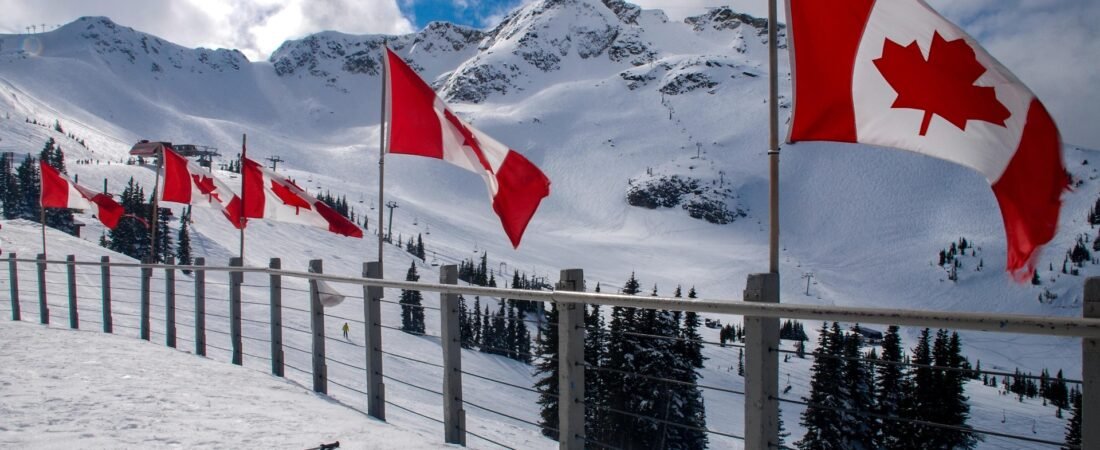
Canada is one of the world’s great skiing destinations.
From the enormous mountains of British Columbia to the spectacular Canadian Rockies and the popular resorts of Quebec and Ontario, Canada offers everything from gentle beginner slopes to deep powder, alpine bowls, glades and extreme terrain.
1. Whistler Blackcomb – British Columbia
Location: Whistler, British Columbia
Skiable terrain: 8,171 acres
Runs: More than 200 marked runs
Average annual snowfall: Approximately 1,072 cm
Mountains: Whistler and Blackcomb
If someone asked me to name Canada’s most internationally recognizable ski destination, Whistler Blackcomb would be an obvious choice.
Located roughly north of Vancouver along the Sea-to-Sky corridor, Whistler combines two enormous mountains with one of Canada’s best-known ski villages.
According to Whistler Blackcomb, the two mountains offer more than 200 marked runs and 8,171 acres of terrain, along with 16 alpine bowls and three glaciers. (whistlerblackcomb.com)
Whistler also has enormous international recognition. The resort hosted alpine events during the 2010 Winter Olympics, and the PEAK 2 PEAK Gondola connecting Whistler and Blackcomb has become one of the destination’s landmarks. (whistlerblackcomb.com)
Why Go?
Whistler is particularly attractive because a group does not necessarily have to consist of skiers at the same level.
There is terrain for beginners, intermediates and highly experienced skiers.
But its enormous size is also exactly why I believe groups should make a communication plan.
Two people taking different runs can end up surprisingly far apart.
My safety recommendation: Decide on a specific meeting location and time before leaving the lift.
Do not simply say:
“We’ll meet at the bottom.”
On a mountain this large, “the bottom” may not be specific enough.
2. Lake Louise Ski Resort – Alberta
Location: Banff National Park, Alberta
Skiable terrain: 4,200+ acres
Runs: 170 named runs
Lifts: 13
Vertical rise: 991 metres
Longest run: Approximately 8 km
Lake Louise is one of the great skiing destinations of the Canadian Rockies.
The scenery alone makes it special.
The resort covers more than 4,200 acres across five mountain faces, with 170 named runs and 13 lifts. (skilouise.com)
The terrain is officially divided approximately into:
- 25% beginner
- 45% intermediate
- 30% advanced
One reason Lake Louise appeals to families and mixed-ability groups is that different difficulty levels can often be accessed from the same lifts.
But again, the mountain is large.
If your group separates, don’t assume everyone will naturally end up at the same location.
3. Banff Sunshine Village – Alberta
Location: Banff National Park, Alberta
Skiable terrain: Approximately 3,358 acres
Runs: More than 130
Lifts: 12
Top elevation: Approximately 2,730 metres
Banff Sunshine Village is another internationally known Canadian Rockies destination.
The resort sits high in the mountains near Banff and is famous for its long ski season and abundant natural snow.
Sunshine offers roughly 3,358 acres of skiable terrain and 12 lifts, with terrain ranging from beginner areas to serious expert skiing. (skibanff.com)
For experienced skiers, areas such as Delirium Dive demonstrate how serious Canadian mountain terrain can become.
That brings me to an important point:
A ski resort is controlled terrain, but that does not make every part of a mountain easy or harmless.
Weather can change.
Visibility can deteriorate.
People can take the wrong trail.
Members of a group can become separated.
Treat the mountain with respect.
4. Sun Peaks Resort – British Columbia
Location: Near Kamloops, British Columbia
Skiable terrain: 4,400 acres
Trails and glades: 144 trails, including 16 gladed areas
Lifts: 13
Skiable vertical: 896 metres
Longest run: Up to 8 km
Sun Peaks describes itself as Canada’s second-largest ski area, with 4,400 acres spread across three mountains. (sunpeaksresort.com)
The terrain distribution is approximately:
- 10% novice
- 58% intermediate
- 32% advanced/expert
That large percentage of intermediate terrain makes Sun Peaks particularly attractive to recreational skiers who want long cruising runs rather than only extreme terrain.
The resort village is also convenient for families.
But with three mountains, once again, make sure everyone knows the day’s plan.
5. Big White Ski Resort – British Columbia
Location: Near Kelowna, British Columbia
Patrolled terrain: Approximately 2,834 acres
Designated trails: 119
Lifts: 17
Vertical drop: 777 metres
Longest run: Approximately 7.2 km
Big White is particularly convenient for visitors to British Columbia’s Okanagan region.
The village centre is approximately 56 km from Kelowna, and Kelowna International Airport makes the resort relatively accessible for visitors arriving by air. (bigwhite.com)
Big White reports 119 designated trails and 17 lifts, with terrain divided approximately into:
- 18% beginner
- 54% intermediate
- 22% expert
- 6% extreme
It is particularly popular with families and intermediate skiers.
Big White also has extensive ski-in/ski-out accommodation, which can make a family ski vacation considerably easier.
6. Revelstoke Mountain Resort – British Columbia
Location: Revelstoke, British Columbia
Skiable terrain: 3,121 acres
Runs: 75
Vertical descent: 1,713 metres
Longest run: 15.2 km
Average annual snowfall: Approximately 10.5 metres
Revelstoke is where the numbers start becoming truly intimidating.
The resort has a 1,713-metre vertical descent and a longest run of approximately 15.2 km. (revelstokemountainresort.com)
It is internationally known among serious skiers for powder, alpine bowls, glades and challenging terrain.
Approximately 45% of its listed terrain is classified as advanced.
For experienced skiers, that can be fantastic.
For inexperienced visitors, it means preparation matters.
This is exactly the type of mountain where I would want everyone in my group to have location sharing activated before starting the day.
7. Kicking Horse Mountain Resort – British Columbia
Location: Golden, British Columbia
Skiable terrain: Approximately 3,486 acres
Runs: 120+
In-bounds chutes: 85+
Vertical: 1,315 metres
Top elevation: 2,505 metres
Kicking Horse is a serious mountain.
The resort has more than 120 runs, 85+ in-bounds chutes and a 1,315-metre vertical, making it particularly attractive to strong skiers looking for challenging terrain. (kickinghorseresort.com)
Its terrain distribution is approximately:
- 20% beginner
- 20% intermediate
- 45% advanced
- 15% expert
That tells you something immediately.
This is not a mountain where an inexperienced skier should blindly follow an advanced friend.
Know the trail classification before committing to a run.
8. RED Mountain Resort – British Columbia
Location: Rossland, British Columbia
Skiable terrain: Approximately 3,850 acres
Runs: 119
Lifts: 8
Longest run: Approximately 7 km
RED Mountain has a different personality from Whistler.
Instead of an enormous internationally famous village, RED is associated with the smaller mountain town of Rossland and a more independent ski culture.
Yet the terrain is huge.
RED reports approximately 3,850 acres, making it one of Canada’s largest ski areas. (redresort.com)
Its terrain is approximately:
- 17% beginner
- 34% intermediate
- 23% advanced
- 26% expert
RED is particularly attractive to people who enjoy glades, powder and a less commercial mountain atmosphere.
9. Mont Tremblant – Quebec
Location: Laurentians, Quebec
Skiable terrain: Approximately 763 acres
Trails: 102
Lifts: 14
Vertical drop: 645 metres
Longest run: Approximately 6 km
Western Canada does not have a monopoly on great ski resorts.
Mont Tremblant is one of eastern Canada’s best-known ski destinations.
The mountain has 102 trails across four sides, approximately 763 acres of skiable terrain and 14 lifts. (tremblant.ca)
Tremblant is also famous for its pedestrian village, which gives a ski vacation here a very different atmosphere from many western Canadian resorts.
For travellers combining skiing, restaurants, accommodation and village entertainment, Tremblant is one of Canada’s classic winter destinations.
10. Blue Mountain Resort – Ontario
Location: Blue Mountains, Ontario
Skiable terrain: Approximately 365 acres
Trails: 43
Vertical: Approximately 720 feet
Night trails: 30
Longest run: Approximately 1.6 km
Blue Mountain cannot compete with Whistler or Revelstoke in vertical size.
But that misses the point.
Its major advantage is accessibility to southern Ontario.
Blue Mountain is approximately 1.5 hours from Toronto and describes itself as Ontario’s largest public ski area. (bluemountain.ca)
It has 43 trails, including 30 illuminated night trails, making it particularly useful for weekend and shorter ski trips.
For families living around the Greater Toronto Area, that convenience can be more valuable than enormous acreage.
My Three-Hour Experience of Being Separated on a Ski Mountain
Now I want to explain why I take mountain safety so seriously.
During one ski trip, I became separated from the people I was skiing with.
At first, it did not seem like an emergency.
That is exactly how these situations can begin.
You think:
“They are probably just on another run.”
Then:
“Maybe they are waiting at the lift.”
Then:
“I’ll ski down and find them.”
But time keeps passing.
In my case, the separation lasted roughly three hours.
As the situation continued, what initially seemed like a simple inconvenience began to feel genuinely dangerous.
I was alone.
I was trying to determine where I was.
And my phone battery was dropping.
That last part frightened me more than I expected.
Cold Weather and Your Phone Battery
A smartphone feels like an incredibly powerful safety tool.
It gives you:
- GPS,
- maps,
- calls,
- text messages,
- location sharing,
- resort information and
- potentially emergency communication.
But there is one major weakness:
The battery.
During my experience, I watched the battery percentage decrease much faster than I expected.
Cold temperatures can reduce the effective performance of lithium-ion batteries. Constant GPS use, a bright screen and searching for cellular service can make the situation worse.
Suddenly I realized something:
If my phone died, I could lose my map, location information and primary communication tool at the same time.
AdventureSmart specifically warns outdoor users not to depend solely on a phone and recommends carrying appropriate navigation and communication equipment with fully charged batteries. (adventuresmart.ca)
What I Do Differently Now
After that experience, my approach to skiing changed.
Before skiing, I believe every member of a group should consider carrying:
- a fully charged phone,
- an offline or resort trail map,
- GPS/location capability,
- a small power bank,
- emergency contact information,
- a whistle,
- appropriate warm clothing,
- water and
- some emergency food.
AdventureSmart similarly recommends essentials including navigation and communication aids, extra clothing, food and water, a flashlight, signalling equipment, first aid supplies and emergency shelter for outdoor recreation. (adventuresmart.ca)
A power bank should also be kept relatively warm rather than left exposed to extreme cold.
I now try to keep my phone in an inside pocket close to my body whenever possible.
GPS Is More Than a Convenience
For skiing, I strongly recommend understanding how to access your GPS location before you need it.
Don’t wait until you are lost to learn how your phone displays coordinates.
AdventureSmart specifically recommends turning on location settings and learning how to obtain GPS coordinates so they can be provided to rescuers. (adventuresmart.ca)
But GPS should be a backup and navigation aid, not permission to ski somewhere unsafe.
Technology can fail.
Phones die.
Signals disappear.
Maps can be misunderstood.
That is why I also recommend downloading the resort trail map before skiing and carrying a physical trail map when available.
Before Your Group Starts Skiing: Make a Missing-Person Plan
This is one of the most important lessons from my experience.
Before your group gets on the first lift, agree on three things:
1. A Meeting Location
Choose an exact place.
Not:
“Meet somewhere near the lodge.”
Instead:
“If we get separated, meet beside the main ticket office entrance.”
2. A Meeting Time
If someone disappears, decide how long you will wait before taking action.
3. Location Sharing
When appropriate, group members can temporarily share phone locations during the ski day.
But never assume location sharing will always work.
Mountains can have poor or nonexistent cellular reception.
If Someone in Your Ski Group Goes Missing, Take It Seriously
This point deserves emphasis.
A missing skier is not a joke.
If someone who should have returned has disappeared, don’t laugh and assume:
“He’s probably having fun somewhere.”
Or:
“She’ll eventually show up.”
Maybe they will.
But maybe they took the wrong trail.
Maybe they were injured.
Maybe their phone died.
Maybe they are cold.
Maybe they cannot determine their location.
Maybe daylight is disappearing.
The people skiing with you are part of your safety system.
If a group member is unexpectedly missing, respond actively.
Try to contact them.
Check your agreed meeting location.
Determine their last known location.
Contact resort staff or Ski Patrol promptly if there is a genuine concern.
Give clear information:
- person’s name,
- clothing colour,
- helmet colour,
- ski or snowboard description,
- approximate age,
- ability level,
- last known location,
- last contact time,
- planned route,
- phone number and
- GPS/location information if available.
Do not waste valuable time because you are embarrassed about overreacting.
When Should You Call 911?
If there is an immediate threat to life or serious safety concern, call 911 where 911 service is available.
AdventureSmart advises people who need Search and Rescue assistance to call 911 first and emphasizes that early contact can improve the chances of a successful outcome. (adventuresmart.ca)
At an operating ski resort, Ski Patrol should also be contacted as quickly as possible for an overdue, injured or missing skier.
Do not assume that Search and Rescue automatically knows someone is missing.
AdventureSmart puts the principle very clearly:
If nobody knows you are missing, nobody will be looking for you. (adventuresmart.ca)
That sentence means much more to me after my own experience.
What to Do If YOU Become Lost
The natural instinct is often:
“I need to keep moving until I recognize something.”
That can make things worse.
If you are genuinely lost and continuing could take you farther from a known location or into dangerous terrain, stop and assess the situation.
AdventureSmart recommends the STOP principle:
Stop. Think. Observe. Plan.
It also recommends staying put when appropriate after seeking help because constantly moving can increase the search area. (adventuresmart.ca)
If you have phone service:
- Contact Ski Patrol/resort emergency services or 911 as appropriate.
- Provide your GPS coordinates if possible.
- Explain your last known trail or lift.
- Describe your clothing.
- Explain whether you are injured.
- Follow the instructions you receive.
Then conserve your phone.
Reduce unnecessary screen use.
Keep the phone warm.
Avoid repeatedly opening apps unless necessary.
Your remaining battery may become your most important communication resource.
Don’t Rely on Your Phone Alone
This may be the biggest lesson of all.
AdventureSmart specifically warns that cell coverage can be blocked by terrain and that a mobile phone may not be suitable as your only emergency alerting device. It also recommends considering satellite-based communication devices depending on the terrain and difficulty of the trip. (adventuresmart.ca)
For ordinary resort skiing, most recreational skiers will rely primarily on their phone.
But if you are moving into remote, advanced or backcountry terrain, your preparation needs to increase accordingly.
And remember:
A GPS device does not make dangerous terrain safe.
It only gives you another tool.
My Simple Ski Safety Rule
My rule today is:
Phone + Power + Position + Plan + People.
Phone
Carry a fully charged communication device.
Power
Protect your battery from cold and carry backup power when practical.
Position
Know where you are and understand how to obtain your GPS coordinates.
Plan
Know your trails, meeting point and emergency procedure.
People
Look after the people you came with.
The final point may be the most important.
If five people arrive together and only four return to the meeting place, the missing fifth person matters.
Do not treat it casually.
Which Canadian Ski Resort Should You Choose?
There is no single “best” ski resort for everyone.
If I wanted the biggest iconic Canadian ski experience, I would consider Whistler Blackcomb.
For spectacular Rocky Mountain scenery, Lake Louise and Banff Sunshine are difficult to beat.
For families and intermediate skiers in British Columbia, Sun Peaks and Big White are particularly attractive.
For serious vertical and powder, Revelstoke deserves attention.
For advanced and expert terrain, Kicking Horse and RED Mountain offer exciting possibilities.
In eastern Canada, Mont Tremblant combines skiing with a famous resort village, while Blue Mountain offers excellent accessibility for people living in southern Ontario.
But whichever resort you choose, remember something I learned personally:
The bigger and more exciting the mountain becomes, the more important preparation becomes too.
Final Thoughts: A Great Ski Day Should End With Everyone Back Safely
Canada’s mountains are extraordinary.
Standing at the top of a Canadian ski run, surrounded by snow-covered peaks and forests, is one of the experiences that makes winter in this country special.
But mountains deserve respect.
My three-hour separation changed my perspective.
Before that experience, my phone was mainly for photographs, messages and maps.
During those hours, it became my connection to safety.
And when I saw the battery dropping in the cold, I realized how fragile that connection could be.
Now I prepare differently.
I check my battery.
I think about GPS.
I know where I am meeting my group.
I pay attention when someone is missing.
And I would never dismiss a missing skier as a joke.
Enjoy the powder.
Enjoy the views.
Explore Canada’s incredible ski resorts.
But before the first chairlift leaves the base, make sure everyone knows the plan.
Because the best ski trip is not simply the one with the deepest snow or the longest run.
It is the one where everyone gets home safely.
Important Safety Note
This article combines my personal skiing experience with publicly available resort and outdoor-safety information. It is not a substitute for instructions from Ski Patrol, Search and Rescue, emergency services, avalanche professionals or the individual ski resort.
Mountain conditions, trails, lifts and resort boundaries can change. Always check the current trail map, weather, closures, avalanche information and resort safety instructions before skiing.
If someone is in immediate danger, contact the appropriate emergency service. In Canada, call 911 where 911 service is available. At a ski resort, follow the resort’s emergency procedures and contact Ski Patrol promptly. Backcountry skiing requires additional avalanche knowledge, equipment and preparation beyond the resort-skiing advice discussed in this article.