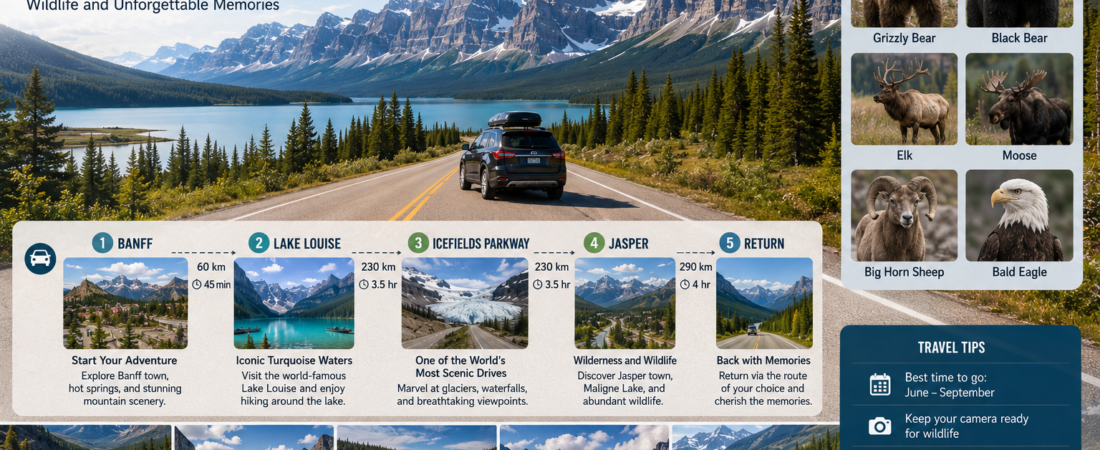
A Canadian Rockies road trip is one of those journeys where the drive itself can become just as memorable as the destination.
Banff, Lake Louise and Jasper are famous for turquoise lakes, enormous mountains, glaciers, wildlife and some of the most dramatic highways in Canada.
But there is one thing that beautiful photographs do not always show:
The Canadian Rockies are big, and getting there takes planning.
This is especially important if you are starting your road trip from Vancouver.
I have found that looking at the route on a map can make the journey seem easier than it actually feels after several hours behind the wheel. Long distances, mountain roads, changing weather, fuel stops and fatigue can turn an exciting road trip into an exhausting one if you try to cover too much in a single day.
For me, breaking up the drive from Vancouver with an overnight stay in Kelowna made the journey much more comfortable. Instead of treating the first day as a marathon drive to Banff, Kelowna became part of the vacation.
If you are flying into Calgary, the situation is very different. Calgary is much closer to Banff and is one of the easiest starting points for a first Canadian Rockies road trip.
This guide covers both options and follows a classic route:
Vancouver or Calgary → Banff → Lake Louise → Icefields Parkway → Jasper
Along the way, we will look at driving distances, accommodation, rental cars, fuel, parking, wildlife, weather and the practical lessons that can make a Canadian Rockies road trip much more enjoyable.
1. How Many Days Do You Need for a Canadian Rockies Road Trip?
One of the biggest mistakes when planning a Canada road trip is trying to fit too much into too little time.
On a map, Banff, Lake Louise and Jasper appear relatively close together.
In reality, you are travelling through mountain terrain where stopping is part of the experience.
You may want to pull over at a viewpoint.
You may encounter construction.
Weather can change.
You may stop for wildlife.
And the Icefields Parkway is not a road I would recommend rushing simply to reach the next hotel.
For a trip focused on Banff, Lake Louise and Jasper, I would consider approximately five to seven days a much more comfortable starting point than trying to squeeze everything into two or three days.
If you are driving from Vancouver and returning to Vancouver, adding more time is even better.
2. Starting from Calgary: The Easier Option
For an international visitor whose main goal is to see the Canadian Rockies, Calgary is often the easiest starting point.
Calgary International Airport has rental-car options, and the drive from Calgary to Banff is approximately 130 kilometres.
Under normal conditions, the drive takes roughly an hour and a half, although weather and traffic can affect travel time.
The route is straightforward:
Calgary → Canmore → Banff
As you leave Calgary and travel west, the landscape gradually changes.
Then the mountains begin to appear.
For a first-time visitor, that transition from prairie and foothills into the Rocky Mountains can be a memorable part of the journey.
Should you stop in Canmore?
Yes, if your schedule allows it.
Canmore is located just outside Banff National Park and has restaurants, accommodation, shops and beautiful mountain scenery.
It can also be worth comparing accommodation prices in Canmore and Banff when planning your trip.
However, always consider the additional driving and parking involved rather than choosing accommodation based only on the nightly rate.
3. Starting from Vancouver: A Very Different Road Trip
Driving from Vancouver creates a much larger adventure.
Vancouver to Banff is roughly 850 kilometres, depending on the route, and can require around nine hours or more of driving before stops, traffic, construction or weather are considered.
That number matters.
Nine hours on Google Maps does not mean nine comfortable hours of vacation.
You need time for:
- Fuel
- Meals
- Washroom breaks
- Stretching
- Traffic
- Road construction
- Mountain conditions
- Unexpected stops
After all of that, the journey can easily consume most of a day.
This is where my own experience changed how I think about the route.
4. My Experience: Why I Prefer Stopping in Kelowna
When travelling from Vancouver toward the Rockies, I found the distance too long to enjoy comfortably as one continuous drive.
It is possible to drive Vancouver to Banff in a day.
But possible and enjoyable are not always the same thing.
Sitting in a vehicle for most of the day can leave you exhausted just as you arrive at one of the most beautiful destinations in Canada.
For me, stopping overnight in Kelowna was a much better experience.
Instead of thinking,
“We have to reach Banff tonight.”
the journey became:
Vancouver → Kelowna → enjoy the evening → rest → continue toward the Rockies the next day.
That small change made a surprisingly large difference.
Kelowna is located in British Columbia’s Okanagan Valley and is a worthwhile destination on its own.
The city sits beside Okanagan Lake and is surrounded by hills, orchards and wineries.
After hours of driving, spending an evening near the lake, having dinner and getting a proper night’s sleep felt much better than continuing to push toward Banff.
The following morning, we could start again feeling rested.
Why I recommend considering this option
An overnight stop can:
- Reduce driver fatigue
- Give everyone time outside the vehicle
- Make the first day feel like part of the vacation
- Give children or family members a break from a long drive
- Allow you to experience the Okanagan
- Make the following day’s drive more manageable
Of course, Kelowna is not the only possible overnight stop.
The best location depends on your route and itinerary.
But the broader lesson from my experience is simple:
Do not plan a Canadian road trip only by asking how far you can drive in one day. Ask how far you actually want to drive while still enjoying the trip.
5. A Sample Vancouver-to-Rockies Itinerary
For travellers with enough time, a relaxed itinerary might look something like this.
Day 1 – Vancouver to Kelowna
Leave Vancouver and drive into British Columbia’s Interior.
Instead of rushing, make the day part of the trip.
After arriving in Kelowna, walk near Okanagan Lake, have dinner and rest.
Day 2 – Kelowna to Banff
Continue east toward the Rocky Mountains.
This is still a substantial driving day, so leave enough time for breaks.
Arrive in the Banff area and settle into your accommodation.
Day 3 – Explore Banff
Spend a full day around Banff rather than immediately driving somewhere else.
Day 4 – Lake Louise and surrounding area
Explore Lake Louise using the transportation arrangements you made in advance.
Depending on the season and reservation availability, consider Moraine Lake as well.
Day 5 – Icefields Parkway
Travel north toward Jasper.
Do not treat this simply as a transfer day.
The highway itself is one of the highlights of the trip.
Day 6 – Jasper
Explore the Jasper area.
Day 7 and beyond
Begin the return journey or continue your Canada road trip depending on your schedule.
If returning all the way to Vancouver, I would again consider breaking up the journey rather than assuming one enormous driving day will be comfortable.
6. Banff: Your First Major Rockies Destination
Banff is an excellent base for exploring the southern Canadian Rockies.
The town itself is compact and surrounded by mountains.
Banff Avenue is filled with restaurants, shops and accommodation, while nearby attractions provide easy access to the surrounding landscape.
Popular places around Banff include:
- Bow Falls
- Lake Minnewanka
- Tunnel Mountain area
- Vermilion Lakes
- Scenic viewpoints
- Hiking trails
- Banff Gondola and Sulphur Mountain area
But one practical issue deserves attention:
parking.
Banff can become extremely busy, particularly during peak summer periods.
Do not assume that driving your car to every attraction is automatically the easiest option.
Parks Canada encourages visitors to consider transit and other transportation options, particularly during busy periods.
If you are staying in town, sometimes leaving your vehicle parked and using public transportation or walking can make the day much less stressful.
7. Lake Louise: Plan Before You Arrive
Lake Louise is approximately 60 kilometres northwest of Banff and is one of Canada’s most recognizable destinations.
The combination of turquoise water, Victoria Glacier and the surrounding mountains is spectacular.
But popularity creates logistical challenges.
Parking and transportation around Lake Louise require advance planning, especially during the busiest months.
Parks Canada operates shuttle services and recommends planning transportation before arrival.
This is not a destination where I would recommend simply waking up in Banff, driving toward Lake Louise and assuming parking will work itself out.
Check the latest Parks Canada information first.
8. Moraine Lake: You Cannot Simply Drive There
This is one of the most important practical details for first-time visitors.
Personal vehicles are not permitted on Moraine Lake Road.
That means you cannot simply rent a car, drive to Moraine Lake and park beside the lake.
Visitors generally need to use Parks Canada shuttle services, public transit or eligible commercial transportation.
This rule is particularly important because older travel blogs and videos may show people driving their own vehicles to Moraine Lake.
Travel information becomes outdated.
Always check the current Parks Canada rules before building your itinerary around Lake Louise or Moraine Lake.
9. Lake Louise to Jasper: The Icefields Parkway
Now comes one of the most memorable sections of the entire road trip.
The Icefields Parkway, Highway 93 North, connects the Lake Louise area with Jasper.
The route is approximately 230 kilometres.
If you drove without stopping, the distance might not sound particularly intimidating.
But that would miss the entire point.
The Icefields Parkway should not be treated like an ordinary highway where the objective is simply to arrive as quickly as possible.
You are travelling through one of Canada’s great mountain landscapes.
Along the route, travellers may encounter spectacular viewpoints, glaciers, lakes, waterfalls and hiking opportunities.
Places often considered along the route include:
- Bow Lake
- Peyto Lake area
- Saskatchewan River Crossing
- Columbia Icefield area
- Athabasca Glacier area
- Sunwapta Falls
- Athabasca Falls
You do not necessarily need to stop at every location.
In fact, trying to do everything can make the day stressful.
Choose several priorities and leave extra time for unexpected stops.
10. Fuel Is More Important Than You Think
This is one of those practical details that can be forgotten while looking at beautiful photographs of the Rockies.
Do not assume there will be a gas station whenever you need one.
Fuel services along remote mountain routes are far more limited than in a major city.
Parks Canada specifically advises motorists travelling the Icefields Parkway to plan ahead because services are limited.
I prefer to think conservatively about fuel on long Canadian drives.
If you have an opportunity to fill the tank before entering a long mountain section, it may be better to do so rather than waiting until the gauge becomes uncomfortable.
The same principle applies to electric vehicles.
Check charging locations, charger availability and your vehicle’s expected range before entering remote stretches.
11. Washrooms and Rest Stops Also Require Planning
In Vancouver, Calgary or another city, finding a washroom, restaurant or convenience store is usually straightforward.
Mountain highways are different.
Services can be widely separated.
Some facilities may also operate seasonally.
Before leaving each morning, I recommend checking:
- Fuel
- Washroom locations
- Food
- Drinking water
- Road conditions
- Weather
- Estimated driving time
If travelling with children, older family members or anyone who needs frequent breaks, this becomes even more important.
A road trip is much more enjoyable when nobody is desperately waiting for the next washroom.
12. Bring Food and Water in the Car
I would not begin a long Rockies driving day without water and some food in the vehicle.
You do not need to pack an enormous amount.
Simple items such as water, fruit, sandwiches, nuts or other snacks can be extremely useful.
Restaurants and cafés are available in the main towns, but you should not assume that remote sections of your route will offer the same convenience.
A small cooler can also be useful on a family road trip.
And, of course, never leave food accessible to wildlife.
13. Weather Can Change Faster Than Expected
One of the lessons of travelling through British Columbia and Alberta is that weather in one place tells you very little about conditions several hours away.
You might leave Vancouver in mild weather and later encounter dramatically different conditions at higher elevations.
Even during warmer months, mountain temperatures can become cool.
Rain can arrive.
Visibility can change.
And outside the main summer season, snow and ice require particular attention.
This is why I recommend packing layers rather than relying on one heavy jacket.
Before a major driving day, check both the weather forecast and official road conditions.
14. Wildlife Is Beautiful, but It Is Not a Roadside Attraction
Seeing wildlife can become one of the most memorable parts of a Canadian Rockies road trip.
Depending on location and season, travellers may encounter animals such as elk, deer, bighorn sheep or bears.
But there is an important rule:
Wild animals are not there for our photographs.
Never approach wildlife to get a better picture.
Do not feed animals.
Do not stop your vehicle in an unsafe location because you saw an animal beside the road.
And do not assume that an animal looks calm because it is safe to approach.
Parks Canada provides specific guidance on maintaining safe distances from wildlife.
Respecting those rules protects both visitors and animals.
15. Jasper: Do Not Treat It as Just the End of the Highway
After the spectacular drive north, Jasper deserves more than an overnight stop before turning around.
The Jasper area provides another side of the Canadian Rockies.
Depending on current access and conditions, travellers can explore lakes, waterfalls, trails and viewpoints around the national park.
Jasper often feels different from Banff.
For me, that difference is part of the reason to include both.
Banff gives you the excitement of one of Canada’s most famous mountain destinations.
Jasper extends the experience deeper into the Rockies.
Important note for current travellers
Jasper was heavily affected by the 2024 wildfire.
Recovery and rebuilding have continued, and access to individual businesses, trails, campgrounds and facilities can change.
For that reason, travellers should check current Jasper National Park and local tourism information rather than relying on an old itinerary.
Supporting open local businesses can also be a meaningful part of visiting the community responsibly.
16. Should You Rent a Car?
For the complete Banff–Lake Louise–Icefields Parkway–Jasper itinerary, having access to a vehicle can provide considerable flexibility.
But rental cars also add responsibilities and costs.
When comparing rental options, look beyond the advertised daily rate.
Consider:
- Insurance
- Fuel
- Additional driver fees
- One-way drop-off charges
- Parking
- Mileage conditions
- Vehicle size
- Winter equipment when applicable
If you are flying into Calgary and returning the car to Calgary, the rental process may be relatively straightforward.
If you plan to pick up a vehicle in Vancouver and return it somewhere else, check one-way rental costs before finalizing your flights and hotels.
A surprisingly expensive drop-off charge can change the economics of the entire itinerary.
17. What Type of Car Do You Need?
Many visitors assume that travelling through the Canadian Rockies automatically requires a large SUV.
That is not necessarily true during normal road conditions.
A regular rental vehicle may be perfectly suitable for major paved routes.
However, season matters.
Winter driving changes the situation significantly.
Tires, road conditions, snow, ice and legal seasonal requirements must all be considered.
Before renting, tell the rental company where you plan to travel and confirm that the vehicle is appropriately equipped for the conditions.
Never choose a vehicle based only on appearance.
Safety and suitability matter more.
18. Accommodation: Banff, Canmore, Lake Louise or Jasper?
Accommodation can become one of the largest expenses on a Canadian Rockies trip.
Banff
Excellent location and atmosphere, but prices can be high during busy periods.
Canmore
Outside Banff National Park and often worth comparing with Banff accommodation.
Lake Louise
Extremely convenient for exploring the surrounding area but accommodation choices are more limited.
Jasper
A natural base for exploring the northern section of the route.
For peak summer travel, booking early is important.
Do not wait until you arrive in the Rockies to begin looking for accommodation unless you are comfortable with limited choices and potentially high prices.
19. What Should You Pack?
My basic Canadian Rockies road-trip checklist would include:
- Comfortable walking shoes
- Layers of clothing
- Waterproof outer layer
- Water
- Snacks
- Sunglasses
- Sunscreen
- Phone charger
- Vehicle charger
- Portable battery
- Offline maps
- Basic first-aid supplies
- Any required medication
- National park information
- Reservation confirmations
If hiking, your equipment should match the trail, weather and season.
A short tourist viewpoint and a backcountry hike require completely different preparation.
20. Download Offline Maps
Mobile reception should never be treated as guaranteed in remote mountain areas.
Before leaving a major town, download the relevant map area to your phone.
Save important addresses.
Screenshot reservation information if necessary.
Know where you are going before losing reception.
Technology is extremely useful, but it works best when you prepare before you need it.
21. Calgary or Vancouver: Which Starting Point Is Better?
This depends on the type of trip you want.
Choose Calgary if:
Your priority is Banff and the Canadian Rockies.
You have limited vacation time.
You want to reduce long-distance driving.
You are flying specifically for a Rockies vacation.
Choose Vancouver if:
You want a larger Western Canada road trip.
You have enough time.
You want to experience British Columbia as part of the journey.
You enjoy long-distance road trips.
You want to combine Vancouver, the Okanagan and the Rockies.
For a first-time visitor with only five or six days, I would generally consider Calgary the more practical gateway.
But with more time, Vancouver → Kelowna → Canadian Rockies becomes a completely different kind of adventure.
22. Why Kelowna Changed the Trip for Me
Looking back, the overnight stop in Kelowna taught me something important about travelling in Canada.
Distance should not always be treated as something to overcome.
Sometimes it should shape the vacation.
If we had simply pushed ourselves to drive as far as possible, Kelowna would have been nothing more than a name on a highway sign.
By stopping there, we were able to enjoy another part of British Columbia.
We could see Okanagan Lake, eat without rushing and start the next morning rested.
Most importantly, the drive no longer felt like an obstacle between Vancouver and Banff.
It became part of the trip.
That is now one of the principles I use when planning long Canadian drives.
23. A Sample Calgary Rockies Itinerary
Travellers starting from Calgary can build a more compact itinerary.
Day 1
Calgary → Canmore → Banff
Day 2
Banff sightseeing
Day 3
Lake Louise and Moraine Lake
Day 4
Lake Louise → Icefields Parkway → Jasper
Day 5
Jasper
Day 6
Additional Jasper sightseeing or begin return journey
Day 7
Return toward Calgary or continue your Canadian road trip
The exact itinerary should always depend on current road conditions, accommodation and seasonal attraction access.
24. A Sample Vancouver Rockies Itinerary
If starting from Vancouver, I would personally allow more time.
Day 1
Vancouver → Kelowna
Day 2
Kelowna → Banff area
Day 3
Banff
Day 4
Lake Louise and Moraine Lake
Day 5
Icefields Parkway → Jasper
Day 6
Jasper
Day 7+
Begin the return journey, add another overnight stop, or continue to another Canadian destination.
If you have only a few days available, flying from Vancouver to Calgary and renting a vehicle there may be much more practical than spending a large portion of the vacation driving.
25. Common Canadian Rockies Road-Trip Mistakes
After travelling long distances in Western Canada, these are the mistakes I would try hardest to avoid.
Trying to drive too far in one day
A road trip should not become an endurance test.
Assuming every attraction has easy parking
Popular destinations may require shuttles, reservations or transit.
Letting the fuel tank become too low
Remote highways do not provide city-level services.
Depending completely on mobile reception
Download maps and important information beforehand.
Approaching wildlife
Observe animals from a safe distance.
Planning an itinerary with no extra time
Construction, weather and unexpected stops happen.
Trusting old travel information
Rules change.
Moraine Lake vehicle access is an excellent example of why current official information matters.
Frequently Asked Questions
How far is Vancouver from Banff by car?
The route is roughly 850 kilometres, depending on the roads used. Driving time can be around nine hours or more before substantial stops, traffic, construction and weather are considered.
Is it better to drive from Vancouver to Banff in one day?
It is possible, but I personally prefer breaking up the journey. Staying overnight in Kelowna made the trip significantly more comfortable for me and allowed the drive itself to become part of the vacation.
How far is Calgary from Banff?
Banff is approximately 130 kilometres west of Calgary, making Calgary one of the most convenient major gateways to the Canadian Rockies.
Can I drive my own car to Moraine Lake?
No. Personal vehicles are not permitted on Moraine Lake Road. Check current Parks Canada information for shuttle and transportation options.
How long is the Icefields Parkway?
The Icefields Parkway between the Lake Louise and Jasper areas is approximately 230 kilometres.
Can I drive from Banff to Jasper in one day?
Yes, but I would avoid treating it as a simple transfer. The Icefields Parkway is one of the main attractions of the trip, so allowing most of the day for the journey makes it much more enjoyable.
Do I need an SUV for Banff and Jasper?
Not necessarily for normal paved-road travel in appropriate conditions. Seasonal weather, winter requirements and the specific roads you plan to use are more important than simply choosing a large vehicle.
Should I start my Canadian Rockies road trip in Calgary or Vancouver?
Calgary is generally more convenient if the Rockies are your primary destination. Vancouver is better suited to travellers who have more time and want a broader Western Canada road-trip experience.
Final Thoughts: Do Not Rush the Canadian Rockies
A Canadian Rockies road trip is not a journey I would recommend measuring only in kilometres.
Yes, you need to know the distance from Calgary to Banff.
You need to understand how long Vancouver to Banff can take.
You need to know where to find fuel, where you are sleeping and how you will reach Lake Louise or Moraine Lake.
But some of the best moments happen between those points.
For me, breaking up the journey from Vancouver with an overnight stay in Kelowna was one of those decisions that made the trip better.
Instead of arriving exhausted after an extremely long day behind the wheel, we allowed ourselves to stop.
We enjoyed another city.
We rested.
Then we continued.
Once you reach the Rockies, the same principle applies.
Do not race through Banff just to reach Lake Louise.
Do not treat the Icefields Parkway as a highway you need to finish.
Do not arrive in Jasper only to turn around the next morning.
Give yourself time to look around.
The Canadian Rockies are not simply a collection of attractions connected by roads.
The road is part of the experience.
And sometimes the best decision you can make on a Canadian road trip is not to drive farther, but to stop, rest and enjoy where you already are.
Road conditions, wildfire impacts, shuttle systems, parking restrictions, seasonal closures and national park services can change. Always check current Parks Canada and provincial road information shortly before travelling.