Moving to Canada as an international student comes with many practical challenges, and opening a Canadian bank account should be one of your first priorities after arrival. A local bank account makes it easier to pay rent, receive money, use a debit card, pay bills, and manage everyday expenses without relying on an overseas credit card.
However, choosing a bank in Canada can be confusing. Major banks offer different student packages, monthly fees, ATM networks, credit cards, and newcomer benefits. The best bank for one student may not necessarily be the best choice for another.
This guide explains how international students can open a bank account in Canada, what documents are usually required, how the major banks compare, and what you should consider before choosing your first Canadian bank.
1. Why International Students Need a Canadian Bank Account
Technically, you may be able to survive for a short period using an international credit or debit card. In reality, having a Canadian bank account makes daily life significantly easier.
International transaction fees can quickly become expensive when you continuously use a foreign card. Currency exchange rates can also make it difficult to know exactly how much you are spending.
A Canadian account gives you easier access to local payment systems.
For example, students commonly use their bank accounts for:
- Paying rent
- Paying phone and internet bills
- Receiving refunds
- Receiving employment income when eligible to work
- Sending and receiving Interac e-Transfers
- Paying credit card bills
- Withdrawing Canadian dollars
- Shopping online
- Building a Canadian financial history
Among these, Interac e-Transfer is especially important.
In Canada, people frequently send money directly between Canadian bank accounts using an email address or phone number. Students may use e-Transfer to split restaurant bills, pay roommates, send rent, or receive money from friends.
Therefore, opening a Canadian bank account is not simply about storing money. It becomes part of your everyday life in Canada.
2. Chequing Account vs. Savings Account
When you visit a Canadian bank, you will probably hear two important terms: chequing account and savings account.
Understanding the difference can prevent unnecessary fees.
Chequing Account
A chequing account is designed for everyday transactions.
You normally use it for debit card purchases, bill payments, ATM withdrawals, e-Transfers, and other regular expenses.
For most international students, this should be the first account to open.
Savings Account
A savings account is primarily designed to hold money that you do not need for everyday spending.
It may offer interest, although rates and conditions vary.
A simple strategy for students is:
Chequing account = everyday spending
Savings account = emergency fund and money you want to keep separate
You do not necessarily need multiple accounts immediately. Starting with one suitable chequing account can make managing your finances much easier.
3. What Documents Do You Need?
Requirements can vary depending on the bank, your immigration status, and the type of account you are opening.
International students should generally be prepared to provide identification and documents showing their legal status in Canada.
Commonly requested documents may include:
- Passport
- Study permit
- Canadian address
- Student identification or proof of enrolment
- Social Insurance Number (SIN) when required for certain interest-bearing accounts or financial products
- Secondary identification, depending on the bank
Do not assume that every bank requires exactly the same documents.
Before visiting a branch, check the bank’s current requirements and bring more identification than you think you will need. This can save you from having to make a second appointment.
4. Comparing Major Banks in Canada
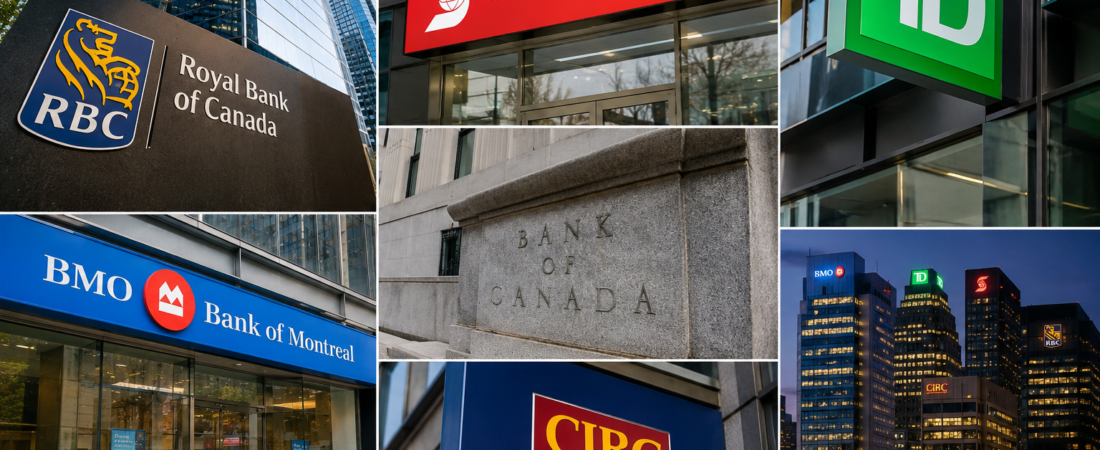
Canada has several large national banks, and international students will frequently encounter RBC, TD, Scotiabank, CIBC, and BMO.
Here is a practical comparison.
| Bank | Main Advantage | Possible Disadvantage | Good For |
|---|---|---|---|
| RBC | Large national network and newcomer services | Package conditions should be checked carefully | Students wanting broad banking access |
| TD | Extensive branch and ATM presence | Fees can apply depending on account type | Students who value physical branches |
| Scotiabank | Strong student and newcomer focus | Promotions and conditions can change | International students comparing student packages |
| CIBC | Student-focused banking options | Benefits depend on eligibility | Students looking for straightforward everyday banking |
| BMO | Large Canadian banking network | Account conditions vary | Students wanting traditional full-service banking |
There is no single bank that is automatically the best for every international student.
A bank offering a promotional bonus may look attractive today, but another bank with a conveniently located branch or ATM may save you more time and money over several years.
5. What Should You Compare Before Choosing a Bank?
Many students choose a bank because of a welcome promotion. That should not be your only consideration.
Compare these factors first.
Monthly Account Fee
Student accounts may offer reduced or waived monthly fees if you meet the eligibility requirements.
Always ask:
“How long is the monthly fee waived?”
A free account today does not necessarily remain free forever.
Transaction Limits
Check whether the account includes unlimited transactions or has monthly limits.
If you frequently use your debit card, e-Transfers, or bill payments, transaction limits can become important.
ATM Access
Using your own bank’s ATM is usually more convenient and can help you avoid additional charges.
Suppose Bank A offers a slightly better promotion, but its nearest ATM is 20 minutes away. Bank B has an ATM beside your school and another near your home.
For everyday student life, Bank B may actually be the better choice.
Interac e-Transfer
Check whether Interac e-Transfers are included and whether there are transaction or account restrictions.
Because e-Transfer is widely used in Canada, this feature can be more important than students initially expect.
Credit Card Options
Some banks offer credit cards designed for students or newcomers who have limited Canadian credit history.
This can be valuable because establishing credit history early may help you later when applying for other financial products.
However, a credit card should be treated as a payment tool, not additional income.
6. How to Open Your Account Step by Step
The exact process differs by bank, but opening an account is usually straightforward.
Step 1: Compare Banks
Look at at least three banks before deciding.
Do not compare only promotional gifts. Compare fees, ATM locations, student eligibility, e-Transfers, credit card options, and long-term account costs.
Step 2: Prepare Your Documents
Bring your passport, immigration documents, proof of student status, and other identification requested by the bank.
Step 3: Visit a Branch or Apply Online
Some accounts can be started online, while others may require identity verification at a branch.
For a new international student, visiting a branch can sometimes be easier because you can ask questions directly.
Step 4: Ask About Student and Newcomer Programs
Do not simply say:
“I want to open a bank account.”
Instead, ask:
“Do you have a student or newcomer banking package that I qualify for?”
This simple question may help you discover lower fees or additional benefits.
Step 5: Confirm All Fees
Before signing anything, ask about:
- Monthly fees
- ATM fees
- Transaction limits
- e-Transfer fees
- International transfer fees
- Overdraft fees
- Credit card annual fees
Understanding these costs before opening the account is much easier than discovering them on your statement later.
Step 6: Set Up Online and Mobile Banking
Once your account is active, install the bank’s official mobile application and activate online banking.
You can then monitor transactions, pay bills, transfer money, and check your balance without visiting a branch.
7. Student Account vs. Regular Account
A student account is usually the better starting point for eligible international students.
Student Account Advantages
Student accounts may provide:
- Lower or waived monthly fees
- Student-specific banking packages
- Debit card access
- Online banking
- Mobile banking
- Access to credit products depending on eligibility
Student Account Disadvantages
The main disadvantage is that student benefits may not last forever.
When you graduate or stop meeting eligibility requirements, your account may be converted to another banking package with different fees.
This is why students should review their account every year rather than opening one and forgetting about it.
8. Traditional Banks vs. Online Banks
International students may also encounter online banks that advertise low or no monthly fees.
They can be useful, but there is an important trade-off.
Traditional Bank
Advantages
- Physical branches
- Face-to-face assistance
- Large ATM networks
- Easier access to multiple banking products
- Helpful for students unfamiliar with Canadian banking
Disadvantages
- Some accounts have monthly fees
- Fee structures can be complicated
Online Bank
Advantages
- Often lower fees
- Convenient digital banking
- Simple everyday banking
Disadvantages
- Limited or no physical branches
- Cash deposits can be less convenient
- Newcomers may prefer in-person assistance
For a student who has just arrived in Canada and is unfamiliar with the banking system, a traditional bank can provide more support.
After becoming comfortable with Canadian banking, you can always compare digital alternatives.
9. Should You Get a Canadian Credit Card?
For many international students, the answer is yes, provided it is used responsibly.
A debit card uses money already available in your bank account.
A credit card allows you to borrow money up to an approved limit and repay it later.
Using a credit card responsibly can help establish Canadian credit history.
A simple approach is to use the card for small regular expenses such as a phone bill or groceries and then pay the statement balance in full by the due date.
For example:
Monthly credit card spending: $200
Statement balance: $200
Payment before due date: $200
Remaining statement balance: $0
This is very different from treating a $1,000 credit limit as $1,000 of extra spending money.
Credit is borrowed money.
10. Common Banking Mistakes International Students Make
Opening the account is easy. Managing it correctly requires more attention.
Mistake 1: Choosing a Bank Only for a Welcome Bonus
A temporary promotion should not determine a banking relationship that may last several years.
Mistake 2: Ignoring Monthly Fees
A $15 monthly fee may not sound significant.
However:
$15 × 12 months = $180 per year
Over four years, that could become $720.
Small monthly fees become meaningful over time.
Mistake 3: Using Out-of-Network ATMs Frequently
ATM fees can accumulate. Whenever possible, use your own bank’s ATM network.
Mistake 4: Carrying a Credit Card Balance
Paying only the minimum payment can result in interest charges and make debt harder to manage.
Mistake 5: Not Checking Bank Statements
Review your transactions regularly.
This allows you to identify unexpected fees, subscriptions, duplicate charges, or suspicious activity quickly.
11. A Practical Comparison: Convenience vs. Promotion
Imagine two international students.
Student A chooses a bank because it offers the most attractive welcome promotion.
Student B chooses a bank because it has an appropriate student account, an ATM near school, a branch near home, convenient e-Transfers, and a suitable credit card option.
After the first few months, Student A’s promotional benefit is already finished.
Student B continues benefiting from convenient banking every week.
This illustrates an important principle:
Short-term promotions are temporary. Convenience and low fees provide long-term value.
When comparing banks, think about the next two to four years rather than only your first month in Canada.
12. Which Bank Is Best for an International Student?
Instead of looking for one universal winner, choose based on your priorities.
If you frequently need face-to-face assistance, prioritize a bank with convenient branches.
If avoiding monthly fees is your priority, compare student and newcomer packages carefully.
If you expect to use ATMs frequently, check the ATM network around your school and home.
If building credit history is important, compare beginner credit card options.
For most new international students, the ideal first bank is usually the one that combines:
low fees + convenient locations + easy digital banking + student benefits + suitable credit options.
Final Verdict
Opening a bank account is one of the first financial steps international students should take after arriving in Canada.
The biggest mistake is assuming that all Canadian banks are essentially the same. Account fees, student benefits, ATM access, transaction limits, and credit card options can differ significantly.
Before opening an account, compare RBC, TD, Scotiabank, CIBC, BMO, and any other options available in your area.
Most importantly, think beyond the welcome bonus.
A bank account that costs less, provides convenient access, and supports your financial needs throughout your studies can be much more valuable than a short-term promotion.
Starting with the right account also makes the next stage of Canadian life easier: learning how to budget, build credit, pay bills, and manage living expenses responsibly.
Frequently Asked Questions
Can an international student open a bank account in Canada?
Yes. International students can generally open Canadian bank accounts as long as they meet the bank’s identification and eligibility requirements.
Do I need a SIN to open a bank account?
A SIN may be requested or required for certain financial products, particularly accounts that pay interest for tax-reporting purposes. Requirements depend on the account and institution, so confirm with the bank before applying.
Which Canadian bank is best for international students?
There is no single best bank for everyone. Compare monthly fees, student eligibility, ATM locations, e-Transfers, digital banking, branch accessibility, and credit card options.
Should international students open a savings account?
It can be useful for emergency funds or money that you do not want mixed with everyday spending. However, a chequing account is generally more important for daily transactions.
Should I get a credit card as an international student?
A Canadian credit card can help establish credit history when used responsibly. Keep spending manageable and pay the statement balance in full by the due date whenever possible.
Is a student bank account always free?
Not necessarily. Banks have different eligibility rules, promotional periods, and account conditions. Always check the current terms before opening an account.
Can I change banks later?
Yes. Opening your first Canadian bank account does not mean you must stay with the same institution permanently. As your financial needs change, you can compare other accounts and switch when another option offers better long-term value.
Conclusion
Banking may seem like a small part of studying abroad, but it affects almost every aspect of daily life in Canada.
The goal is not simply to find a famous bank. The goal is to find an account that matches your student lifestyle.
Compare the costs, understand the conditions, ask questions before signing, and use credit carefully.
Making a thoughtful banking decision at the beginning of your study-abroad journey can save money, reduce stress, and help you build a stronger financial foundation in Canada.