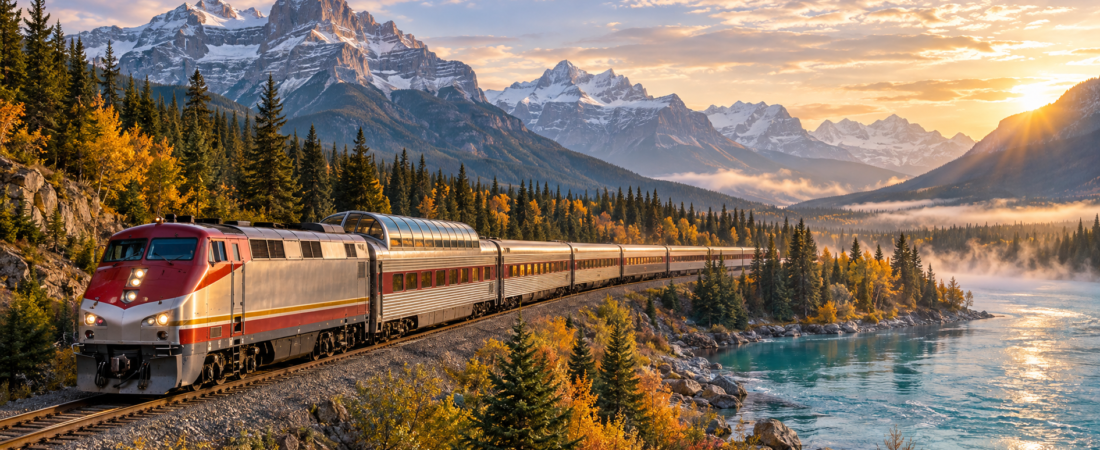
Flying from Vancouver to Toronto takes only a few hours. Travelling between the same cities aboard VIA Rail’s The Canadian takes approximately four days and four nights.
At first, the difference may sound inconvenient. Why spend nearly 100 hours on a train when an airplane can cross the country before lunchtime?
The answer becomes clearer as Vancouver slowly disappears behind the train.
A flight carries you over Canada, but the train takes you through it. Snow-covered mountains rise beyond the windows, prairie fields stretch toward an almost invisible horizon, and the lakes and forests of Northern Ontario seem to continue forever.
Instead of skipping the distance between two cities, you experience the enormous scale of Canada one kilometre at a time.
This is not simply transportation from Vancouver to Toronto. It is a slow journey through changing landscapes, time zones and communities—and an opportunity to create memories that would never exist on a short flight.
Vancouver-to-Toronto Train at a Glance
| Item | Details |
|---|---|
| Train | VIA Rail’s The Canadian |
| Departure station | Pacific Central Station, Vancouver |
| Arrival station | Union Station, Toronto |
| Distance | Approximately 4,466 kilometres |
| Scheduled travel time | Approximately 92–97 hours |
| Nights aboard | Four nights |
| Provinces crossed | British Columbia, Alberta, Saskatchewan, Manitoba and Ontario |
| Travel classes | Economy, Sleeper Plus and Prestige |
| Typical frequency | Usually two departures per week in each direction |
| Wi-Fi | Not normally available |
| Best-known feature | Dome cars with elevated panoramic windows |
Travellers should review the official VIA Rail page for The Canadian before booking because schedules, services and train configurations can change.
How Long Does the Vancouver-to-Toronto Train Take?
The eastbound journey from Vancouver to Toronto is scheduled to take approximately 92 to 97 hours. Passengers normally spend four nights aboard the train and arrive in Toronto on the fifth day.
The train crosses five provinces and several time zones along its 4,466-kilometre route.
However, the published schedule should not be treated like an airline schedule. The Canadian travels mainly on railway tracks that are also heavily used by freight trains. Passenger trains may sometimes wait while long freight trains pass.
Weather, track conditions and operational issues can also affect the arrival time. Delays of several hours are possible on a long transcontinental journey.
Passengers can check current departure information on VIA Rail’s official train schedules page.
It is best not to reserve an important flight, cruise or non-refundable tour immediately after the scheduled arrival in Toronto. Spending at least one night in Toronto creates a safer and more relaxing travel plan.
How Much Does the Vancouver-to-Toronto Train Cost?
VIA Rail uses variable pricing. The final fare depends on the season, availability, accommodation, promotions and how early the ticket is purchased.
The following amounts are broad one-way estimates in Canadian dollars. They are provided for preliminary budgeting and are not guaranteed fares.
| Class | Approximate one-way cost | Main inclusions |
|---|---|---|
| Economy | From approximately CAD $500–$800 | Reclining seat; food purchased separately |
| Sleeper Plus berth | Often CAD $1,400–$2,500 or more | Bed, meals and sleeper lounge access |
| Sleeper Plus cabin | Often CAD $2,500–$5,000 or more per person | Private cabin, meals and shared shower access |
| Prestige | Often CAD $5,000–$10,000 or more per person | Larger cabin, private shower, premium meals and enhanced service |
Summer, Christmas and popular fall departures usually cost more. Winter tickets may be less expensive, particularly outside the holiday period.
The price of a private cabin also depends on whether one or two people occupy it. Travellers should enter their exact date and number of passengers through the official VIA Rail reservation system before making a final comparison.
Ways to Find a Lower Fare
Travellers with flexible schedules may be able to reduce the cost by:
- Booking several months in advance
- Comparing more than one departure date
- Travelling during late fall, winter or early spring
- Checking VIA Rail promotions
- Comparing an open berth with a private cabin
- Joining the VIA Préférence loyalty program
- Avoiding Christmas and peak summer dates
Economy is the least expensive choice, but spending four nights in a seat can be physically demanding. A Sleeper Plus berth often offers a more practical balance between price and comfort.
Which Stations Does the Train Pass?
The route includes large cities, small communities and request stops. The stopping pattern may vary, but the principal route from west to east includes the following locations:
| Province | Important stations and communities |
|---|---|
| British Columbia | Vancouver, Kamloops North, Clearwater, Blue River and Valemount |
| Alberta | Jasper, Hinton, Edson and Edmonton |
| Saskatchewan | Wainwright, Unity, Biggar, Saskatoon, Watrous and Melville |
| Manitoba | Rivers, Portage la Prairie and Winnipeg |
| Ontario | Sioux Lookout, Savant Lake, Armstrong, Hornepayne, Foleyet, Capreol, Sudbury Junction, Parry Sound, Washago and Toronto |
Jasper and Winnipeg are generally among the longer service stops. When the train is operating on schedule, passengers may be permitted to step onto the platform for fresh air and a short walk.
These are operational stops, not organized sightseeing visits. Passengers should stay near the train, listen carefully to crew announcements and return before the stated boarding time.
If the train is behind schedule, a long stop may become much shorter.
Travellers who want to explore Jasper National Park should book the journey in two sections. They can travel from Vancouver to Jasper, stay for several nights and then continue from Jasper to Toronto on a later train.
Beginning the Journey in Vancouver
The journey starts at Pacific Central Station near Vancouver’s False Creek area.
There is a distinctive feeling when the train finally begins to move. The platform slides away, Vancouver’s buildings slowly disappear and the ordinary rhythm of the city gives way to railway crossings, rivers and darkening hills.
An airplane departure is immediate and dramatic. A train departure feels more gradual. Familiar streets remain visible for a while, almost as though the city is reluctant to let its passengers go.
The first evening is usually spent learning the layout of the train: locating the dining car, walking carefully between swaying carriages and discovering the panoramic dome car.
By bedtime, passengers realize that the train is not merely a vehicle. For the next four nights, it will be a moving hotel, restaurant, observation deck and temporary neighbourhood.
British Columbia and the Canadian Rockies
British Columbia offers some of the journey’s most dramatic scenery.
The route follows rivers and passes forests, steep slopes and small communities before approaching the Rocky Mountains. Depending on the season, passengers may see snow on distant peaks, mist above the rivers or sunlight moving across the mountains.
The dome car becomes especially popular as the train approaches Jasper. Its elevated windows allow passengers to look forward, sideways and upward.
Travellers who were strangers in Vancouver begin pointing out waterfalls, mountain peaks and possible wildlife sightings to one another. Someone may see an elk, deer, bear or eagle and quietly alert the rest of the car.
No photograph completely captures the sensation. A mountain appears in the distance, grows larger for several minutes and then disappears behind another ridge.
The landscape does not wait while passengers adjust their cameras. Sometimes the best decision is to put the phone down and simply watch.
Alberta, Saskatchewan and Manitoba
East of the Rockies, the landscape opens.
The Canadian Prairies are sometimes described as empty, but from the train they rarely feel empty. Their appearance changes constantly with the light. Grain elevators mark distant communities, farm roads run toward the horizon and the enormous sky makes the train appear very small.
Sunrise and sunset become important parts of the day. There is something memorable about eating dinner while the sky changes from gold to orange and then purple outside the dining-car windows.
The Prairies also change the social atmosphere aboard the train. By this stage, passengers begin to recognize one another. Someone may save a seat in the lounge, bring out a deck of cards or ask about the photographs another passenger has taken.
Conversations that begin with “Where are you travelling from?” can gradually develop into stories about family, immigration, retirement or a journey postponed for many years.
Winnipeg is an important operational stop near the middle of the route. If time permits, stepping onto the platform feels surprisingly refreshing. After many hours of continuous movement, standing on motionless ground can feel strange.
Northern Ontario: Forests, Lakes and Quiet Mornings
Northern Ontario is less dramatic than the Rockies, but its scale is equally impressive.
Forests and lakes appear one after another, often without a visible road or building nearby. Summer brings deep green forests and blue water. Autumn turns parts of the landscape red, orange and yellow. Winter covers the trees and frozen lakes in snow.
This section of the journey often creates a quieter mood.
Passengers read, write, talk softly or sit beside a window with coffee. At home, doing nothing can feel unproductive. On the train, watching a lake pass outside the window feels like a complete activity.
Eventually, cottages, roads and increasingly populated communities begin to appear. The landscape signals that Toronto is getting closer.
Passengers start organizing their bags, exchanging contact information and taking their final photographs. The excitement of arriving is mixed with a small sense of loss. The temporary community created aboard the train is about to disappear.
Economy, Sleeper Plus or Prestige?
Economy Class
Economy Class is the most affordable option. Passengers receive a reclining seat, while meals, snacks and beverages are purchased separately.
Economy may suit:
- Travellers on a limited budget
- Passengers comfortable sleeping in a seat
- Younger travellers accustomed to long journeys
- People travelling only part of the route
The main disadvantage is comfort. Four consecutive nights in a reclining seat can be challenging, particularly for older passengers or anyone with back, neck or mobility problems.
Privacy is also limited. An eye mask, earplugs, blanket and supportive neck pillow can make the experience easier.
Sleeper Plus Class
Sleeper Plus includes open berths and private cabins. Meals in the dining car are included, and passengers have access to sleeper lounges and shared showers.
An open berth is converted into a bed at night and separated from the aisle by a curtain. It is less private than a cabin but usually more affordable.
A cabin for two normally contains seats during the day that are converted into upper and lower beds at night. The cabin includes a small private toilet and sink, while the shower is shared with other Sleeper Plus passengers.
Sleeper Plus is often the best choice for couples who want the classic overnight-train experience without paying for Prestige Class.
Prestige Class
Prestige Class provides a larger private cabin with a double bed, private bathroom and shower, a larger window and enhanced service.
Meals and beverages are included, and Prestige passengers receive a more luxurious and private experience.
The price can be similar to that of an international luxury vacation. Prestige therefore makes the most sense for a honeymoon, anniversary or once-in-a-lifetime celebration when the train itself is the main destination.
What Are the Meals Like?
Food becomes one of the main ways passengers measure time during a four-night train journey.
Sleeper Plus and Prestige fares include meals served in the dining car. VIA Rail states that Sleeper Plus passengers receive three-course meals with a choice of main dishes. Options generally include meat, fish and vegetarian selections.
Breakfast may feature eggs, toast, potatoes, fruit and hot drinks. Lunch and dinner selections change and may include chicken, beef, fish or vegetarian dishes, followed by dessert.
Current meal inclusions and dietary information are available on VIA Rail’s official food and drinks page.
Dining tables may be shared with other passengers during busy periods. The first shared meal can feel slightly awkward. By the second or third day, however, communal dining often becomes one of the most enjoyable parts of the trip.
A lunch companion may be a retired teacher from Alberta. Dinner may be shared with a visitor seeing Canada for the first time. The food is part of the experience, but the stories exchanged across the table are often what passengers remember.
Economy travellers can purchase light meals, snacks and beverages. Selected hot meals may also be available for advance purchase. Travellers with allergies or special dietary needs should contact VIA Rail before departure.
Celebrations and Onboard Activities
The Canadian is not a cruise ship, so passengers should not expect a large daily entertainment program.
Activities vary according to the departure, season and crew. Possible experiences may include:
- Informal information about the route and scenery
- Card games and board games in the lounge
- Conversations and social gatherings among passengers
- Wildlife watching from the dome car
- Photography and travel journaling
- Occasional presentations or seasonal activities
VIA Rail’s former Artists on Board program has been cancelled indefinitely. Travellers should therefore not book the journey expecting scheduled musicians or live performances.
VIA Rail currently offers an optional Celebration Package for Sleeper Plus and Prestige cabin passengers. It is intended for occasions such as honeymoons, anniversaries, birthdays or family trips.
Depending on the selected package, it can include sparkling wine or champagne, chocolates and a personalized card signed by the onboard crew. It must be purchased in advance, and availability or pricing may change.
Some of the most memorable activities are not scheduled. They happen naturally when passengers play cards, share photographs, watch the sunset or talk with people they would never have met elsewhere.
Life Without Wi-Fi
Wi-Fi is not normally available aboard The Canadian. Mobile service can also disappear for long periods, particularly in the mountains and remote parts of Northern Ontario.
Movies, podcasts, music, electronic books and important documents should be downloaded before leaving Vancouver.
The lack of internet may initially feel inconvenient. After a day or two, it can become one of the journey’s greatest benefits.
Without constant notifications, time seems to slow down. Passengers begin paying attention to the landscape, meals and conversations instead of looking at a screen every few minutes.
Small Moments That Become Lasting Memories
The famous images from this route usually feature mountain peaks and dome cars. Yet the strongest memories may come from quieter moments.
It could be the rhythm of the wheels during the first night. It might be drinking coffee before sunrise while most passengers are still asleep. It may be watching a child press both hands against the dome-car window when the mountains first appear.
There is also an unusual closeness in travelling with strangers for several days. People see one another when they are excited, tired, hungry and amazed.
Small acts of kindness become part of the journey: holding a door between carriages, watching someone’s seat, sharing snacks or quietly calling other passengers when wildlife appears.
By the final morning, the train contains a collection of temporary friendships. Names may eventually be forgotten, but fragments of conversation remain connected to certain landscapes.
That is the romance of The Canadian. It is not simply luxury or nostalgia. It is the rare experience of having enough time to notice where you are.
Advantages of Travelling Across Canada by Train
You See Canada at Ground Level
The route reveals mountains, rivers, farms, forests, lakes and remote communities that cannot be appreciated from an airplane.
The Journey Becomes Part of the Vacation
Travel time does not feel completely wasted. Sleeping, eating and observing the changing scenery become central parts of the experience.
Sleeper Passengers Can Move Around
Passengers can walk between their cabin, dining car, lounge and dome car instead of remaining in one seat for the entire trip.
The Train Encourages Rest
Limited internet access creates an opportunity to disconnect from work, social media and daily responsibilities.
Shared Spaces Create Connections
Dining tables and observation areas make conversation easier than on most airplanes or buses.
Every Season Looks Different
Summer provides long daylight hours, autumn brings colourful forests, and winter creates a peaceful landscape of snow and frozen lakes.
Disadvantages to Consider
The Journey Requires Four Nights
This route is unsuitable for travellers with limited vacation time or anyone who needs to reach Toronto quickly.
Delays Are Possible
Freight traffic, weather and operational conditions can affect arrival times.
Sleeper Cabins Are Compact
Private cabins have limited floor space and storage. Travellers should not expect the dimensions of a hotel room.
Economy Can Be Physically Demanding
Sleeping in a reclining seat for four nights may be uncomfortable for many passengers.
Sleeper Tickets Can Be Expensive
Sleeper Plus and Prestige may cost much more than a flight, especially during peak travel periods.
Internet Access Is Limited
The journey can be difficult for passengers who must work online.
Long Station Stops Are Not Guaranteed
A scheduled service stop may be shortened when the train is delayed. Independent sightseeing during a stop is not recommended.
What Should You Pack?
Essential belongings should be placed in a carry-on because checked luggage may not be accessible during the journey.
Useful items include:
- Comfortable layered clothing
- Slip-on shoes
- A light sweater
- Personal toiletries
- Prescription medication
- Earplugs and an eye mask
- A reusable water bottle
- Charging cables and a power bank
- Downloaded entertainment
- A book or travel journal
- A deck of cards
- Snacks
- A compact camera or binoculars
- Shower sandals for Sleeper Plus passengers
Baggage limits depend on the selected route and ticket. Passengers should confirm their allowance on VIA Rail’s official baggage page.
Is the Vancouver-to-Toronto Train Worth It?
The answer depends on what the traveller expects.
If the goal is to reach Toronto quickly and inexpensively, flying is usually the better choice. The train takes much longer, and a sleeper ticket can be expensive.
However, if crossing Canada is part of the dream, The Canadian provides an experience that an airplane cannot reproduce.
The route allows travellers to watch the country change outside the window and understand how much land, nature and human history exist between Vancouver and Toronto.
It is particularly suitable for couples, retirees, international visitors, railway enthusiasts and families with enough time to travel slowly.
It may be less suitable for people who require reliable high-speed internet, dislike compact spaces or have an inflexible arrival deadline.
Frequently Asked Questions
How many days does the train take from Vancouver to Toronto?
The scheduled journey takes approximately 92 to 97 hours. Passengers normally spend four nights aboard and arrive in Toronto on the fifth day.
What is the train called?
The Vancouver-to-Toronto train is called The Canadian. It is operated by VIA Rail Canada.
How much is a train ticket from Vancouver to Toronto?
Economy fares may begin at approximately CAD $500–$800 one way. Sleeper Plus and Prestige fares can range from roughly CAD $1,400 to more than CAD $10,000 per person, depending on the season, cabin and availability.
These amounts are estimates. Travellers should check the official booking price for their chosen date.
Are meals included?
Meals are included for Sleeper Plus and Prestige passengers. Economy passengers purchase food separately.
Does The Canadian stop in Banff?
No. The train travels through Jasper rather than Banff. Travellers wishing to visit Banff can leave the train in Jasper and arrange ground transportation through the Rockies.
Can passengers explore Jasper during the stop?
Passengers may sometimes step onto the platform during a longer service stop. However, it is not a sightseeing stop, and its duration may be shortened if the train is late.
Is there Wi-Fi aboard The Canadian?
Wi-Fi is not normally available. Cellular service may also be unreliable in remote areas.
Are there showers aboard the train?
Sleeper Plus passengers have access to a shared shower. Prestige cabins include a private shower. Economy passengers do not normally have shower access.
Can passengers sleep comfortably in Economy?
Economy seats recline but do not become beds. Some travellers manage with a neck pillow, blanket, eye mask and earplugs, while others find four nights in a seat too difficult.
Which side of the train has the best view?
There is no permanently superior side because scenery appears on both sides and train orientation may vary. The dome car provides the widest view.
What is the best season for this journey?
Summer offers longer daylight hours. Autumn provides colourful forests. Winter often has lower fares and snowy scenery, while spring can be quieter and less crowded.
Should I book a flight on the same day the train arrives?
It is safer not to. Long-distance trains can be delayed, so spending at least one night in Toronto before an important flight or cruise is recommended.
Final Thoughts
A Vancouver-to-Toronto train journey asks travellers to accept something modern transportation usually tries to eliminate: time.
Four nights is a long time to sit beside the same windows, hear the wheels moving over the rails and watch the horizon slowly change. Yet this is exactly what makes the experience memorable.
By the time the train reaches Toronto, the distance between the Pacific Coast and Central Canada no longer feels like an abstract line on a map.
It has become a sequence of mountains, rivers, prairie sunsets, shared meals, quiet mornings and unfamiliar faces.
Flying gives travellers more time at their destination. The Canadian reminds us that sometimes the time spent getting there becomes the story we remember most.