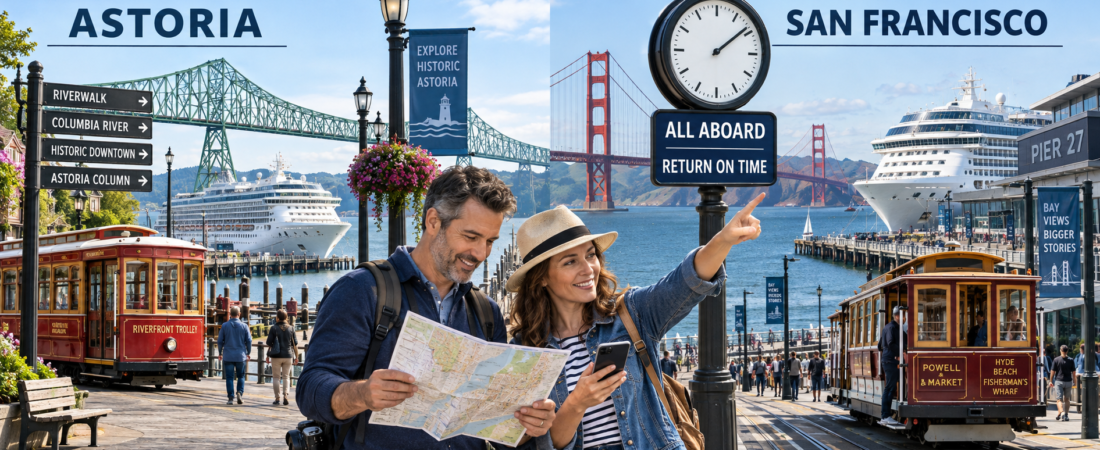
A Vancouver-to-San Diego cruise includes plenty of time at sea, but its two principal port calls offer very different experiences.
Astoria is a small Oregon city with maritime history, a scenic riverfront and an easygoing atmosphere. San Francisco is a major international destination where passengers must choose carefully among dozens of famous attractions.
The challenge is not finding something to do. It is creating a realistic plan that fits within the ship’s limited time in port.
This guide explains where cruise passengers arrive, which attractions are practical and how to avoid one of the most serious cruise mistakes: returning after the all-aboard deadline.
Port times, docking locations, transportation and attraction hours can change. Use the schedule in the cruise-line app or daily program as the final authority during your sailing.
The Two Main Stops on the Pacific Coast Route
Royal Caribbean currently lists a seven-night Pacific Coastal itinerary aboard Serenade of the Seas with the following route:
Vancouver → Astoria → San Francisco → San Diego
The cruise includes sea days between the ports, making Astoria and San Francisco the two main opportunities for sightseeing before arriving in Southern California.
View the official Vancouver-to-San Diego itinerary
The first two articles in this series cover the complete route and booking process:
- Part 1: Vancouver to San Diego Cruise Guide: Route, Ports and What to Expect
- Part 2: How to Book a Vancouver to San Diego Cruise: Tickets, Cabins and Total Cost
Before Leaving the Ship
Passengers should check several details before going ashore:
- The local arrival time
- The all-aboard time
- Whether the ship’s time matches local time
- The name and address of the terminal
- Whether identification is required to re-enter the port
- The weather forecast
- Transportation availability
- Attraction reservations
- Emergency contact information for the ship’s port agent
The ship’s departure time and the all-aboard time are not the same.
If the ship is scheduled to depart at 5:00 p.m., passengers may need to be back aboard by 4:30 p.m. or earlier. The exact deadline will be announced onboard.
Take a photograph of the port information before leaving the ship. It should show the terminal location, all-aboard time and emergency telephone number.
Astoria, Oregon: A Small Port with Maritime Character
Astoria is located near the mouth of the Columbia River, where the river meets the Pacific Ocean.
The city has a long connection to fishing, shipping, exploration and maritime trade. It feels very different from the larger urban destinations found on many cruises.
Rather than rushing between major attractions, passengers can enjoy a slower day focused on:
- The Columbia River
- Local history
- Riverfront walking
- Small shops
- Seafood
- Historic architecture
- Views of the Astoria–Megler Bridge
Astoria is a good port for independent exploration, although attractions outside the central area may require a shuttle, taxi or organized excursion.
Where Do Cruise Ships Dock in Astoria?
Cruise ships generally use the Port of Astoria area along the Columbia River waterfront. The exact berth and passenger arrangements can vary.
Passengers may find local volunteers and visitor information near the ship. Maps, transportation information and recommendations may be available after disembarkation.
The Port of Astoria lists pier-side activities and transportation information for cruise visitors. Its current information includes a historic riverfront trolley and shopping-area transportation, although availability and prices can change.
Check current Port of Astoria pier-side information
Do not assume that every attraction begins directly beside the gangway. Check the distance before starting a walking route.
Option 1: Explore the Astoria Riverwalk
The Astoria Riverwalk is one of the easiest attractions to include during a cruise stop.
The paved route follows the Columbia River waterfront and connects several points of interest. Depending on how far passengers walk, they may see:
- Working docks
- Fishing boats
- Large commercial ships
- Riverfront restaurants
- Maritime Memorial Park
- Astoria–Megler Bridge views
- Sea lions
- Historic buildings
- Sections of old railway track
Astoria’s official tourism organization recommends the Riverwalk as one of the best ways to experience the area.
Explore the official Astoria Riverwalk guide
The entire trail is longer than most cruise passengers need to cover. A short section near the port can still provide river views and a sense of the city.
Wear comfortable shoes and carry a light waterproof jacket. Oregon’s coastal weather can change quickly, especially during the spring and autumn cruise seasons.
Option 2: Ride the Historic Astoria Riverfront Trolley
The historic trolley, often known as “Old 300,” travels along a section of the Astoria waterfront.
It can be both transportation and a local sightseeing experience. The route offers river views while reducing the amount of walking required.
The published local information describes the trolley as weather-dependent and generally seasonal. Passengers should not build their entire day around it until confirming that it is operating.
According to current visitor information, the trolley fare has been inexpensive, with single-ride and all-day options. Fares and operations may change by the time of the cruise.
Check the current Astoria Riverfront Trolley information
Carry a small amount of U.S. cash in case electronic payment is unavailable.
Option 3: Visit the Columbia River Maritime Museum
The Columbia River Maritime Museum is one of Astoria’s strongest attractions for cruise passengers.
Its exhibits focus on the Columbia River, navigation, fishing, shipwrecks, Coast Guard operations and the dangerous waters near the mouth of the river.
This region is sometimes associated with the “Graveyard of the Pacific” because of its difficult bar conditions and long maritime history.
The museum is a good choice for:
- Maritime enthusiasts
- Families
- Visitors interested in local history
- Rainy or windy days
- Passengers who prefer an indoor attraction
Check opening hours and admission prices before leaving the ship. Allow enough time to travel back to the terminal.
Option 4: See the Astoria Column
The Astoria Column stands on Coxcomb Hill and provides wide views over the city, river, bridge and surrounding landscape.
The column is not directly beside the cruise terminal, and the route includes a significant uphill climb. A taxi, shuttle or organized tour is usually more practical than walking from the port.
Passengers who climb the interior staircase should consider:
- Mobility
- Weather
- Available time
- The physical effort required
- The time needed to return to the ship
Even without climbing to the top, the hilltop setting can provide impressive views when the sky is clear.
Option 5: Explore Downtown Astoria
Downtown Astoria contains independent shops, cafés, restaurants and historic buildings.
A relaxed visit may include:
- Coffee at a local café
- Oregon seafood
- Small bookstores
- Antique shops
- Local art
- Historic architecture
- River views
- Craft beer, if time allows
Oregon has no general state sales tax, which can make shopping attractive to visitors. However, Canadian residents should still understand the customs rules that apply when bringing purchases back into Canada.
Keep receipts for purchases made during the trip.
Option 6: Book an Excursion Outside Astoria
Several attractions outside central Astoria may require organized transportation.
Possible regional excursions can include:
- Fort Clatsop
- Lewis and Clark National Historical Park
- Fort Stevens State Park
- The Peter Iredale shipwreck
- Oregon Coast viewpoints
- Seaside
- Cannon Beach
These locations may be rewarding, but they require more planning than a Riverwalk or downtown visit.
An organized cruise-line excursion can offer a significant scheduling advantage. If a cruise-line-operated tour is delayed, the ship is normally aware of the group’s situation. Independent passengers are responsible for returning on time.
This does not mean that every passenger must buy a cruise-line tour. It means that the risk increases with distance from the port.
A Practical Astoria Walking Plan
Passengers with a moderate-length port call can use a simple route:
Step 1: Leave the ship and collect a local map
Confirm the all-aboard time before walking away from the port.
Step 2: Walk along the riverfront
Enjoy views of the Columbia River, ships and Astoria–Megler Bridge.
Step 3: Visit the Columbia River Maritime Museum
Spend approximately one to two hours, depending on interest and operating hours.
Step 4: Walk into downtown Astoria
Stop for lunch, coffee or shopping.
Step 5: Return by trolley, shuttle or on foot
Begin returning well before the final deadline.
This plan avoids long-distance transportation and provides flexibility if the weather changes.
Sample Astoria Schedule
The following is only an example. Adjust it to the ship’s actual port times.
| Time | Activity |
|---|---|
| 9:00 a.m. | Leave the ship and confirm terminal information |
| 9:15 a.m. | Walk along the Astoria Riverwalk |
| 10:15 a.m. | Visit the Columbia River Maritime Museum |
| 12:00 p.m. | Lunch in the waterfront or downtown area |
| 1:15 p.m. | Explore shops and historic streets |
| 2:30 p.m. | Begin returning toward the terminal |
| 3:00 p.m. | Arrive back near the ship |
If the ship’s all-aboard time is earlier, shorten the route rather than rushing at the end.
San Francisco: A Major City with Limited Port Time
San Francisco requires a different strategy.
The city offers world-famous attractions, but attempting to visit all of them during one cruise call is unrealistic. Traffic, hills, ticket lines and public transportation can consume a large part of the day.
The best approach is to choose one major attraction and combine it with nearby sights.
For example:
- Alcatraz plus the Embarcadero
- Fisherman’s Wharf plus Pier 39
- Golden Gate Bridge plus a city tour
- Ferry Building plus Chinatown
- A waterfront walking day without advance reservations
Where Do Cruise Ships Dock in San Francisco?
The primary cruise facility is the James R. Herman Cruise Terminal at Pier 27 on the Embarcadero.
The Port of San Francisco states that Pier 27 is approximately a 20-minute walk from the Embarcadero BART and Muni station. The nearest streetcar stop is The Embarcadero and Sansome Street.
Pier 35 may also be used. It is located a short distance north of Pier 27.
Check official San Francisco cruise terminal information
Passengers should verify the assigned pier in the cruise app or daily program. Do not assume the ship will use Pier 27 simply because it is the main terminal.
Option 1: Walk the Embarcadero
The Embarcadero is the easiest area to explore independently from the cruise terminal.
A waterfront walking route may include:
- Pier 27
- Pier 33
- Exploratorium area
- Pier 39
- Fisherman’s Wharf
- Ferry Building
- Bay Bridge views
- Restaurants and waterfront cafés
The direction you choose should depend on your priorities.
Walking north leads toward Pier 39 and Fisherman’s Wharf. Walking south leads toward the Ferry Building and Bay Bridge.
Because Pier 27 sits between these areas, it is possible to explore part of the waterfront without relying heavily on transportation.
Option 2: Visit Pier 39 and Fisherman’s Wharf
Pier 39 and Fisherman’s Wharf are among the most convenient sightseeing areas for cruise passengers.
Visitors can find:
- Sea lions
- Bay views
- Restaurants
- Souvenir shops
- Street performers
- Views of Alcatraz
- Boat tours
- Family attractions
- Seafood stands
This area is popular and commercial, but it works well for travellers visiting San Francisco for the first time.
A relaxed visit can be combined with a waterfront walk and lunch without travelling far from the ship.
Option 3: Visit Alcatraz Island
Alcatraz is one of San Francisco’s most popular attractions, but it requires advance planning.
The only authorized ferry service to Alcatraz departs from Pier 33, which is near the cruise terminal. The National Park Service strongly recommends purchasing tickets in advance because sailings can sell out.
The standard ticket includes:
- Round-trip ferry transportation
- Access to Alcatraz Island
- The Cellhouse audio tour
The National Park Service advises visitors to plan on spending several hours for the complete experience.
Check official Alcatraz visitor information
Is Alcatraz Safe During a Cruise Stop?
It can be practical if:
- The ship has a long port call.
- The ticket time is well after the ship’s scheduled arrival.
- The return ferry leaves several hours before all-aboard time.
- The ship docks on schedule.
- Weather does not interrupt ferry operations.
It becomes risky if the tour ends close to the ship’s departure time.
Do not reserve the final possible return ferry. Give yourself a substantial buffer because you must return from the island before walking back to the cruise terminal.
The National Park Service confirms that ferry tickets are required and advance reservations are strongly recommended.
Review official Alcatraz ticket guidance
Option 4: See the Golden Gate Bridge
The Golden Gate Bridge is one of the city’s most recognizable landmarks, but it is not within a short walk of Pier 27.
Possible viewing locations include:
- Golden Gate Welcome Center
- Crissy Field
- Fort Point
- Presidio viewpoints
- A sightseeing bus
- A bay cruise
- An organized shore excursion
Fog can partially or completely hide the bridge, even when the rest of the city is clear. No tour can guarantee an unobstructed view.
Passengers using taxis or rideshare services should allow extra time for traffic and return transportation.
Option 5: Visit Chinatown
San Francisco’s Chinatown can be combined with North Beach or the downtown area.
Visitors may explore:
- Grant Avenue
- Chinatown Gate
- Food shops
- Bakeries
- Restaurants
- Herbal shops
- Decorative streets and architecture
The neighbourhood is not extremely far from the waterfront, but San Francisco’s hills can make a short map distance feel more difficult.
Passengers with limited mobility may prefer public transportation, a taxi or rideshare service rather than walking uphill.
Option 6: Ride a Cable Car or Historic Streetcar
San Francisco’s historic transportation is part of the sightseeing experience.
The F-line historic streetcar travels along the Embarcadero and can connect the waterfront with other parts of the city. Cable cars operate on different routes and are especially popular with visitors.
Waiting lines can be long, particularly at major turnaround points. A cable-car ride should not be treated as the fastest transportation option when the ship’s departure time is approaching.
Use it as an attraction, not as the final connection back to the terminal.
Option 7: Visit the Ferry Building
The Ferry Building is located south of the main cruise terminal along the Embarcadero.
It is a practical destination for travellers interested in:
- Local food
- Coffee
- Baked goods
- Specialty shops
- Waterfront views
- Architecture
- A less complicated sightseeing day
The Ferry Building can be combined with a walk along the Embarcadero. It is also close to major public transportation connections.
This route avoids long travel times and is a good option when the weather is uncertain.
Three Practical San Francisco Itineraries
Plan A: Easy Waterfront Day
This plan requires no major advance reservation.
- Walk from the cruise terminal to Pier 39.
- See the sea lions and bay views.
- Continue to Fisherman’s Wharf.
- Have lunch near the waterfront.
- Walk or take the historic streetcar toward the Ferry Building.
- Return to the ship with a comfortable time buffer.
This is the lowest-stress choice for a first visit.
Plan B: Alcatraz and Waterfront
This plan requires advance tickets.
- Leave the ship as soon as passengers are permitted ashore.
- Walk to Pier 33.
- Take the reserved Alcatraz ferry.
- Complete the Cellhouse audio tour.
- Return to Pier 33.
- Visit Pier 39 or have lunch nearby.
- Return to the cruise terminal early.
Do not add distant attractions after Alcatraz unless the ship has an unusually long stay.
Plan C: Golden Gate Bridge and City Highlights
This plan works best with an organized tour or reliable private transportation.
- Travel to a Golden Gate Bridge viewpoint.
- Stop at the Presidio or Palace of Fine Arts.
- Visit Chinatown or North Beach.
- Return to the Embarcadero.
- Walk back to the ship.
Traffic conditions can affect this itinerary. Keep the final part of the day close to the terminal.
Sample San Francisco Schedule
This example assumes a full daytime port call. Replace it with the actual ship schedule.
| Time | Activity |
|---|---|
| 8:30 a.m. | Leave the ship at Pier 27 or assigned terminal |
| 9:00 a.m. | Begin waterfront walk or reserved tour |
| 10:00 a.m. | Major attraction such as Alcatraz or city tour |
| 1:00 p.m. | Lunch |
| 2:00 p.m. | Pier 39, Chinatown or Ferry Building |
| 3:30 p.m. | Begin returning to the terminal |
| 4:00 p.m. | Arrive near the ship |
| 4:30 p.m. | Example all-aboard buffer |
A passenger should not copy these times without checking the sailing’s actual schedule.
Cruise-Line Excursion or Independent Sightseeing?
Both approaches can work.
| Choice | Main advantage | Main disadvantage |
|---|---|---|
| Cruise-line excursion | Coordinated with the ship’s schedule | Often more expensive |
| Independent tour | More choice and possible savings | Passenger manages timing and delays |
| Walking tour | Low cost and flexible | Limited geographic range |
| Taxi or rideshare | Convenient for specific destinations | Traffic and availability can vary |
| Public transit | Economical | May require more time and navigation |
A cruise-line excursion is especially useful for attractions far from the ship. Independent exploration works well when attractions are close to the terminal.
How Early Should You Return?
A sensible personal target is to return to the terminal at least 60 minutes before the official all-aboard time, particularly when travelling independently.
More time may be necessary when:
- The attraction is far from the port.
- Traffic is heavy.
- A ferry is involved.
- Weather is poor.
- Public transportation requires transfers.
- A passenger has limited mobility.
- The ship requires additional screening.
The ship is not required to wait for independent passengers who return late.
If the ship departs without a passenger, that person may need to arrange transportation to the next port at personal expense. Passport and immigration complications may also arise.
Safety and Practical Tips
Astoria and San Francisco are very different, but the same basic precautions apply.
- Carry only the documents and money needed for the day.
- Keep valuables secure.
- Do not leave phones or bags unattended.
- Avoid displaying large amounts of cash.
- Use official transportation services.
- Confirm a rideshare vehicle before entering.
- Stay aware of traffic when crossing streets.
- Keep the ship’s emergency contact information.
- Monitor weather and transportation delays.
- Return before the deadline.
In San Francisco, do not leave luggage or visible valuables inside a parked vehicle. If a private tour includes a vehicle, keep passports, phones and other essential items with you.
What Should You Bring Ashore?
A small day bag may include:
- Cruise card
- Government-issued identification, if required
- Passport or passport copy according to ship instructions
- Mobile phone
- Portable charger
- Credit card
- Small amount of U.S. cash
- Water
- Waterproof jacket
- Sunscreen
- Medication
- Printed reservation confirmations
- Ship and port-agent contact information
Follow the cruise line’s instructions about whether the original passport must be carried ashore.
Which Port Is Better?
Astoria and San Francisco should not be compared as if they offer the same type of experience.
Astoria is better for:
- A calm walking day
- Maritime history
- River scenery
- Small-city atmosphere
- Low-cost independent exploration
San Francisco is better for:
- Famous landmarks
- Major museums and attractions
- Alcatraz
- Diverse food
- Urban sightseeing
- Multiple transportation options
Astoria provides a slower introduction to the Pacific Northwest coast. San Francisco provides more choices but demands stricter time management.
Together, the two ports give the Vancouver-to-San Diego itinerary much of its variety.
Frequently Asked Questions
Can I walk from the Astoria cruise port to the main attractions?
Some riverfront and downtown areas can be reached on foot, but distances depend on the ship’s berth. The Astoria Column and attractions outside the city usually require transportation.
Does Astoria have a shuttle for cruise passengers?
Transportation arrangements can vary by ship visit. Local shuttle or shopping services may be available, but passengers should confirm the current schedule after arriving.
Does the Astoria trolley operate every day?
No. The historic trolley is seasonal and weather-dependent. Confirm operation before relying on it.
What is the best attraction in Astoria for a first visit?
The Riverwalk and Columbia River Maritime Museum provide a good introduction to the city without requiring a long trip from the port.
Can I visit Cannon Beach during the Astoria stop?
It may be possible on a sufficiently long organized tour, but Cannon Beach is outside Astoria. Transportation time and the ship’s all-aboard deadline must be considered carefully.
Where do cruise ships dock in San Francisco?
Most use the James R. Herman Cruise Terminal at Pier 27. Pier 35 or another approved facility may occasionally be used, so verify the assigned terminal.
Is Pier 39 within walking distance of Pier 27?
Yes, many passengers can walk between them along the waterfront. Walking time depends on pace, crowds and the exact berth.
Can I visit Alcatraz during a cruise stop?
Yes, if the port call is long enough and tickets are scheduled with a substantial return buffer. Reserve in advance through the authorized operator.
Where does the Alcatraz ferry depart?
The authorized ferry departs from Pier 33 on the Embarcadero, near the main cruise terminal area.
Should I book Alcatraz through the cruise line?
Compare the cruise-line excursion with the authorized Alcatraz ticket provider. A cruise-line excursion may offer schedule protection, while an independent reservation may offer more choice.
Can I visit Alcatraz and the Golden Gate Bridge on the same day?
It may be possible during a long port call, but it can create a rushed schedule. For most passengers, Alcatraz plus nearby waterfront attractions is a safer plan.
Is public transportation practical in San Francisco?
Yes. Historic streetcars, Muni services, BART, buses, taxis and rideshare services are available. Allow extra time for waiting, transfers and traffic.
How early should I return to the ship?
Follow the official all-aboard time. Independent travellers should consider arriving at the terminal at least one hour earlier, with an even larger buffer after a distant excursion.
Will the ship wait if my independent tour is late?
Usually not. Passengers using independent transportation are responsible for returning before the deadline.
What happens if I miss the ship?
You may have to arrange and pay for transportation to the next port. Immigration, accommodation and passport issues can make the situation expensive and complicated.
Can the ship cancel either port?
Yes. Weather, safety, river conditions or operational circumstances can cause a port to be changed or cancelled.
Continue This Series
Part 1: Vancouver to San Diego Cruise Guide: Route, Ports and What to Expect
Part 2: How to Book a Vancouver to San Diego Cruise: Tickets, Cabins and Total Cost
Part 4: How to Return from San Diego to Vancouver After a One-Way Cruise
The next article compares flights, trains, buses, rental cars and possible cruise options for returning from San Diego to Vancouver.