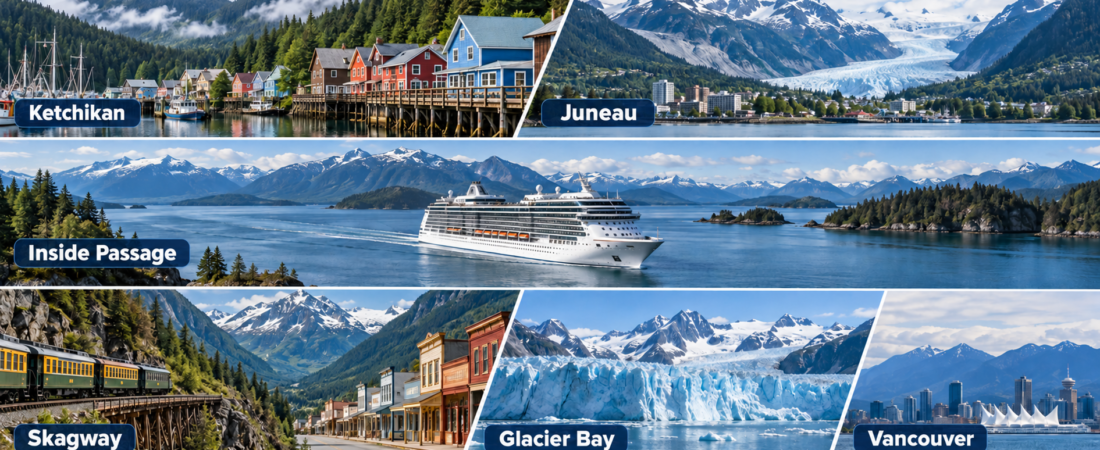
A cruise from Vancouver to Alaska is not simply transportation between two destinations. Much of the journey takes place through narrow waterways surrounded by forested islands, steep mountains and remote coastal communities.
The most common option is a seven-night round-trip itinerary departing from Canada Place in downtown Vancouver. These cruises usually travel through the Inside Passage and visit several Southeast Alaska ports before returning to Vancouver.
Ketchikan, Juneau and Skagway appear on many itineraries, while Sitka and Icy Strait Point are common alternatives. A glacier-viewing destination—such as Glacier Bay, Hubbard Glacier, Tracy Arm or Endicott Arm—is often the scenic centrepiece.
This guide follows the route in geographical order and explains what travellers can see at each major stop.
Routes, port order and arrival times vary by cruise line, ship and departure date. Weather, ice, tides and operational conditions can also lead to itinerary changes. Check the exact day-by-day schedule before booking.
Typical Seven-Night Vancouver to Alaska Route
A representative round-trip itinerary may look like this:
| Day | Route or destination | Main experience |
|---|---|---|
| Day 1 | Vancouver | Depart from Canada Place |
| Day 2 | Inside Passage | Scenic sailing through coastal waterways |
| Day 3 | Ketchikan | Creek Street, totem poles and rainforest |
| Day 4 | Juneau | Mendenhall Glacier, whale watching and mountain views |
| Day 5 | Skagway | Gold Rush history and the White Pass railway |
| Day 6 | Glacier Bay or another glacier area | Full-day scenic glacier viewing |
| Day 7 | Inside Passage | Southbound scenic sailing |
| Day 8 | Vancouver | Return to Canada Place |
Some ships visit the glacier before the ports, and others replace Skagway or Ketchikan with Sitka or Icy Strait Point.
The number of ports is not the only factor that matters. Travellers should also compare:
- The number of hours in each port
- Morning or evening arrival times
- Whether the ship docks or uses tenders
- The specific glacier destination
- The amount of scenic cruising
- Whether the route is round-trip or one-way
Starting Point: Vancouver and Canada Place
The journey begins at Canada Place on Vancouver’s downtown waterfront.
Before the ship departs, passengers can see several recognizable features of the city:
- Canada Place’s white sail-shaped roof
- Burrard Inlet
- Stanley Park
- The North Shore Mountains
- Lions Gate Bridge
- Downtown Vancouver’s skyline
- Floatplanes taking off from Coal Harbour
Depending on the ship’s direction and assigned berth, passengers may see the downtown waterfront from one side and the North Shore Mountains from the other.
Sailing Under Lions Gate Bridge
One of the most memorable moments of a Vancouver departure is passing beneath Lions Gate Bridge.
The bridge connects Vancouver with the North Shore and marks the entrance from Burrard Inlet toward the Strait of Georgia. Large cruise ships pass beneath it with what can appear to be surprisingly little clearance.
Passengers often gather on the upper decks shortly after departure to watch:
- Stanley Park on the southern side
- West Vancouver on the northern side
- The bridge overhead
- Coastal mountains in the distance
- Smaller boats crossing the harbour
The exact departure experience depends on weather and sailing time, but remaining outside for the first part of the voyage is often worthwhile.
Scenic Sailing Through the Inside Passage
The Inside Passage is not one road-like channel. It is a broad network of coastal waterways extending through British Columbia and Southeast Alaska.
The route is sheltered by islands for much of the journey, although individual itineraries may also include open-water sections.
Along the Inside Passage, passengers may see:
- Forest-covered islands
- Narrow channels
- Rocky shorelines
- Waterfalls
- Snow-covered peaks
- Lighthouses
- Fishing communities
- Bald eagles
- Seals
- Porpoises
- Humpback whales
Wildlife sightings are possible but never guaranteed. A sighting may last only a few seconds, so passengers interested in wildlife often keep binoculars or a camera nearby.
Why Vancouver Departures Are Known for Scenic Sailing
Some Vancouver itineraries travel east of Vancouver Island through more protected waters. This can provide extensive coastal scenery as the ship moves through British Columbia.
The exact route depends on navigation, ship size and itinerary. Passengers should not assume that every Vancouver departure follows precisely the same channels.
Scenic sailing is part of the cruise experience rather than a day with no destination. Early morning and late evening can provide some of the most atmospheric views.
Port 1: Ketchikan
Ketchikan is frequently the first Alaska port on a northbound journey from Vancouver.
The town is built along the edge of Revillagigedo Island, with forested mountains rising behind its narrow waterfront. It is known for rainfall, salmon, Alaska Native art and colourful buildings.
Ketchikan is relatively compact, making it suitable for passengers who want to explore independently.
What to See in Ketchikan
Creek Street
Creek Street is one of Ketchikan’s most photographed locations.
The historic wooden boardwalk stands on pilings above Ketchikan Creek. The buildings once formed part of the town’s red-light district, but the area now contains:
- Shops
- Galleries
- Restaurants
- Historic displays
- Colourful waterfront buildings
Creek Street is within walking distance of many downtown cruise berths. During salmon season, visitors may see fish moving through the creek.
The Travel Alaska Ketchikan guide identifies Creek Street as one of the main attractions in the downtown district.
Totem Heritage Center
The Totem Heritage Center preserves historic totem poles recovered from abandoned Tlingit and Haida village sites.
The centre helps visitors understand that totem poles are not simply decorations. Their designs can preserve family histories, cultural identities and important stories.
This is a good choice for travellers who want a museum-style cultural experience within the town.
Totem Bight State Historical Park
Totem Bight State Historical Park is located north of downtown Ketchikan.
Visitors can see:
- Reconstructed totem poles
- A traditional-style clan house
- Coastal forest
- Views across the water
- Interpretive information about Alaska Native culture
Transportation is required from most cruise berths. The park’s official information is available through the Alaska Department of Natural Resources.
Saxman Totem Park
Saxman is another popular destination for learning about Tlingit art and culture. Tours may include carved poles, cultural presentations or visits to carving facilities.
The experience differs from Totem Bight, so travellers should compare what each excursion includes.
Southeast Alaska Discovery Center
The Southeast Alaska Discovery Center introduces visitors to the region’s rainforest, wildlife, communities and cultural history.
It can be a practical choice on a rainy day and is located near the downtown area.
Misty Fjords National Monument
Misty Fjords is a large wilderness area known for dramatic cliffs, waterfalls, lakes and forested landscapes.
Visitors generally experience it through:
- Floatplane tours
- Boat excursions
- Combination air-and-water tours
Misty Fjords is not a quick walk from the cruise terminal. It requires an organized excursion and enough port time.
Best Ketchikan Choices by Interest
| Traveller’s interest | Suggested Ketchikan experience |
|---|---|
| First visit | Creek Street and downtown |
| Alaska Native culture | Totem Heritage Center, Totem Bight or Saxman |
| Wilderness scenery | Misty Fjords |
| Fishing | Salmon-fishing excursion |
| Easy independent visit | Creek Street and Discovery Center |
| Photography | Creek Street and the waterfront |
Port 2: Juneau
Juneau is Alaska’s state capital and one of the most geographically unusual capitals in the United States.
The city cannot be reached from the rest of Alaska by a conventional connecting highway. Visitors generally arrive by air or sea.
Mountains rise immediately behind the downtown waterfront, while the Juneau Icefield and nearby waterways provide access to glaciers and wildlife.
What to See in Juneau
Mendenhall Glacier
Mendenhall Glacier is one of Juneau’s best-known attractions.
The glacier is located outside the downtown cruise area, so transportation is required. Visitors may explore designated viewpoints, interpretive areas and nearby trails.
Nugget Falls is a popular destination near the glacier area. The walk provides waterfall and glacier views, but visitors must carefully manage their return transportation and ship schedule.
Access arrangements, visitor capacity and transportation options can change. Check current information before assuming that a taxi, shuttle or tour will be available.
Whale Watching
The waters near Juneau are well known for marine wildlife excursions.
Whale-watching tours often depart from Auke Bay and may search for:
- Humpback whales
- Orcas
- Sea lions
- Seals
- Bald eagles
- Porpoises
Wildlife is not staged, and sightings or specific behaviours cannot be guaranteed unless a tour operator explicitly provides its own written guarantee.
Travellers often combine whale watching with Mendenhall Glacier, but the combined schedule can leave less time at each location.
Goldbelt Tram
The Goldbelt Tram rises from the downtown waterfront toward Mount Roberts.
From the upper area, visitors can enjoy views over:
- Downtown Juneau
- Gastineau Channel
- Douglas Island
- Cruise ships
- Surrounding mountains
Walking trails and interpretive experiences may also be available, depending on conditions.
Because the lower station is near the cruise docks, the tram can be convenient for travellers with limited time. Visibility, however, depends heavily on the weather.
Downtown Juneau
Passengers who remain downtown can visit:
- Alaska State Capitol
- St. Nicholas Russian Orthodox Church
- Local museums
- Historic streets
- Shops and galleries
- Waterfront viewpoints
Downtown Juneau is walkable, although some streets have noticeable slopes.
Helicopter and Icefield Experiences
Some excursions travel by helicopter to glacier areas or include guided glacier walks.
These are weather-dependent activities. Flights may be delayed or cancelled because of wind, visibility or other safety concerns.
Passengers considering a flight excursion should understand the cancellation and refund policy before booking.
Best Juneau Choices by Interest
| Traveller’s interest | Suggested Juneau experience |
|---|---|
| Glacier viewing | Mendenhall Glacier |
| Wildlife | Whale-watching tour |
| Panoramic view | Goldbelt Tram |
| Adventure | Helicopter or glacier excursion |
| History and architecture | Downtown walking route |
| Limited port time | Downtown and tram |
Port 3: Skagway
Skagway has a different atmosphere from Ketchikan and Juneau.
Its historic centre preserves the appearance of a small Gold Rush town surrounded by steep mountains. During the Klondike Gold Rush of 1897–1898, thousands of prospectors passed through this region on their way toward the Yukon.
Today, Skagway’s central streets contain restored buildings, museums and businesses connected with that period.
What to See in Skagway
Klondike Gold Rush National Historical Park
The park preserves important Gold Rush sites in and around Skagway.
Visitors can begin at the National Park Service Visitor Center and explore restored buildings in the historic district. Exhibits explain:
- Why prospectors came north
- What they carried
- The dangers of the journey
- The White Pass and Chilkoot routes
- The effect of the Gold Rush on Indigenous communities
- The development of Skagway
The National Park Service provides current visitor information and historical resources.
The historic district is relatively close to the waterfront, making it one of the easiest major Alaska attractions to explore without an expensive excursion.
White Pass and Yukon Route Railway
The White Pass railway is one of Skagway’s signature experiences.
The route climbs from the coastal town through mountainous terrain associated with the Gold Rush. Depending on the selected journey, passengers may see:
- Steep valleys
- Waterfalls
- Historic trestles
- Mountain passes
- Sections of the original Gold Rush route
- Views toward British Columbia and the Yukon region
Passport or border documentation may be required for itineraries that cross into Canada. Not every railway excursion follows the same route, so passengers should check the destination and duration.
Chilkoot Trail and Dyea
Dyea was once a major Gold Rush settlement and the starting point of the Chilkoot Trail.
Today, the area offers a quieter historical and natural experience than central Skagway. Access generally requires transportation or a guided excursion.
The full Chilkoot Trail is a serious multiday route, but cruise passengers may visit sections of the historical area during shorter tours.
Lower Reid Falls and Gold Rush Cemetery
The Gold Rush Cemetery contains graves connected with Skagway’s early history. A trail near the cemetery leads toward Lower Reid Falls.
This can be an alternative for visitors interested in a combination of history and a short nature walk. Travellers should confirm transportation and trail conditions.
Downtown Skagway
Broadway and the surrounding streets contain:
- Restored Gold Rush-era buildings
- Museums
- Shops
- Cafés
- Historic signs
- Railway facilities
Skagway’s compact layout makes it practical for independent exploration.
Best Skagway Choices by Interest
| Traveller’s interest | Suggested Skagway experience |
|---|---|
| First visit | White Pass railway and historic downtown |
| Gold Rush history | National Historical Park |
| Independent exploration | Broadway and park buildings |
| Nature and history | Dyea or Gold Rush Cemetery |
| Scenic photography | Railway or mountain overlook |
| Families | Junior Ranger activities and downtown |
Scenic Destination: Glacier Bay National Park
Glacier Bay is not a conventional cruise port. Passengers usually remain onboard while the ship travels through the national park.
The park covers approximately 3.3 million acres of mountains, glaciers, rainforest, coastline and fjords. It is also the homeland of the Huna and Yakutat Lingít.
The official Glacier Bay National Park website describes the area as a major highlight of Alaska’s Inside Passage.
What Happens During a Glacier Bay Cruise Day?
A Glacier Bay day often begins early.
As the ship enters the park, passengers may see:
- Forested shorelines
- Snow-covered mountains
- Tidewater glaciers
- Floating ice
- Seabirds
- Sea otters
- Seals
- Mountain goats
- Bears in distant shoreline areas
- Humpback whales
Wildlife can be far away, making binoculars useful.
Park rangers or cultural interpreters may board participating vessels and provide commentary, educational programs and information about the landscape.
The ship generally sails through the bay and spends time near selected glacier areas, subject to ice, weather and park regulations.
Glacier Calving
Calving occurs when ice breaks away from the face of a glacier and falls into the water.
Passengers may hear cracking or rumbling before seeing the ice fall. However, calving is a natural event and cannot be scheduled or guaranteed.
For the widest view, outdoor public decks are often better than watching from only one side of a cabin.
Hubbard Glacier
Some Vancouver itineraries visit Hubbard Glacier instead of Glacier Bay.
Hubbard is a large tidewater glacier located farther north, near the border between Alaska and Canada. Ships approach through Yakutat Bay and Disenchantment Bay.
The experience usually focuses on viewing one massive glacier rather than sailing through the multiple landscapes of Glacier Bay.
How closely a ship can approach depends on:
- Floating ice
- Visibility
- Weather
- Navigation restrictions
- Safety conditions
Hubbard Glacier should not be treated as a lesser substitute. It is a different type of glacier-viewing experience.
Tracy Arm and Endicott Arm
Tracy Arm and Endicott Arm are narrow fjords southeast of Juneau.
Depending on the itinerary, a ship may travel toward:
- Sawyer Glaciers in Tracy Arm
- Dawes Glacier in Endicott Arm
The fjords are known for:
- High rock walls
- Waterfalls
- Floating ice
- Narrow waterways
- Mountain scenery
- Possible wildlife sightings
Ice conditions may prevent ships from reaching the planned glacier. In some cases, the vessel may enter Endicott Arm when access to Tracy Arm is limited.
Travellers should read the itinerary wording carefully. “Scenic cruising” may mean viewing from the main ship, while another itinerary may offer an optional smaller-boat excursion.
Alternative Port: Sitka
Sitka appears on many Alaska itineraries but not on every standard Vancouver round trip.
The town is located on Baranof Island and reflects a combination of Tlingit heritage, Russian colonial history and coastal wilderness.
Unlike ports located deep inside narrow channels, Sitka faces more open water and has views toward island-dotted Sitka Sound.
What to See in Sitka
Sitka National Historical Park
The park protects an important cultural and historical landscape.
Visitors can explore forest trails, view totem poles and learn about Tlingit history and the events of 1804. The park provides a more reflective experience than a typical commercial cruise attraction.
St. Michael’s Cathedral
St. Michael’s Cathedral stands in central Sitka and represents the town’s Russian Orthodox heritage.
The current building is a reconstruction after the original structure was destroyed by fire. Its interior contains religious objects and historical displays.
Alaska Raptor Center
The Alaska Raptor Center rehabilitates injured birds, including bald eagles and other raptors.
Visitors can learn about wildlife treatment and see birds that cannot be released into the wild.
Fortress of the Bear
Fortress of the Bear is an educational bear facility located outside the downtown centre. Transportation is required.
It may appeal to families and wildlife enthusiasts, but visitors should understand that it is a managed facility rather than a wild bear-viewing excursion.
Sitka Sound
Boat tours around Sitka Sound may search for:
- Sea otters
- Whales
- Seals
- Sea lions
- Bald eagles
- Coastal birds
The scattered islands and volcanic mountain views create a landscape distinct from Ketchikan or Skagway.
Best Sitka Choices by Interest
| Traveller’s interest | Suggested Sitka experience |
|---|---|
| Tlingit culture | Sitka National Historical Park |
| Russian history | St. Michael’s Cathedral |
| Wildlife education | Alaska Raptor Center |
| Marine wildlife | Sitka Sound boat tour |
| Family activity | Raptor Center or Fortress of the Bear |
| Independent visit | Downtown and historical sites |
Alternative Port: Icy Strait Point and Hoonah
Icy Strait Point is a cruise destination near the community of Hoonah on Chichagof Island.
It is owned by the Huna Totem Corporation and emphasizes Alaska Native culture, wildlife and outdoor activities.
The atmosphere is generally less urban than Juneau or Ketchikan.
What to See at Icy Strait Point
Whale Watching
The surrounding waters are known for marine wildlife. Tours may search for humpback whales, orcas, sea lions and other animals.
As with every wildlife activity, sightings and behaviours depend on natural conditions.
Alaska Native Cultural Experiences
Visitors may learn about Huna Tlingit traditions through cultural presentations, art, storytelling and community-based experiences.
Travellers should select programs that provide respectful interpretation rather than viewing culture only as entertainment.
Gondola and Mountain Views
Gondola systems connect parts of the destination and can provide access to elevated viewpoints and walking areas.
Visibility depends on cloud and weather conditions.
Bear-Viewing Excursions
Chichagof Island has a significant brown bear population. Guided excursions travel to designated viewing areas, but no tour can guarantee that a wild bear will appear.
Coastal Walking
Passengers who do not want a major excursion can explore waterfront areas, restored cannery buildings, shops and coastal viewpoints near the cruise facilities.
The official Alaska tourism guide describes whale watching, bear viewing, cultural performances, gondola rides and hiking among the main Hoonah and Icy Strait Point experiences.
Comparing the Main Alaska Ports
| Destination | Best known for | Good choice for |
|---|---|---|
| Ketchikan | Totem poles, Creek Street and rainforest | Culture and easy downtown exploration |
| Juneau | Mendenhall Glacier and whale watching | Glaciers, wildlife and adventure |
| Skagway | Klondike history and White Pass railway | History and mountain scenery |
| Glacier Bay | Fjords, glaciers and park interpretation | Full-day scenic cruising |
| Sitka | Tlingit and Russian history | Culture and marine wildlife |
| Icy Strait Point | Huna Tlingit culture and wildlife | Nature and a quieter port experience |
| Hubbard Glacier | Massive tidewater glacier | Concentrated glacier viewing |
| Tracy or Endicott Arm | Narrow fjords and waterfalls | Dramatic scenic sailing |
Round-Trip Vancouver Route vs. One-Way Route
Not every Vancouver to Alaska cruise returns to Vancouver.
Round-Trip Vancouver Cruise
A round-trip itinerary begins and ends at Canada Place.
It is usually best for travellers who want:
- Simple transportation
- No flight home from Alaska
- A seven-night vacation
- Several Southeast Alaska ports
- Extensive Inside Passage sailing
One-Way Vancouver to Alaska Cruise
A northbound cruise may travel from Vancouver to Whittier or Seward. A southbound itinerary travels in the opposite direction.
One-way cruises can include:
- Ketchikan
- Juneau
- Skagway
- A glacier destination
- Whittier or Seward
- Access to an Alaska land tour
These routes are suitable for travellers planning to continue toward Anchorage, Denali or inland Alaska.
However, Whittier and Seward are not neighbourhoods of Anchorage. Additional transportation is required.
How to Choose the Best Route
The ideal itinerary depends on what the traveller values most.
Choose a Glacier Bay Route If:
- National park scenery is the main priority
- You want an educational scenic-cruising day
- You prefer varied fjord and glacier landscapes
Choose Hubbard Glacier If:
- You want to see a particularly large tidewater glacier
- A one-way or northbound route appeals to you
- You may add an Alaska land journey
Choose Ketchikan, Juneau and Skagway If:
- This is your first Alaska cruise
- You want a balance of culture, wildlife, history and scenery
- You prefer the classic Southeast Alaska route
Choose Sitka or Icy Strait Point If:
- You want a different experience from the three classic ports
- Wildlife and cultural experiences are priorities
- You prefer a less conventional itinerary
Route-Planning Mistakes to Avoid
Looking Only at the Number of Ports
Four short port visits are not automatically better than three longer ones. Check the actual arrival and departure times.
Assuming Every Cruise Visits Glacier Bay
An itinerary advertised as an Alaska cruise may visit Hubbard Glacier, Tracy Arm, Endicott Arm or another scenic area instead.
Confusing Scenic Cruising With a Port Visit
Passengers generally remain onboard during Glacier Bay or fjord cruising. There may be no opportunity to walk on a glacier unless a separate excursion is offered elsewhere.
Booking Two Long Activities in One Port
Transportation and meeting times can make it difficult to combine major excursions. Leave enough time to return to the ship.
Expecting Guaranteed Wildlife
Alaska is a natural environment. Whales, bears, eagles and other animals do not appear on a schedule.
Ignoring Tender Information
At some ports or on certain days, passengers may travel between the ship and shore in smaller tender boats. Tendering can reduce available sightseeing time and may affect accessibility.
Final Recommendation
For a first Vancouver to Alaska cruise, a route including Ketchikan, Juneau, Skagway and a designated glacier-viewing day offers the most balanced introduction.
Ketchikan provides Alaska Native art, rainforest and historic Creek Street. Juneau combines glaciers, mountain views and whale-watching opportunities. Skagway presents the history of the Klondike Gold Rush, while Glacier Bay or another glacier destination supplies the journey’s most dramatic natural scenery.
Sitka and Icy Strait Point are valuable alternatives rather than inferior replacements. Sitka offers a distinctive combination of Tlingit and Russian history, while Icy Strait Point emphasizes wildlife and Huna Tlingit culture.
The most important step is to read the complete itinerary. Do not choose a cruise based only on its length or advertised destination. Compare its ports, glacier area, hours ashore and scenic-cruising route.
Frequently Asked Questions
1. What is the most common Vancouver to Alaska cruise route?
A common seven-night round-trip route travels from Vancouver through the Inside Passage and visits Ketchikan, Juneau, Skagway and a glacier area before returning to Vancouver.
2. Does every Vancouver to Alaska cruise visit Glacier Bay?
No. Some cruises visit Hubbard Glacier, Tracy Arm, Endicott Arm or another glacier-viewing area. Glacier Bay must be specifically listed in the itinerary.
3. Which Alaska port is best for first-time visitors?
There is no single best port. Ketchikan is convenient for culture and walking, Juneau is strong for glaciers and wildlife, and Skagway is ideal for Gold Rush history and railway scenery.
4. Can I walk from the Ketchikan cruise port to Creek Street?
Creek Street is within walking distance of many downtown Ketchikan berths. Ships docking outside the central area may require shuttle transportation, so check the berth information.
5. Can I walk from the Juneau cruise port to Mendenhall Glacier?
No. Mendenhall Glacier is outside downtown Juneau and requires transportation. Confirm shuttle, tour or other transportation arrangements before leaving the ship.
6. Is the White Pass railway close to the Skagway cruise port?
Railway facilities are near Skagway’s waterfront and historic centre, although the exact meeting point depends on the excursion and ship berth.
7. Do passengers leave the ship in Glacier Bay?
Cruise passengers normally experience Glacier Bay from the ship. It is a scenic-cruising day rather than a conventional port visit.
8. Is Sitka better than Icy Strait Point?
They offer different experiences. Sitka is stronger for historical sites and museums, while Icy Strait Point focuses more on wildlife, outdoor activities and Huna Tlingit culture.
9. Which port is best for whale watching?
Juneau, Icy Strait Point and Sitka all offer whale-watching excursions. Sightings depend on the season, weather and natural wildlife movement.
10. Is a round-trip or one-way Alaska cruise better?
A round-trip cruise is easier for travellers who want to begin and end in Vancouver. A one-way cruise is better for those planning to continue into inland Alaska or add a land tour.
Suggested Internal Links
- Vancouver to Alaska Cruise Prices and Seven-Day Itineraries
- When to Book a Vancouver to Alaska Cruise: Early Booking vs. Last-Minute Deals
- Best Cabin for a Vancouver to Alaska Cruise: Views, Location and Hidden Costs
- Vancouver Alaska Cruise Checklist: Documents, Packing and Canada Place Boarding
Suggested External References
- Travel Alaska: Ketchikan
- Alaska State Parks: Totem Bight
- National Park Service: Klondike Gold Rush National Historical Park
- National Park Service: Glacier Bay National Park
- Travel Alaska: Hoonah and Icy Strait Point
Editorial Note
Ports, glacier destinations, arrival times and excursion availability can change because of weather, ice, tides, wildlife activity and operational conditions. Always check the cruise line’s final itinerary and the ship’s all-aboard time.