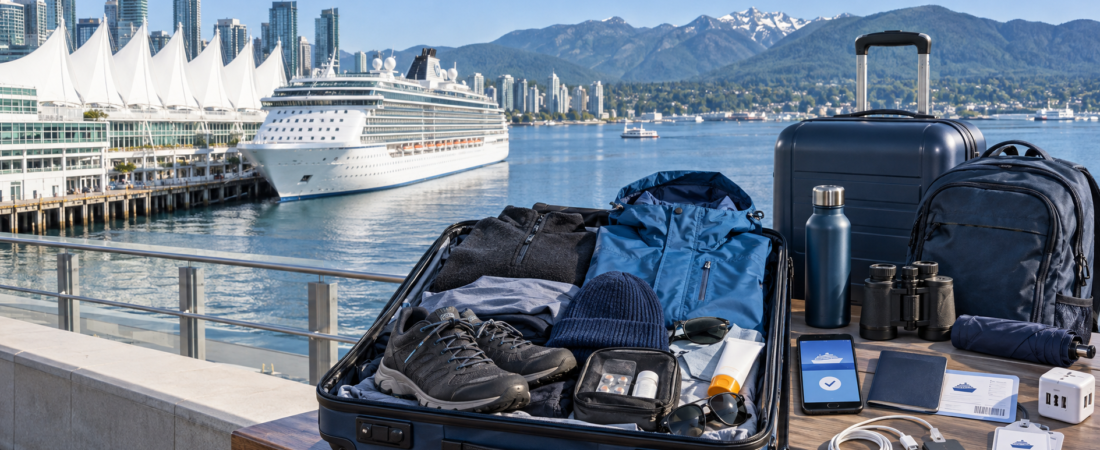
A Vancouver to Alaska cruise begins long before the ship leaves Canada Place.
Passengers must complete online check-in, verify their travel documents, attach luggage tags and prepare for changing weather. Because the cruise enters the United States, travellers must also meet the entry requirements that apply to their nationality and immigration status.
A missing jacket can be replaced in Vancouver. A missing passport or required visa may prevent a passenger from boarding.
The most important preparation is to confirm every passenger’s travel documents directly with the cruise line and government authorities before the cancellation-penalty period begins.
This guide provides a step-by-step checklist from final payment through embarkation, seven days at sea and disembarkation in Vancouver.
This article provides general travel-planning information as of September 7, 2026. Passport, visa, health, customs and cruise-line requirements can change. Rules also vary by citizenship, residence status and itinerary. Verify the requirements that apply to every passenger before departure.
Why Travel Documents Require Special Attention
A round-trip Alaska cruise from Vancouver begins in Canada, visits the United States and returns to Canada.
Even if a passenger does not plan to leave the ship at an Alaska port, the cruise is still an international journey. Remaining onboard does not automatically remove immigration-document requirements.
Passengers may need documents for:
- Departing Canada
- Entering the United States
- Visiting Alaska ports
- Returning to Canada
- Boarding an international flight before or after the cruise
- Proving temporary or permanent resident status
A cruise line can deny boarding when a passenger does not possess the documents required for the entire itinerary.
Do not rely only on advice from social media, a friend who travelled previously or an unofficial cruise forum.
Passport Checklist
A valid passport is the safest and most widely accepted travel document for an Alaska cruise from Vancouver.
Before departure, check:
- The passport has not expired
- The name matches the cruise reservation
- The passport is not damaged
- There are sufficient blank pages, if required
- Every child has an individual passport
- The passport remains valid for the required period
- Any visa or travel authorization is connected to the correct passport
Some countries and travel providers recommend or require additional passport validity beyond the end of the trip. The cruise line may also apply documentation standards that are stricter than the minimum border requirement.
If you renew your passport after obtaining an electronic travel authorization, determine whether you must obtain a new authorization linked to the new passport.
Make Backup Copies
Keep:
- A paper copy of the passport identification page
- A secure digital copy
- Copies of visas and immigration documents
- The cruise booking number
- Emergency contact information
Copies do not replace original documents, but they may help if something is lost.
Do not pack the original passport in checked luggage. Keep it in your personal carry-on bag.
United States Entry Requirements
Alaska is part of the United States. Every passenger must be eligible to enter the United States according to their citizenship and circumstances.
Depending on nationality and status, a traveller may need:
- A valid passport
- A U.S. visitor visa
- An approved ESTA under the Visa Waiver Program
- A U.S. permanent resident card
- Other supporting documents
An approved ESTA or valid visa does not guarantee admission. Final entry decisions are made by U.S. border authorities.
Travellers should use the official U.S. Customs and Border Protection and U.S. Department of State travel website to determine what applies to them.
Do Canadian Citizens Need a U.S. Visa?
Canadian citizens generally do not require a non-immigrant visa for ordinary tourism visits to the United States, but exceptions exist. They should still carry an appropriate valid passport and confirm the cruise line’s requirements.
Do Canadian Permanent Residents Automatically Have U.S. Entry Rights?
No. Canadian permanent resident status does not automatically authorize entry into the United States.
A Canadian permanent resident must meet U.S. entry requirements according to the passport they hold and their individual circumstances.
Do Canadian Work or Study Permits Authorize Entry into Alaska?
No. A Canadian work permit, study permit or visitor record controls status in Canada. It is not a U.S. visa and does not independently authorize entry into the United States.
Temporary residents should check both:
- Whether they can enter the United States
- Whether they have the proper documents to return to Canada
Documents for Returning to Canada
Passengers who are not Canadian citizens must verify what they need to re-enter Canada by cruise ship.
The correct document depends on citizenship, Canadian immigration status and method of travel.
Possible documents include:
- Passport
- Canadian permanent resident card
- Permanent resident travel document
- Canadian visitor visa
- Work or study permit
- Visitor record
- Other proof of lawful status
A work permit, study permit or visitor record is not the same as a Canadian visa. A permit shows a person’s status and authorization inside Canada, while a visa or other applicable document may be needed for travel to the Canadian border.
An electronic travel authorization, or eTA, is mainly connected with air travel to Canada. Travellers arriving by cruise ship may be subject to different document rules. IRCC provides a tool to check whether a visa or eTA is required.
Canadian permanent residents should carry a valid PR card when travelling internationally. Canadian citizens, including dual Canadian citizens, should follow the Canadian government’s passport guidance.
Because a Vancouver round-trip sailing leaves and returns to Canada, temporary residents should not assume that a valid permit alone is sufficient.
Documents for Children
Children require their own travel documents.
Parents or guardians should check:
- Passport validity
- U.S. entry requirements
- Canadian re-entry requirements
- Cruise-line age policies
- Proof of relationship, if needed
- Consent documentation when one or both parents are not travelling
When a child travels with only one parent, grandparents, relatives or another adult, a consent letter may help demonstrate that the trip has been authorized.
The Government of Canada recommends carrying a consent letter when a child travels abroad without all parents or legal guardians. Guidance and a sample are available on the Government of Canada consent-letter page.
Families with different surnames may also consider carrying a copy of the child’s birth certificate or another document showing the relationship.
Travel Document Checklist
| Traveller | Documents to verify |
|---|---|
| Canadian citizen | Valid passport and cruise documents |
| Canadian permanent resident | Passport, valid PR card and U.S. entry documents |
| Canadian temporary resident | Passport, Canadian status documents, re-entry document and U.S. entry documents |
| U.S. citizen | Valid passport and cruise documents |
| U.S. permanent resident | Passport or applicable travel document, valid Green Card and cruise documents |
| Visa Waiver Program traveller | Passport, approved ESTA if required and Canadian entry documents |
| Visa-required traveller | Passport, valid visas for the United States and Canada as applicable |
| Child travelling without both parents | Passport, entry documents and recommended consent documentation |
This table is a planning overview, not an individual eligibility decision. Requirements can vary.
Complete Online Check-In Early
After final payment, the cruise line generally opens or continues its online check-in process through its website or mobile app.
Passengers may be asked to provide:
- Full legal name
- Date of birth
- Passport information
- Citizenship
- Home address
- Emergency contact
- Arrival and departure plans
- Payment card for onboard purchases
- Security photograph
- Preferred boarding time
- Health information
- Acceptance of the passenger contract
Complete check-in as early as the cruise line allows. This provides time to correct a spelling error or document problem.
The passenger name on the reservation should match the passport. If it does not, contact the cruise line before travelling to the terminal.
Download the Cruise Line’s App
Many cruise lines use an app for check-in and onboard services.
The app may contain:
- Boarding pass or QR code
- Daily schedule
- Dining reservations
- Shore-excursion details
- Onboard account
- Ship map
- Messaging
- Safety information
- Port schedules
Download and update the app while connected to reliable internet at home. Sign in and confirm that every reservation appears correctly.
Take screenshots of the boarding pass and important booking information in case mobile service is weak at the terminal.
A printed copy can also be useful.
Select the Correct Arrival Time
Cruise lines may assign or ask passengers to select an arrival window.
Follow the time shown on the boarding pass. Arriving several hours too early does not necessarily result in earlier boarding and can contribute to congestion.
Allow additional time for:
- Downtown Vancouver traffic
- Public-transit delays
- Parking
- Walking from Waterfront Station
- Luggage drop-off
- Security screening
- Document inspection
- U.S. border processing
- Cruise check-in
Do not plan to arrive close to the final boarding deadline. The ship cannot wait for passengers delayed by traffic or missing documents.
The final arrival and all-aboard times shown by the cruise line are more important than the ship’s scheduled departure time.
Getting to Canada Place
The Canada Place cruise terminal is located on Vancouver’s downtown waterfront.
Common transportation options include:
- SkyTrain
- SeaBus
- West Coast Express
- Taxi
- Rideshare
- Private vehicle
- Hotel shuttle
- Prearranged transfer
Waterfront Station is near Canada Place and connects to several transit services.
Public Transit
Public transit may be economical for travellers living in Metro Vancouver. However, passengers should consider:
- Number and size of bags
- Stairs or elevators
- Crowded trains
- Walking distance
- Mobility needs
- Weekend service changes
Taxi or Rideshare
A taxi or rideshare can be more convenient for families and passengers carrying several bags. Confirm the designated passenger drop-off location and allow time for terminal traffic.
Driving and Parking
Passengers who drive should reserve parking in advance when possible and check:
- Total price for the entire cruise
- Vehicle height restriction
- Entry and exit times
- Reservation and cancellation policy
- Walking distance to the terminal
Parking availability and procedures can change on busy cruise days.
What Happens at the Canada Place Terminal?
The precise order can vary according to ship operations, but passengers should generally expect several stages.
1. Luggage Drop-Off
Large suitcases with cruise luggage tags are handed to the designated porters or luggage staff.
Make sure each tag shows the correct:
- Passenger name
- Ship
- Sailing date
- Cabin number, when assigned
Remove old airline and cruise tags to prevent confusion.
Do not place passports, medication, money, jewellery, electronics or other essentials in checked luggage.
2. Security Screening
Passengers and carry-on items undergo security screening. Checked luggage is also screened.
Weapons, illegal drugs, certain heating devices and other prohibited items are not allowed. Cruise lines publish their own prohibited-item lists. Princess, for example, provides current security and packing guidance in its pre-cruise FAQ.
Rules for alcohol, bottled drinks, power bars and electrical appliances differ by cruise line. Confirm the policy rather than assuming an item permitted by one company will be accepted by another.
3. Border and Document Processing
Because the ship will visit the United States, passengers may complete U.S. border processing as part of the Vancouver embarkation procedure.
Have the following ready:
- Passport
- Visa or ESTA information, if applicable
- Permanent resident card, if applicable
- Cruise boarding pass
- Supporting documents requested by the cruise line or border authorities
Answer border questions clearly and truthfully.
4. Cruise-Line Check-In
Staff verify the reservation and travel documents. Passengers may receive or activate a cruise card, wearable device or onboard account.
5. Boarding
After all required processing is complete, passengers proceed to the ship when their boarding group is called.
The cabin may not be available immediately. Public areas and selected dining venues may open before staterooms are ready.
Carry-On Bag: What You Need for the First Day
Checked luggage may not arrive at the cabin until later in the day. Pack a small carry-on containing everything you may need during the first several hours.
Essential Carry-On Items
- Passport and immigration documents
- Boarding pass
- Wallet and payment cards
- Prescription medication
- Basic pain or motion-sickness medication
- Phone and charging cable
- Portable battery, if permitted
- Glasses or contact lenses
- Valuable electronics
- Camera
- Light jacket
- Change of clothing
- Essential toiletries
- Swimsuit, if desired
- Children’s immediate necessities
Keep medication in its original labelled packaging where practical. Bring enough for the voyage plus an additional supply in case of delay.
Princess currently recommends carrying extra medication as a precaution and printing luggage tags before leaving home on its cruise preparation page.
Alaska Cruise Clothing: Use Layers
Alaska cruise weather can change quickly. A morning may begin cool and rainy, become sunny in the afternoon and feel cold again near a glacier.
The most practical approach is layering.
Base Layer
A base layer sits close to the body and helps manage warmth and moisture.
Consider:
- Short-sleeved shirts
- Long-sleeved shirts
- Lightweight thermal tops
- Comfortable underlayers
Middle Layer
The middle layer provides insulation.
Useful options include:
- Fleece jacket
- Sweater
- Lightweight insulated jacket
- Hoodie
Outer Layer
The outer layer should help protect against wind and rain.
Consider bringing:
- Waterproof or water-resistant jacket
- Windproof shell
- Jacket with a hood
- Compact rain pants for outdoor excursions
A heavy winter coat may be unnecessary during many summer sailings, but a warm layer is valuable during glacier viewing and windy conditions.
Footwear
Bring shoes appropriate for both the ship and shore.
A practical selection may include:
- Comfortable walking shoes
- Water-resistant shoes or hiking shoes
- Casual shoes for evenings
- Non-slip footwear
- Activity-specific footwear when required
New shoes should be broken in before the trip. Alaska ports can involve long walks, uneven paths, rain and wet docks.
Check the difficulty level and footwear requirement for every booked excursion.
Other Useful Alaska Items
Consider packing:
- Compact umbrella
- Warm hat
- Light gloves
- Sunglasses
- Sunscreen
- Reusable water bottle, if permitted
- Small daypack
- Binoculars
- Camera
- Spare memory card
- Insect repellent
- Lip balm
- Moisturizer
- Waterproof phone pouch
- Laundry bag
- Small first-aid supplies
Binoculars can be particularly useful for wildlife and distant glacier views.
Pack for the actual activities on your itinerary. A traveller taking a helicopter tour may receive specific instructions that differ from those for a city walking tour.
What Not to Pack
Prohibited-item policies vary, but commonly restricted items can include:
- Firearms and ammunition
- Illegal drugs
- Fireworks
- Candles
- Irons and certain heating devices
- Some power strips and extension cords
- Large knives or weapons
- Certain sports equipment
- Drones
- Alcohol beyond the permitted allowance
- Large quantities of non-alcoholic beverages
Cruise ships may restrict surge-protected power bars because of their electrical systems. If you need additional charging outlets, check the cruise line’s current policy and use only an approved device.
Do not assume that an airline-approved item is also cruise-approved.
Medication and Health Preparation
Passengers should carry an adequate supply of medication for the entire trip and possible delays.
Before departure:
- Refill prescriptions
- Keep medicine in the carry-on
- Bring a medication list
- Record generic drug names
- Bring copies of important prescriptions
- Review refrigeration needs
- Check rules for needles or medical devices
- Notify the cruise line of accessibility needs
- Purchase appropriate travel medical insurance
The ship has a medical centre, but treatment is not necessarily included in the cruise fare. Charges can be substantial and may need to be paid through the onboard account.
Travel insurance should be reviewed for emergency treatment, evacuation, cancellation, interruption and pre-existing-condition provisions.
Motion-Sickness Preparation
The Inside Passage can be sheltered, but calm water is not guaranteed. Open-water sections may feel different from protected channels.
Passengers concerned about motion sickness can:
- Discuss suitable medication with a doctor or pharmacist
- Select a lower, midship cabin
- Take preventive medication according to professional directions
- Eat light meals
- Stay hydrated
- Spend time where the horizon is visible
- Avoid excessive alcohol
Some treatments work best before symptoms become severe. Travellers with medical conditions should obtain personalized advice before using medication.
Preparing for Shore Excursions
Review every excursion several weeks before departure.
Confirm:
- Meeting time
- Meeting location
- Duration
- Physical difficulty
- Minimum age
- Weight or height restrictions
- Required footwear
- Clothing recommendations
- Food availability
- Cancellation conditions
- Whether transportation is included
Ship time and local time may not always be interpreted the same way by passengers. Follow the ship’s published time and instructions.
For an independent excursion, leave a generous return margin. The ship may wait for a delayed cruise-line excursion, but it is generally not obligated to wait for independently touring passengers.
Money and Payment
Most onboard purchases are charged to the passenger’s cruise account rather than paid in cash.
Before departure:
- Add a valid payment card
- Check the card’s expiration date
- Notify the bank if appropriate
- Review foreign-transaction fees
- Confirm whether onboard prices are in U.S. dollars
- Set a spending budget
- Check the account daily
Alaska ports use U.S. dollars. Credit cards are widely accepted, but a modest amount of cash may be useful for small purchases or tips.
Canadian passengers should consider the exchange rate when estimating their final cost.
Phone and Data Use
Mobile-phone charges can be confusing at sea.
A phone may connect to:
- Canadian land networks
- U.S. land networks
- The ship’s cellular-at-sea service
- Shipboard Wi-Fi
Cellular-at-sea charges can be expensive and may not be included in an ordinary mobile plan.
Before sailing:
- Check Canada–U.S. roaming terms
- Ask whether maritime cellular service is covered
- Download offline maps
- Download entertainment
- Update apps
- Save documents locally
- Turn off automatic updates
- Consider airplane mode while at sea
Passengers can keep airplane mode on and activate Wi-Fi separately when using a ship internet package.
The Day Before Departure
Use this final checklist:
- Complete online check-in
- Confirm the terminal and ship
- Review the assigned arrival time
- Check passport and visa documents
- Print or download boarding passes
- Print luggage tags
- Attach tags securely
- Charge phones and power banks
- Check transportation
- Review traffic and transit alerts
- Pack medication in the carry-on
- Check the weather forecast
- Confirm excursion reservations
- Save emergency contact numbers
- Set several alarms
- Avoid making non-refundable plans immediately before boarding
Place all original travel documents together in a secure carry-on pouch.
Embarkation Morning Checklist
Before leaving home or the hotel, confirm that you have:
- Passport for every passenger
- Required visas or travel authorizations
- Canadian status and re-entry documents
- Child consent documentation, if applicable
- Boarding pass
- Payment card
- Medication
- Phone
- Charging cable
- Correctly tagged checked luggage
- Terminal transportation plan
Check that no passport has accidentally been placed in a checked suitcase.
First Things to Do After Boarding
Once onboard:
- Confirm that the cabin and onboard account are correct
- Locate the assigned emergency assembly station
- Complete the required safety procedure
- Put phones in the appropriate roaming or airplane-mode setting
- Check dining arrangements
- Review excursion tickets
- Reserve activities that may fill quickly
- Learn the route from the cabin to the main stairways
- Check when checked luggage is expected
- Watch the departure from Vancouver
Safety instructions are mandatory even for experienced cruise passengers.
Returning to Vancouver
Near the end of the cruise, the ship will provide disembarkation instructions.
Passengers may be asked to:
- Review the onboard account
- Choose a disembarkation group
- Attach departure luggage tags
- Place checked bags outside the cabin
- Complete customs information
- Keep travel documents available
- Leave the cabin by a designated time
Do not place the following in luggage collected on the final night:
- Passport
- Canadian immigration documents
- Medication
- Wallet
- Phone
- Keys
- Travel clothes
- Essential toiletries
You will need a carry-on bag for these items.
Passengers usually cannot leave the ship until it has been cleared by border and port authorities. Delays are possible, so avoid scheduling a tight flight or appointment immediately after arrival.
Complete Vancouver Alaska Cruise Timeline
| Time before departure | Main tasks |
|---|---|
| 6–12 months | Check passports, visas, cabin and insurance |
| 3–6 months | Reserve priority excursions and review payment deadlines |
| 1–3 months | Complete online check-in and arrange transportation |
| 2–4 weeks | Review documents, packages, weather and excursion requirements |
| 1 week | Begin packing and confirm terminal information |
| 1 day | Print tags, charge devices and organize carry-on documents |
| Embarkation day | Arrive during the assigned window and keep documents accessible |
| Final cruise night | Review account and prepare disembarkation luggage |
| Arrival in Vancouver | Complete entry procedures and collect luggage |
Final Recommendation
The safest way to prepare for a Vancouver to Alaska cruise is to divide the process into three priorities.
First, verify the travel documents for every passenger. Citizenship, Canadian immigration status and U.S. entry eligibility can create different requirements within the same family.
Second, complete online check-in and transportation planning early. Canada Place can be busy when several ships are in port, and arriving without completed information can slow the process.
Third, pack in layers and keep essential items in a carry-on. Alaska’s weather can change quickly, and checked luggage may not reach the cabin immediately.
A well-prepared passenger does not need to pack everything. The goal is to bring the correct documents, useful clothing and essential medication while avoiding prohibited or unnecessary items.
Frequently Asked Questions
1. Do I need a passport for a Vancouver to Alaska cruise?
A valid passport is the safest document and is commonly required by cruise lines for this international itinerary. Requirements depend on citizenship and the cruise line, so confirm them before booking.
2. Does a Canadian permanent resident card allow me to enter Alaska?
No. A Canadian PR card helps prove status when returning to Canada, but it does not independently authorize entry into the United States. U.S. requirements depend on the traveller’s passport and circumstances.
3. Is a Canadian work permit enough for the cruise?
No. A work permit proves authorization inside Canada but is not a passport, U.S. visa or Canadian travel visa. Temporary residents must verify both U.S. entry and Canadian re-entry requirements.
4. Do children need passports?
Children generally need their own appropriate travel documents. When a child travels without both parents or guardians, carrying a consent letter is also recommended.
5. How early should I arrive at Canada Place?
Follow the arrival window assigned by the cruise line and allow additional time for transportation, luggage, security, border processing and check-in. Do not arrive close to the final boarding deadline.
6. Can I bring my suitcase directly onto the ship?
Small carry-on bags are permitted within the cruise line’s size and security rules. Larger tagged luggage is normally handed to terminal luggage staff and delivered to the cabin later.
7. What should I keep in my carry-on?
Keep passports, immigration documents, medication, valuables, electronics, a payment card, a light jacket and anything needed during the first several hours.
8. Do I need a winter coat for an Alaska cruise?
Not necessarily. Layered clothing with a warm middle layer and a waterproof or wind-resistant outer layer is generally more versatile. Conditions vary by month and itinerary.
9. Can I bring a power strip?
Some power strips, particularly surge-protected models, may be prohibited. Check the cruise line’s current electrical-device policy before packing one.
10. What happens if I return late from an independent excursion?
The ship may leave without independently touring passengers who miss the all-aboard time. Return well before the deadline and follow ship time.
Suggested Internal Links
- Vancouver to Alaska Cruise Prices and Seven-Day Itineraries
- When to Book a Vancouver to Alaska Cruise: Early Booking vs. Last-Minute Deals
- Best Cabin for a Vancouver to Alaska Cruise: Views, Location and Hidden Costs
Suggested External References
- Government of Canada: Check if You Need a Visa or eTA
- Government of Canada: Children and Consent Letters
- U.S. Customs and Border Protection
- U.S. Department of State: Visitor Visas
- Princess Cruises: Pre-Cruise FAQ
- Canada Place Cruise Terminal Information
Editorial Note
Travel-document and embarkation requirements can change without notice. Cruise lines may apply requirements that differ from minimum government rules. Every passenger is responsible for carrying the original documents required for the complete itinerary. Confirm current information with the cruise line and relevant government authorities before departure.