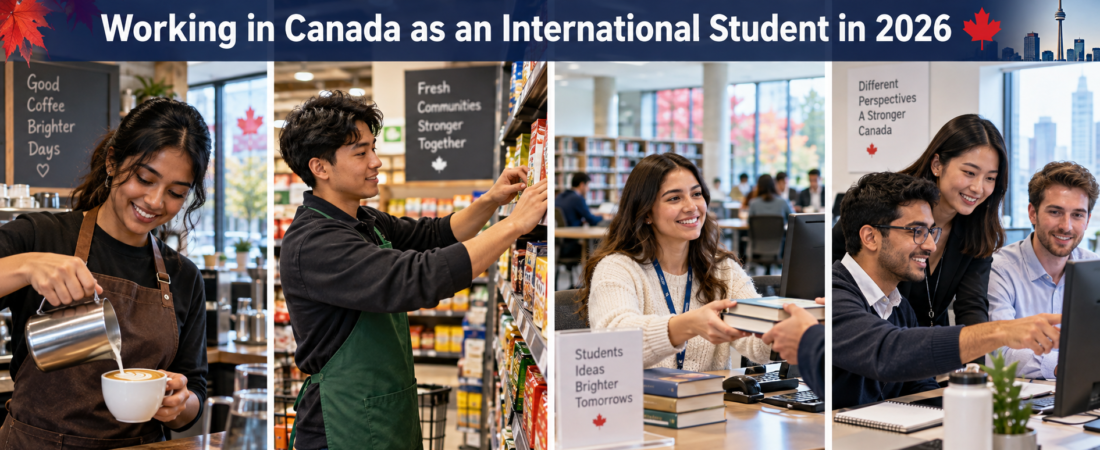
International students may be permitted to work in Canada, but a study permit does not automatically give every student unrestricted employment rights.
Work authorization depends on the wording of the study permit, the type of program, the student’s enrolment status and whether the work takes place during a regular academic session or a scheduled break.
Official-information notice: Never rely only on a school brochure, employer or online article when deciding whether you may work. Check your permit conditions and the current Government of Canada student work rules before beginning employment.
The following information was verified on September 6, 2026.
The 24-Hour Off-Campus Work Limit
Eligible international students may work off campus for up to 24 hours per week during regular academic sessions.
Working more than 24 hours during a regular academic week violates study permit conditions. IRCC states that a violation can affect a student’s status and future immigration applications.
Students are responsible for recording their hours, including hours worked for more than one employer.
The official rules are available on the IRCC off-campus work page.
Who May Work Off Campus Without a Separate Work Permit?
A student generally must satisfy all applicable conditions, including:
- Holding a valid study permit with an appropriate work condition
- Studying full-time at a DLI
- Being enrolled in an eligible post-secondary academic, vocational or professional training program, or an eligible Quebec secondary-level vocational program
- Being enrolled in a program lasting at least six months
- Studying in a program leading to a degree, diploma or certificate
- Having started the program
- Having a Social Insurance Number
Students who do not meet the official conditions must not assume that a study permit authorizes employment.
Working During Scheduled Breaks
An eligible student may work unlimited off-campus hours during a break officially scheduled by the DLI, such as:
- Summer holidays
- Winter holidays
- Reading week
The student must normally be a full-time student before and after the break. A student who begins a new program after the break may also need to satisfy additional conditions.
If a program does not have scheduled breaks, the student remains subject to the regular 24-hour weekly limit.
Check the school calendar: A personal vacation or self-selected break is not necessarily a scheduled break. Confirm the official academic calendar and review the current IRCC instructions.
Working On Campus
Eligible students may work on campus without a separate work permit if their study permit contains the required work condition and they meet the official eligibility rules.
A student generally must be enrolled full-time at a DLI in an eligible program and hold a valid study permit. Limited exceptions may apply to students studying part-time during their final semester after maintaining full-time status in previous semesters.
The detailed conditions are published on the official IRCC on-campus work page.
Can Students Work Before Their Program Begins?
No. A student cannot begin working merely because the study permit has been issued.
The student must have started the eligible program and meet all other work requirements.
Working During an Authorized Leave
Students generally cannot work on or off campus during an authorized leave from their studies, even if their study permit contains a work condition.
IRCC allows authorized leave in limited circumstances, but the student must continue to comply with study permit conditions.
Review the official study permit conditions before taking leave.
Co-op, Internships and Required Student Placements
A significant rule took effect on April 1, 2026.
Eligible post-secondary international students no longer need a separate co-op work permit for a student work placement that is required to complete their program.
A qualifying placement must:
- Be required by the study program
- Be approved by the DLI
- Form part of a program at a Canadian DLI
- Meet all other IRCC eligibility conditions
The DLI may need to provide a letter confirming that all students in the program must complete the placement.
Secondary-school international students still require a co-op work permit for eligible placements.
Students enrolled only in English or French as a second language, general-interest courses or courses preparing them for another program may not qualify for the placement authorization.
Do not rely on the April 2026 change alone: Program type and student status still matter. Confirm eligibility on the official IRCC student work-placement page.
Social Insurance Number Requirements
International students need a Social Insurance Number to work in Canada.
The study permit must contain a condition authorizing eligible work. If the necessary condition is missing, the student may need to request an amendment before applying for a SIN or beginning employment.
Possessing a SIN does not independently create work authorization. The student must continue to meet immigration requirements.
Self-Employment and Multiple Jobs
The 24-hour weekly limit applies to the combined total of off-campus work.
Students with several employers must add all hours together. Self-employed students must also track time spent earning wages, commissions or other income as described by IRCC.
FAQ
Can an international student work 24 hours for each employer?
No. The limit applies to the total off-campus hours across all employment.
Can students work full-time during summer?
Eligible students may work unlimited off-campus hours during a break officially scheduled by their DLI, provided they meet the applicable conditions.
Can a student work during an authorized leave?
Generally, no. IRCC states that students cannot work on or off campus during an authorized leave.
Do all post-secondary students no longer need co-op work permits?
No. The change applies to eligible post-secondary students completing placements required by their programs. Students must review all official eligibility conditions.
Do secondary-school students need a co-op work permit?
Yes. Under the rules in effect on September 6, 2026, eligible secondary-school students still need one for required work placements.
Does having a SIN mean a student can legally work?
No. A SIN is required for employment, but work authorization comes from the student’s immigration status and permit conditions.
Final Reminder
Employment can affect immigration status. Students should check their study permit, academic status, school calendar and the current Government of Canada rules before accepting work or increasing their hours.
If official IRCC instructions change after this article’s verification date, the current Canada.ca instructions take priority.