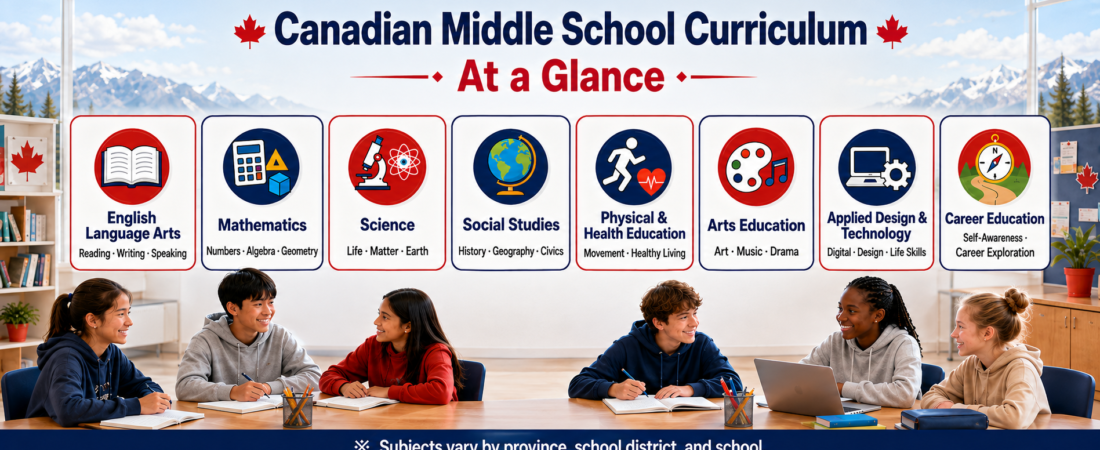
What subjects do students take after entering a Canadian middle school, and how many classes do they have in one semester?
There is no single answer that applies to every student in Canada. Each province and territory manages its own education system, while local school boards determine matters such as school organization and timetable structure. This article explains the general Canadian system and then looks more closely at British Columbia and Coquitlam School District 43.
1. What Grades Are Considered Middle School in Canada?
Canada does not have one national curriculum controlled by the federal government. Provincial and territorial ministries are responsible for organizing, delivering, and assessing elementary and secondary education. Local school boards or districts operate schools and implement provincial requirements. As a result, curriculum, assessment policies, grade organization, and school names vary across the country. Council of Ministers of Education, Canada
The term “middle school” is therefore not tied to one fixed group of grades.
| School type | Grades it may include | What parents should know |
|---|---|---|
| Elementary School | Kindergarten to Grade 5, 6, 7, or 8 | The final elementary grade depends on the district |
| Middle School | Commonly Grades 6–8 or 7–9 | Not every district uses a separate middle-school model |
| Junior High School | Often Grades 7–9 | This name is more common in certain provinces and districts |
| Secondary School | Commonly Grades 9–12 or 8–12 | Grade 9 may be part of middle school in one district and secondary school in another |
In Coquitlam School District 43, the usual structure is elementary school followed by middle school for Grades 6–8 and secondary school for Grades 9–12. For example, Riverside Secondary describes itself as a Grade 9–12 school. This means an SD43 student generally leaves middle school after Grade 8 and enters secondary school in Grade 9. Riverside Secondary School
This arrangement should not be treated as a rule for all of British Columbia or Canada. Families moving to another district should check the grade configuration of the specific school.
2. Major Subjects in the BC Middle School Curriculum
The BC curriculum focuses on communication, thinking, and personal and social competencies, as well as literacy and numeracy. Students in Grades 6–9 study several broad areas of learning, but schools may organize and name individual classes differently. BC Curriculum
| Subject area | Common English name | What students generally learn | What to verify |
|---|---|---|---|
| Language Arts | English Language Arts | Reading, writing, speaking, listening, media literacy, research, and responding to different kinds of texts | English or French-language program |
| Mathematics | Mathematics | Number concepts, fractions, algebraic thinking, geometry, statistics, financial literacy, and problem-solving | Regular, enriched, or support options |
| Science | Science | Life science, physical science, earth and space science, experimentation, and scientific inquiry | Course organization varies by grade |
| Social Studies | Social Studies | History, geography, government, cultures, economics, Indigenous perspectives, and critical thinking | Topics change by grade |
| Physical Education | Physical and Health Education | Movement skills, fitness, healthy choices, safety, and personal well-being | Uniform and participation requirements |
| Arts | Arts Education | Visual art, music, drama, dance, or media arts | Offerings depend on the school |
| Technology and practical learning | Applied Design, Skills and Technologies | Design, digital literacy, food studies, woodwork, textiles, coding, robotics, or other practical modules | Modules depend on facilities and staff |
| Second language | Core French or another language | Basic communication, culture, reading, listening, and speaking | Available languages and exemptions |
| Career learning | Career Education | Personal interests, strengths, goal-setting, career awareness, and educational planning | May be taught separately or across subjects |
| Electives and explorations | Electives or Explorations | Band, choir, art, drama, technology, cooking, leadership, and other school-based options | Courses differ greatly by school |
English Language Arts is broader than grammar and essay writing. The Grade 8 curriculum includes oral, written, visual, and digital texts, such as speeches, novels, articles, photographs, films, advertisements, and web pages. BC English Language Arts 8
Social Studies develops historical knowledge as well as the ability to evaluate evidence and different perspectives. Grade 8, for example, examines societies and major changes from approximately the seventh century to 1750, including exploration, colonization, population, and political and economic systems. BC Social Studies 8
Applied Design, Skills and Technologies, commonly shortened to ADST, is particularly flexible. In Grade 8, schools must provide learning equivalent to a full-year course, but they may divide it into modules of different lengths. Depending on the school, students might rotate through areas such as coding, digital media, food studies, textiles, robotics, drafting, metalwork, or woodwork. BC Applied Design, Skills and Technologies 8
Career Education also begins before high school graduation planning. Grade 8 students reflect on their abilities, preferences, educational choices, career possibilities, and the changing world of work. BC Career Education 8
3. Is French Compulsory for Every Student?
In British Columbia, boards of education must offer second-language instruction to students in Grades 5–8, except for students covered by an exemption in the provincial order. Core French is common, but some schools or districts may offer another approved language. BC Language Education Policy
This does not mean that every Canadian student follows exactly the same French program. Language requirements differ by province, and French immersion, francophone education, Core French, and other language programs are not interchangeable.
Parents should check the assigned school’s program information, particularly if their child recently arrived in Canada, requires English Language Learning support, or has previous education in another language.
4. How Many Courses Do Students Take in One Semester?
The most important distinction is between:
- the number of subjects studied during the entire school year; and
- the number appearing on a student’s timetable during one semester or on one school day.
A student may study eight or more subject areas over a year without attending all of them every day. The answer depends on the school’s timetable model.
| Timetable model | How courses are scheduled | Year-long organization | Student experience |
|---|---|---|---|
| Semester system | Students complete one group of courses from September to January and another from February to June | A common example is four courses per semester and eight during the year | Fewer subjects at one time, but longer or more frequent classes |
| Linear system | Most courses run from September to June | Students may carry the same set of courses throughout the year | More subjects continue at the same time |
| Quarter system | The year is divided into four shorter terms | Students take a small number of intensive courses in each quarter | Courses change more frequently |
| Block schedule | The day is divided into longer instructional blocks | It may be combined with semester or linear scheduling | Students usually attend fewer classes per day |
| Day 1/Day 2 or A/B schedule | Different classes meet on alternating days | Courses may still continue for a semester or the full year | The daily timetable changes in a repeating pattern |
| Rotation or Explorations | Short practical or arts modules replace one another during the year | Several modules may collectively satisfy one curriculum area | Students experience multiple subjects without taking each one all year |
A “four-course semester” does not mean that students receive less education. Each course usually meets for a longer block or more frequently, allowing the required instructional time to be completed within half of the school year.
Middle schools often organize learning differently from secondary schools. Core subjects may run throughout the year, while arts, technology, and practical subjects rotate every several weeks. Career learning may also be integrated into other classes rather than appearing as a separate daily period.
Quarter systems are another possible arrangement, but families should not assume that an SD43 school uses quarters unless the current school timetable says so. The pandemic-era timetable used by a school several years ago may not reflect its present schedule.
5. A Current SD43 Grade 9 Example
A current School District 43 course-planning example helps illustrate the difference between middle and secondary school.
Pinetree Secondary’s 2026–27 Grade 9 planning sheet tells students to request five required courses and three electives, plus one alternate elective. That gives the student eight main course requests for the school year, although the way those courses appear each day depends on the school timetable. Pinetree Secondary Grade 9 Planning Sheet, 2026–27
Centennial Secondary also provides a dedicated 2026–27 course-planning site and a current bell-schedule page. Its offerings include regular academic courses as well as specialized choices such as culinary arts and accelerated or honours options for eligible students. Families should use the current Centennial planning information rather than assuming that every SD43 secondary school offers the same courses or schedule. Centennial Course Planning 2026–27 and Centennial Bell Schedule 2026–27
The practical answer is therefore:
An SD43 Grade 9 student may request approximately eight courses for the school year, but the number taken at one time depends on the school’s current timetable.
This Grade 9 example should not be applied automatically to Grades 6–8. Middle-school students may have year-long core classes, rotating explorations, integrated subjects, or a combination of these arrangements.
6. Sample Grade 8 and Grade 9 Timetables
The following examples are illustrations, not official schedules for every SD43 school.
Sample A: Grade 8 Middle-School Model
| Year-long or regular learning | Rotating explorations |
|---|---|
| English Language Arts | Visual Art |
| Mathematics | Food Studies |
| Science | Digital Technology |
| Social Studies | Woodwork or Design |
| Physical and Health Education | Drama or Music |
| Second Language | Other school-based modules |
| Career Education, sometimes integrated |
A student following this model may appear to study many subjects during the year, but some exploration classes run only for part of the year.
Sample B: Grade 9 Semester Model
| Semester 1 | Semester 2 |
|---|---|
| English Language Arts 9 | Science 9 |
| Mathematics 9 | Social Studies 9 |
| Physical and Health Education 9 | Elective 2 |
| Elective 1 | Elective 3 |
A school may arrange the same eight courses differently, including a linear or blended timetable. Always verify the actual structure with the school.
7. Required Subjects and Electives
In the middle years, students spend much of their timetable on required learning areas. Schools may then provide electives or exploration rotations in band, choir, art, drama, computers, coding, foods, textiles, woodworking, leadership, or other areas.
Not every school can provide every option. Course availability depends on student demand, teaching staff, facilities, equipment, safety requirements, and timetable compatibility. Even when students request an elective, placement is not always guaranteed. Schools often ask for an alternate choice for this reason.
English Language Learning support can also affect a student’s schedule. A newcomer may take regular classes while receiving additional language support, but the arrangement depends on the student’s assessment and the services available at the school.
8. What Changes Beginning in Grade 10?
Grade 9 is part of secondary school in SD43, but British Columbia’s formal graduation program is mainly organized around Grades 10–12.
BC students need at least 80 credits to earn the Dogwood Diploma. The current requirements include 52 credits from required courses and at least 28 elective credits. Students must also meet Grade 12-level and Indigenous-focused coursework requirements and complete the applicable provincial graduation assessments. BC Graduation Requirements
Course planning becomes increasingly important from Grade 10 onward. Students must balance graduation requirements, personal interests, career goals, and post-secondary admission requirements. A course that is optional for graduation may still be necessary or recommended for a particular university program.
Students considering university should therefore look ahead to Grade 11 and Grade 12 prerequisites instead of choosing each year’s courses in isolation.
9. What Parents Should Check Before Enrolment
Before the school year begins, parents and students should confirm:
- Which school serves their home address
- Which grades the school includes
- Whether courses are semestered, linear, quartered, or rotated
- How many courses are taken during one term and the entire year
- Which subjects are required
- Which electives and exploration modules are available
- When elective requests must be submitted
- Whether alternate elective choices are required
- How English Language Learning support is scheduled
- The deadline and conditions for requesting a course change
- Whether special materials, athletic clothing, instruments, or fees are required
- Where to find the Course Guide, Bell Schedule, and Student Handbook
- Whether international students receive separate instructions from the district’s international education office
10. Canadian and Korean Middle Schools: General Differences
The comparison below describes common patterns, not universal rules.
| Area | Common Korean middle-school model | Models found in Canada and BC |
|---|---|---|
| Grade organization | Middle school is normally a defined three-year stage | Middle-school grades vary by province and district |
| Timetable | Students commonly study many subjects concurrently | Schools may use linear, semester, block, or rotating systems |
| Classroom movement | Students often remain in a homeroom while teachers move | Students frequently move to subject-specific classrooms |
| Electives | Many subjects are determined by the school curriculum | Students may have more elective or exploratory options |
| Practical learning | Practical subjects are included in the regular program | ADST may include foods, coding, robotics, textiles, or woodwork |
| Assessment | Tests and assignments are commonly used | Assessment may include projects, demonstrations, discussions, assignments, and tests |
Neither structure is automatically better. The important task for a newly arriving student is to understand how the assigned school organizes classes, assignments, course selection, and assessment.
Frequently Asked Questions
Q1. What Grades Are Considered Middle School in Canada?
There is no Canada-wide grade definition for middle school. A middle school may include Grades 6–8, Grades 7–9, or another combination. Some districts do not use separate middle schools at all. In SD43, middle schools generally serve Grades 6–8, followed by secondary school beginning in Grade 9.
Q2. How Many Courses Does a Canadian Middle-School Student Take Per Semester?
It depends on the school’s timetable. In a semestered secondary school, a student may take about four courses at a time and approximately eight over the year. A middle-school student may study several year-long core subjects plus shorter rotating explorations. The school’s current Course Guide and timetable provide the most reliable answer.
Q3. Does Taking Four Courses Per Semester Mean a Smaller Workload?
Not necessarily. Semestered courses generally meet for longer blocks or more often during half of the school year. Students complete another group of courses during the second semester. The total instructional time can therefore be similar even though fewer subjects appear on the timetable at once.
Q4. Do Students Have English and Mathematics Every Day?
Some students do, while others attend these classes on alternating days. A Day 1/Day 2 or A/B timetable may place different blocks on different days. Semestered and linear schools can also arrange meeting times differently. Parents should read the bell schedule together with the student’s personal timetable.
Q5. Is French Mandatory for Every Student?
BC school boards must offer second-language education in Grades 5–8, subject to exemptions under provincial policy. Core French is common, but available languages and program arrangements vary. Requirements in other provinces may be different, so this should not be treated as a Canada-wide rule.
Q6. Can Middle-School Students Choose Electives?
Yes, but the degree of choice depends on the school and grade. Some students select subjects such as band, choir, art, or technology. Other schools place students in an exploration rotation so that everyone experiences several subjects. Requested courses may not be available when classes are full or timetable conflicts occur.
Q7. Can Students Receiving ELL Support Attend Regular Classes?
Many students receive English Language Learning support while participating in regular classes. The exact balance depends on language assessment results, individual needs, and the school’s support model. Families should discuss the timetable with the ELL teacher or school counsellor.
Q8. Can a Student Change an Elective After Classes Begin?
A change may be possible, but it is not guaranteed. Schools consider class capacity, timetable conflicts, course requirements, and the date of the request. Students should contact their counsellor as early as possible instead of waiting several weeks.
Q9. Do High-School Credits Begin in Grade 9 in BC?
Grade 9 is part of secondary school in SD43, but the BC Graduation Program’s credit requirements focus on Grades 10–12. Grade 9 remains important because achievement and course choices can affect placement and options in later grades. Students should check prerequisites before planning Grade 10 courses.
Q10. Where Can Families Find the Official School Timetable?
Visit the school’s official website and look for “Course Planning,” “Course Guide,” “Bell Schedule,” “Programs,” or “Student Handbook.” The school district website can confirm school boundaries and grade structure. Because course offerings and schedules can change each year, use the current or upcoming school year’s documents.
Conclusion
Canadian middle school subjects and course numbers are not identical across the country. Provinces establish curriculum and education policies, while school districts and individual schools organize grades, courses, and daily timetables.
In BC, students in the middle years study core areas such as English Language Arts, mathematics, science, social studies, physical and health education, arts, ADST, career education, and a second language where required. In SD43, middle school generally covers Grades 6–8, while Grade 9 students enter secondary school and may follow a different course-selection and timetable structure.
Rather than looking only at the number of subjects, families should check whether each course lasts for a full year or one semester and when elective requests must be submitted. These details make it much easier to prepare for Canadian school life.
Official Sources Consulted
- Council of Ministers of Education, Canada, Education in Canada: An Overview, accessed September 4, 2026
https://www.cmec.ca/299/Education-in-Canada-An-Overview/index.html - Government of British Columbia, B.C. Curriculum, accessed September 4, 2026
https://curriculum.gov.bc.ca/ - Government of British Columbia, Language Education Policy, updated December 18, 2025
https://www2.gov.bc.ca/gov/content/education-training/k-12/administration/legislation-policy/public-schools/language-education-policy - Government of British Columbia, Applied Design, Skills and Technologies 8, accessed September 4, 2026
https://curriculum.gov.bc.ca/curriculum/adst/8/core - Government of British Columbia, Graduation Requirements, accessed September 4, 2026
https://www2.gov.bc.ca/gov/content/education-training/k-12/administration/legislation-policy/public-schools/graduation-requirements - School District 43, Pinetree Secondary, Grade 9 Course Planning 2026–2027
https://www.sd43.bc.ca/school/pinetree/ProgramsServices/Counselling/CoursePlanningInformation/Documents/2026-2027%20Grade%209%20Planning%20Sheet%20-%20Fillable.pdf - School District 43, Centennial Secondary, Course Planning 2026–27
https://mycentennial.sd43.bc.ca/courseplanning/ - School District 43, Centennial Secondary, Bell Schedule for 2026–27
https://www.sd43.bc.ca/centennial/bell-schedule-for-2026-27