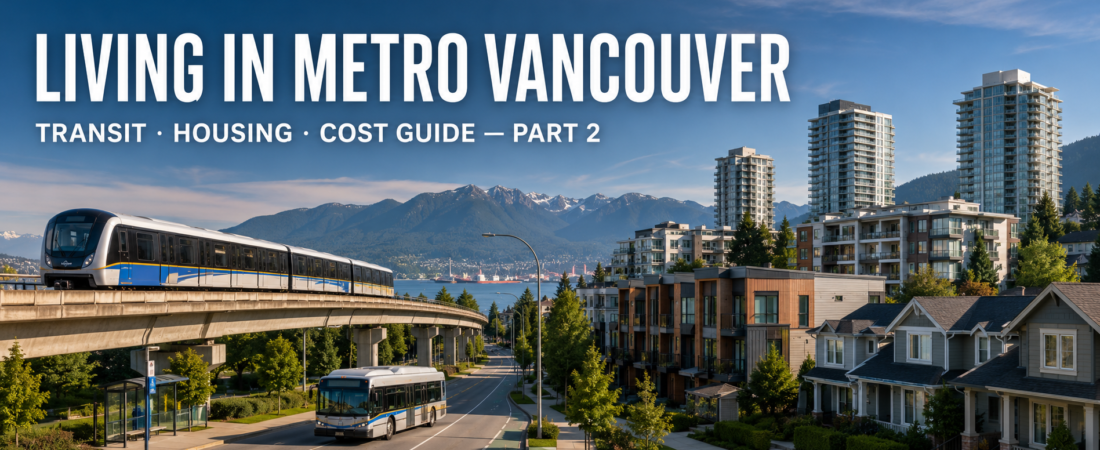
Choosing a Metro Vancouver municipality is only the beginning of a relocation decision. The exact neighbourhood determines whether a household can walk to grocery stores, reach work without a car, enter the expected school catchment or manage its monthly budget.
Part 1 of this guide compares the region’s cities and communities using Metro Vancouver’s official 2024 population projections. This second part focuses on daily life, including transportation, weather, renting, employment, education and recreation.
It also provides a decision-making process and answers common questions from newcomers, international students and families.
Getting Around Metro Vancouver
TransLink operates buses, SkyTrain, SeaBus and West Coast Express services throughout the region.
SkyTrain’s Expo, Millennium and Canada lines serve Vancouver, Burnaby, New Westminster, Richmond, Coquitlam and parts of Surrey. Port Moody is also served by the Millennium Line.
The SeaBus connects Lonsdale Quay in the City of North Vancouver with Waterfront Station in downtown Vancouver.
West Coast Express provides weekday commuter-rail service between downtown Vancouver and communities to the east. Its Metro Vancouver stations include Moody Centre, Coquitlam Central, Port Coquitlam, Pitt Meadows, Maple Meadows and Port Haney.
West Coast Express can be convenient for traditional weekday commuting, but its schedule is more limited than SkyTrain. Residents should confirm departure times before depending on it for shift work, evening classes or weekend travel.
Compass Card and Fare Zones
The Compass Card is a reusable fare card that can hold Stored Value, a DayPass or a monthly pass.
As checked on September 2, 2026, adult Stored Value fares are:
- One zone: $2.85
- Two zones: $4.20
- Three zones: $5.40
Adult monthly pass prices are:
- One zone: $117.20
- Two zones: $156.70
- Three zones: $211.65
All regular bus trips are charged as one-zone travel, regardless of the number of municipal boundaries crossed.
SkyTrain and SeaBus fares depend on the number of zones crossed during weekday daytime travel. Trips beginning after 6:30 p.m. on weekdays are charged as one zone throughout the system. Weekend and provincial statutory holiday trips are also charged as one zone.
A regular single fare is generally valid for 90 minutes on buses, SkyTrain and SeaBus when the passenger uses an accepted transferable payment method.
Cash paid on a bus does not provide a transfer to SkyTrain or SeaBus. A Compass Card, Compass Ticket or accepted contactless payment method is more convenient for multimodal journeys.
Trips beginning at YVR–Airport, Sea Island Centre or Templeton stations may include a $6.50 YVR Airport AddFare.
Transit fares and policies can change. Readers should check TransLink’s official pricing page before budgeting a commute.
Cycling and Walking
Walking and cycling are practical in downtown Vancouver, central Burnaby, New Westminster and some regional town centres. Richmond’s flat terrain can also be convenient for cycling.
Conditions vary significantly outside central areas. Hills, highways, incomplete cycling connections and long distances may make active transportation more difficult.
A property that appears close to a station on a map may involve a steep hill, an uncomfortable road crossing or an indirect walking route. Visit the area before signing a lease.
Driving, Parking and Traffic
Driving provides flexibility in lower-density communities and for travel to some industrial areas, parks or workplaces with irregular hours.
Car owners must budget for insurance, fuel, parking, maintenance and repairs—not only the vehicle purchase or lease payment.
Bridges and limited Fraser River crossings can produce serious traffic congestion. The Lions Gate Bridge, Ironworkers Memorial Bridge, Port Mann Bridge, Alex Fraser Bridge, Knight Street Bridge and Massey Tunnel are important regional connections.
An accident, construction project or severe weather can significantly lengthen a commute. Always compare travel times during the hours you expect to work or attend school.
Airport and Ferry Connections
The Canada Line connects Vancouver International Airport with Richmond and downtown Vancouver.
BC Ferries operates major routes from Tsawwassen in Delta and Horseshoe Bay in West Vancouver. Tsawwassen provides access to Vancouver Island and the Southern Gulf Islands, while Horseshoe Bay connects with Nanaimo, the Sunshine Coast and Bowen Island.
Public transportation reaches both terminals, but passengers should allow additional time for bus connections and ferry check-in requirements.
Weather and Seasonal Life
Metro Vancouver generally has milder winters than many other Canadian regions. However, winters are frequently wet, dark and windy.
Rain is common during fall and winter. Waterproof shoes, a rain jacket and layered clothing are usually more practical than relying only on an umbrella.
Snow is occasional near sea level but more frequent at higher elevations. North Shore and hillside communities may experience snow when lower areas receive rain.
Even a relatively small snowfall can disrupt roads and public transportation. Newcomers who drive should understand winter tire requirements for routes outside the urban region and prepare for changing mountain conditions.
Summer weather is often dry and pleasant. Long daylight hours make beaches, parks, patios and trails popular.
Heat events and wildfire smoke can still affect health and outdoor plans. Residents should monitor weather warnings and British Columbia’s Air Quality Health Index when conditions change.
Weather is not identical throughout Metro Vancouver. Communities near mountains may receive more precipitation, while inland locations can feel hotter during summer.
Housing and Cost of Living
Housing is usually the largest expense for households living in Metro Vancouver.
Common options include:
- Purpose-built rental apartments
- Individually rented condominiums
- Basement suites
- Shared houses and apartments
- Townhouses
- Detached homes
Rental costs vary according to municipality, neighbourhood, building age, condition, unit size and proximity to public transportation.
A single regional average may not represent an individual search. A new apartment beside a SkyTrain station may be more expensive than an older unit in the same city.
Basement suites can provide additional housing choices, particularly in suburban communities. Prospective tenants should check ventilation, natural light, ceiling height, laundry access, noise and whether utility costs are shared.
Shared accommodation may reduce expenses for students and newcomers. Residents should clearly understand which rooms and facilities are private, how bills are divided and who appears on the tenancy agreement.
Expenses Beyond Monthly Rent
Monthly housing costs may include more than the advertised rent.
Ask whether the following items are included:
- Electricity
- Heat
- Hot water
- Internet
- Laundry
- Parking
- Storage
- Building move-in fees
Tenants may also need to budget for tenant insurance, mobile phone service, transportation, groceries, childcare and household supplies.
A lower-priced home far from work may not save money if the household needs a second vehicle. Compare the total cost and travel time rather than rent alone.
Questions to Ask Before Renting a Home
Before agreeing to rent a property, ask the following questions:
- Which utilities are included in the rent?
- How are shared utility bills calculated?
- Is laundry private, shared or coin-operated?
- Is parking included?
- Is the parking space suitable for the household’s vehicle?
- How far is the nearest reliable transit stop?
- Is the tenancy fixed-term or month-to-month?
- What security deposit is required?
- Is a pet damage deposit required?
- What are the building’s pet rules?
- Are there move-in or move-out fees?
- Will the landlord and tenant complete a condition inspection?
- Is tenant insurance required?
- What is the realistic travel time to work or school?
- Is the person advertising the property authorized to rent it?
- Can the unit be viewed before money or identification is sent?
Rental scams may use unusually low prices, emotional stories, pressure to send money immediately or claims that the owner cannot arrange a viewing.
Verify the property address and the identity of the landlord or property manager. Use a written tenancy agreement and keep copies of payments and communication.
The B.C. Residential Tenancy Branch provides official information for tenants and landlords. This article offers general information and should not be treated as legal advice.
Employment and Major Industries
Metro Vancouver’s economy includes technology, film and digital media, construction, skilled trades, health care, education, tourism, hospitality, transportation, logistics, retail and professional services.
Employment is distributed across the region rather than concentrated only in downtown Vancouver.
Airport and aviation-related work is concentrated around Richmond. Port, warehousing and distribution work is found along major industrial and transportation corridors.
Health-care and educational employers operate throughout the region. Film studios and technology companies are also located in several municipalities.
A job’s location can be as important as its salary. A cross-region commute involving bridges or multiple transit transfers can significantly affect transportation expenses and family time.
Living in a particular municipality does not guarantee employment, income, immigration approval or permanent residence.
Schools and Post-Secondary Education
Public kindergarten-to-Grade-12 education is administered by separate school districts throughout Metro Vancouver.
A family living in Coquitlam does not belong to the same school district as a family living in Burnaby or Vancouver. Catchment boundaries generally depend on the home address.
Before signing a lease, families should confirm:
- The correct school district
- The designated catchment school
- Registration requirements
- Available programs
- Space and placement procedures
- Transportation arrangements
- International student policies, if applicable
Catchment boundaries and program availability can change. Information from a real-estate advertisement should not replace confirmation from the official school district.
Major post-secondary institutions in the region include:
- The University of British Columbia
- Simon Fraser University
- British Columbia Institute of Technology
- Douglas College
- Kwantlen Polytechnic University
- Capilano University
- Langara College
Some institutions operate several campuses in different municipalities. Students should confirm their exact campus before choosing housing.
For example, attending SFU’s Burnaby campus creates a different commute from attending its Surrey or Vancouver facilities. Douglas College students may study in New Westminster or Coquitlam, depending on the program.
Admission requirements, tuition, programs and campus locations may change. Confirm details with the institution’s official website.
Outdoor Recreation and Attractions
Metro Vancouver offers beaches, seawalls, mountain trails, regional parks, skiing, paddling and community recreation facilities.
Residents of Vancouver may reach Stanley Park, English Bay, Kitsilano Beach and the seawall by walking, cycling or public transportation.
North Shore residents are closer to Grouse Mountain, Mount Seymour, Cypress Mountain and extensive hiking trails. However, bridge traffic may affect travel to other parts of the region.
Richmond offers Steveston, dike trails and flat cycling routes. Port Moody provides waterfront recreation around Rocky Point Park.
Coquitlam, Port Coquitlam, Maple Ridge and Pitt Meadows provide access to rivers, forests and larger natural areas.
A vehicle makes remote trailheads and some regional parks easier to reach, but it is not necessary for every outdoor activity. Urban parks, waterfront paths and community recreation centres provide lower-cost options across the region.
Before visiting a remote location, check seasonal trail conditions, parking reservations, transit return times and emergency preparation requirements.
Advantages and Challenges of Living in Metro Vancouver
| Advantages | Challenges |
|---|---|
| Ocean, mountain and river scenery | High housing costs |
| Diverse communities, food and cultural events | Competition for some rentals and jobs |
| Strong public transportation in major corridors | Uneven transit coverage outside town centres |
| Universities, colleges and public services | Long regional commuting distances |
| Mild winters compared with much of Canada | Rain and occasional snow disruption |
| Year-round outdoor recreation | Wildfire smoke during some summers |
| Access to an international airport and ferry routes | Bridge congestion and expensive car ownership |
How to Choose the Right Metro Vancouver Community
Start with the exact location of work or school and build the housing search outward.
1. Establish a Complete Monthly Budget
Include rent, utilities, tenant insurance, transportation, parking, groceries, phone service and childcare.
Do not assume that the lowest advertised rent creates the lowest total monthly cost.
2. Decide on an Acceptable Commute
Calculate the door-to-door trip rather than the time between two stations.
Include walking, waiting, transfers, parking and delays. Test the journey during the hours you expect to travel.
3. Determine Whether SkyTrain Is Necessary
Living near SkyTrain can reduce commuting time and support car-free living. However, homes close to stations may have higher rents.
A frequent direct bus may sometimes be more practical than living farther away simply to claim proximity to SkyTrain.
4. Compare Urban and Suburban Living
Urban neighbourhoods generally provide greater walkability and smaller housing. Suburban communities may offer additional space but require more driving.
Neither choice is automatically better. The right option depends on household priorities.
5. Check Schools and Childcare
Families should confirm school catchments, registration procedures, childcare availability and travel time before choosing a home.
6. Consider Everyday Services
Check the distance to grocery stores, pharmacies, medical services, parks and recreation facilities.
A neighbourhood that works well on weekends may be inconvenient for daily responsibilities.
7. Decide Whether the Household Needs a Vehicle
Car-free living is practical in central neighbourhoods and major transit corridors. It becomes more difficult in lower-density areas or for workers with irregular schedules.
General Recommendations by Household Type
International Students
Students should prioritize their exact campus and a direct public-transportation route. Shared housing may help control expenses, but tenancy conditions and household expectations should be clear.
Families with Children
Families should compare school catchments, childcare, parks, housing size and both parents’ commuting requirements.
Surrey, Burnaby, the Tri-Cities, Delta and Langley all contain family-oriented neighbourhoods, but convenience differs by address.
Young Professionals
Young professionals may compare Vancouver, Burnaby, New Westminster or regional town centres with rapid-transit access.
The best choice depends on workplace location, budget and preference for nightlife or additional housing space.
Newcomers Without a Car
A walkable neighbourhood near SkyTrain or frequent bus service is usually the most practical starting point.
Check whether grocery stores, banks, medical clinics and government services can be reached without a vehicle.
Outdoor Enthusiasts
The North Shore, Tri-Cities and eastern municipalities provide strong access to outdoor recreation.
Residents should balance mountain access against bridge congestion or longer travel to employment centres.
Retirees
Retirees may prioritize health services, building accessibility, walkability, community programs and public transportation.
Hills and steep streets should be considered, even if a neighbourhood appears compact on a map.
Workers Commuting Downtown
SkyTrain and SeaBus corridors generally provide the most predictable trips to downtown Vancouver.
A home’s straight-line distance from downtown is less important than its connection to reliable transportation.
These profiles are general considerations rather than universal recommendations.
Frequently Asked Questions About Metro Vancouver
Is Metro Vancouver the same as the City of Vancouver?
No. Vancouver is one city within Metro Vancouver.
The regional federation consists of 21 municipalities, one electoral area and one treaty First Nation. It includes Burnaby, Richmond, Surrey, Coquitlam and numerous other communities.
Municipal services, school districts, transportation and housing conditions vary by address.
Which Metro Vancouver city is best for newcomers?
There is no single best city for every newcomer.
Someone without a car may value Burnaby, New Westminster or another rapid-transit centre. A family seeking additional space may compare Surrey, Langley or the Tri-Cities.
The strongest choice aligns housing costs, work, schools, community services and a realistic commute.
Can I live in Metro Vancouver without a car?
Yes, particularly near SkyTrain, SeaBus or frequent bus routes.
Central Vancouver, Burnaby town centres, New Westminster, Richmond City Centre, Surrey City Centre and parts of Coquitlam and Port Moody are useful places to compare.
Car-free living becomes more difficult in lower-density neighbourhoods or for jobs with irregular hours.
Which communities have convenient SkyTrain access?
SkyTrain currently serves Vancouver, Burnaby, New Westminster, Richmond, Coquitlam, Port Moody and parts of Surrey.
Convenience varies within each city. Living in a municipality served by SkyTrain does not mean every neighbourhood is close to a station.
The Surrey–Langley extension is anticipated to enter service in 2029 and should not be treated as current service.
Is Metro Vancouver expensive to live in?
Generally, yes, especially when housing is considered.
Actual expenses depend on housing type, household size, neighbourhood, transportation and childcare needs.
Comparing rent alone may overlook utilities, parking, tenant insurance and the cost of owning a vehicle.
Is Surrey part of Metro Vancouver?
Yes. Surrey is a Metro Vancouver member municipality and one of the region’s two largest cities.
It contains several different communities, including City Centre, Guildford, Fleetwood, Newton, Cloverdale and South Surrey.
Transportation and housing conditions vary significantly among these areas.
Are Coquitlam, Port Coquitlam and Port Moody the same city?
No. They are three separate municipalities collectively known as the Tri-Cities.
They share School District 43 and some regional services, but they have separate municipal governments.
Coquitlam and Port Moody have SkyTrain stations. Port Coquitlam relies on buses and West Coast Express for rail connections.
What is the difference between North Vancouver and West Vancouver?
North Vancouver may refer to the City of North Vancouver or the District of North Vancouver. These are separate municipalities.
West Vancouver is a third municipality located farther west.
The City of North Vancouver is denser and directly connected to downtown by SeaBus. The surrounding districts contain larger residential and mountain areas.
Where should international students live?
Students should first confirm their exact campus.
UBC, SFU, KPU, Douglas College and BCIT operate in different locations, and some have multiple campuses.
A direct transit route may be more valuable than living in a well-known neighbourhood. Compare rent, evening transportation, groceries and travel time.
Which Metro Vancouver areas are suitable for families?
Families live successfully throughout the region.
The right community depends on budget, school catchment, childcare, housing type, parks and workplace locations.
Surrey, the Tri-Cities, Delta, Langley, Burnaby and eastern communities all offer family-oriented neighbourhoods, but none is uniformly affordable or convenient.
How rainy is Metro Vancouver?
Rain is frequent during fall and winter, while summer is generally drier.
Conditions vary across the region. Mountain-adjacent communities may be wetter or snowier than lower coastal areas.
Waterproof footwear, layered clothing and reflective items for dark winter commutes are practical preparations.
How long does it take to travel between Metro Vancouver cities?
There is no reliable answer without knowing the exact addresses and departure time.
Traffic, construction, weather, bridge incidents and transit connections can significantly change a journey.
Use TransLink’s trip planner or a current map service during the time you expect to travel and include an additional delay buffer.
What should I check before renting a home?
Confirm rent, utilities, deposits, laundry, parking, pets, lease terms, transit and distance from work or school.
View the unit, verify that the person is authorized to rent it, use a written tenancy agreement and complete a condition inspection.
Consult the B.C. Residential Tenancy Branch for current official information.
Is Metro Vancouver good for outdoor activities?
Yes. Beaches, seawalls, regional parks, mountain trails, skiing and paddling are available throughout the region.
Access depends on where a person lives. Some attractions are reachable by public transportation, while remote trailheads may require a vehicle.
Seasonal conditions and safety preparation remain important.
Final Thoughts
Metro Vancouver contains many different lifestyles within one connected region. The most suitable community is not necessarily the closest to downtown or the one with the lowest advertised rent.
Compare the exact home with work, school, transportation, grocery shopping and recreation before making a decision.
Information such as transit fares, rental costs, school policies and development projects can change. Readers should confirm current details with the relevant official organization.
Official Sources and Further Reading
- Metro Vancouver — Member Jurisdictions and 2024 Population Projections
- Metro Vancouver — Regional Data and Projections
- Statistics Canada — 2021 Census Profile
- TransLink — Pricing and Fare Zones
- TransLink — Transit for New Riders
- TransLink — Surrey–Langley SkyTrain
- Government of British Columbia — Residential Tenancies
- Government of British Columbia — Move-in Condition Inspections
- Government of British Columbia — Air Quality Information
- Destination Vancouver
- BC Ferries — Routes and Schedules