Choosing a school in Canada can feel surprisingly complicated for international families.
Should your child attend a public school? Would a private or independent school offer more support? Is online learning a realistic option? And if a child studies from home, does that mean the student is being homeschooled?
The answer depends on much more than tuition.
Families should consider curriculum, language support, class environment, extracurricular activities, transportation, university plans, flexibility, social interaction, and the student’s own learning style.
There is also one important point to understand from the beginning:
Online Learning and homeschooling are not the same thing.
This distinction is especially clear in British Columbia, where the provincial government treats homeschooling, Online Learning, and in-person learning as different educational approaches.
This guide compares public, private or independent, and online schooling in Canada, with British Columbia used as a detailed example where useful.
Information in this article was checked in August 2026. Tuition, admission rules, curriculum requirements, ELL services, Online Learning policies, and graduation requirements can change, so families should always verify details with the appropriate provincial education authority and individual school or district.
First, Understand How Education Works in Canada
Canada does not have one national elementary and secondary school system.
Instead, each of Canada’s 10 provinces and three territories is responsible for organizing, delivering, and assessing education within its jurisdiction. This means curriculum, graduation rules, school structures, accountability systems, and terminology can differ across the country.
That matters when comparing schools.
A family researching schools in British Columbia should not assume that the same rules apply in Ontario, Alberta, Quebec, or another province.
International families should therefore research in this order:
Province → School district or board → Individual school or program
The school type matters, but the province determines much of the legal and academic framework.
What Is a Public School in Canada?
Public schools are government-funded schools that operate within provincial education systems.
They generally follow the provincial curriculum and are organized through local school boards or districts.
For domestic students who meet the applicable residency and eligibility rules, public education is usually provided without regular tuition.
International students are different.
Many Canadian public school districts accept fee-paying international students, but tuition and admission procedures vary by district, province, grade, and student status.
That is why there is no meaningful single answer to the question:
“How much does public school cost for an international student in Canada?”
Families should check the actual district where the student intends to study.
Public schools may offer:
- In-person classroom instruction
- School counsellors
- Sports teams
- Clubs
- Music or band
- Leadership programs
- Libraries
- Career education
- English-language support
The range varies greatly.
A large urban secondary school may offer many electives and clubs, while a smaller school may have fewer choices.
What Is a Private or Independent School?
Canada also has private or independent schools.
The terminology varies by province.
These schools typically charge tuition and may offer a particular educational philosophy, religious focus, academic model, arts program, language program, boarding option, or specialized learning environment.
However, one common misconception should be avoided:
Private does not automatically mean better.
Private schools can differ substantially from one another.
Some may offer smaller classes.
Others may not.
Some may have extensive university counselling.
Others may focus on a particular philosophy or specialized program.
Some may offer large extracurricular programs, while smaller independent schools may actually have fewer course and activity choices than large public schools.
In British Columbia, independent schools operate within a provincial regulatory and inspection framework. The province maintains inspection processes intended to ensure that independent schools meet the legislated standards applicable to their classification.
So families should compare the actual school, not simply the label “private.”
What Is Online Learning?
Online Learning is an officially recognized form of schooling in which students complete some or all of their education remotely.
It is not simply watching educational videos or purchasing a commercial online course.
In British Columbia, Online Learning students connect with B.C.-certified teachers and may study through the internet, web conferencing, correspondence, phone, or other methods. Students may learn fully online or combine online and in-person courses, depending on grade and program.
For example, B.C. students in Grades 8–12 may be able to take a full program online or combine separate online courses with other schooling arrangements.
Recognized Online Learning can therefore provide flexibility while remaining within the provincial education system.
Online Learning Is NOT the Same as Homeschooling
This distinction is extremely important.
In B.C., the province directly compares homeschooling, Online Learning, and in-person schooling as separate alternatives.
| Topic | Online Learning in B.C. | Homeschooling in B.C. |
|---|---|---|
| Student status | Enrolled student | Registered homeschooler |
| Main educator | B.C.-certified teacher | Parent or guardian |
| Provincial curriculum | Yes | Not required in the same way |
| Teacher supervision | Yes | No |
| Teacher assessment/reporting | Yes | No |
| Graduation credits | Eligible courses can earn credits | Homeschool program itself does not provide Dogwood credits |
| Graduation assessments | Required where applicable | Optional unless taking recognized graduation pathway |
| Learning location | Often home | Usually home |
| Parent responsibility | Supportive/organizational | Primary responsibility for educational program |
B.C.’s official guidance states that homeschooling is primarily led by a parent or guardian, while Online Learning is supervised by a B.C.-certified teacher and follows provincial education standards.
The province also states that recognized Online Learning courses can count toward the B.C. Certificate of Graduation.
By contrast, registered homeschoolers are not automatically eligible for a Dogwood Diploma solely through the homeschool program.
A child studying at home can therefore be either an online-school student or a homeschooler, depending on the educational arrangement.
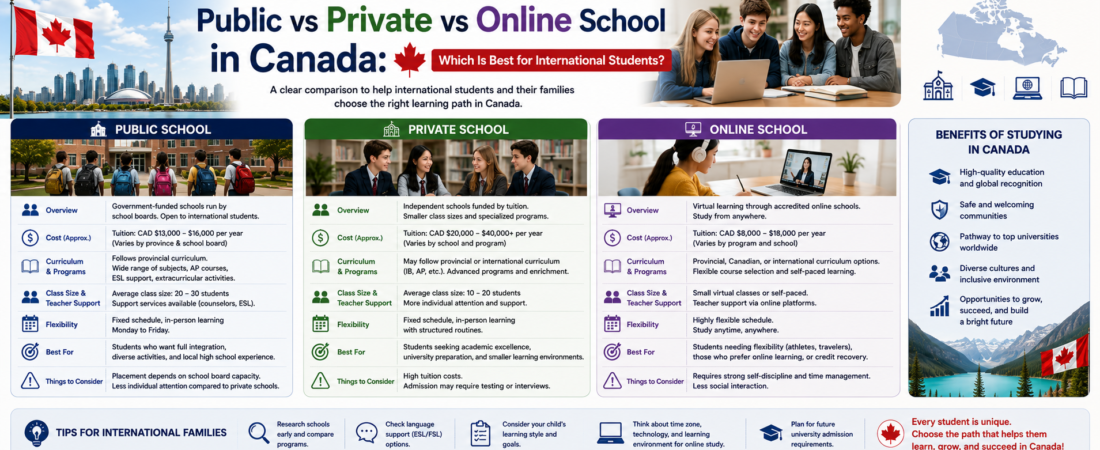
Public vs Private vs Online School: Quick Comparison
| Feature | Public School | Private/Independent School | Online Learning |
|---|---|---|---|
| Tuition | Usually publicly funded for eligible domestic students; international fees may apply | Usually tuition-based | Depends on province, eligibility, and program |
| Location | In-person school | Usually in-person; boarding possible | Primarily remote |
| Curriculum | Provincial | Regulated under provincial framework | Provincial/recognized program |
| Teacher | Certified teacher | Qualified according to applicable provincial rules | Certified teacher in recognized programs |
| Flexibility | Lower | Depends on school | Usually higher |
| Social interaction | High daily peer contact | High daily peer contact | More intentional planning may be needed |
| Transportation | Daily commute | Often daily commute, sometimes longer | Usually no daily school commute |
| ELL support | Varies by district/school | Varies by institution | Varies by program |
| Extracurriculars | Often school-based | Varies widely | Often community-based or program-specific |
| Parent involvement | Moderate | Varies | Often higher organizational involvement |
| Technology dependence | Moderate | Moderate | High |
| University pathway | Yes, with proper courses | Yes, with proper courses | Yes, if recognized credits and prerequisites are completed |
| Class environment | Group classroom | Depends on school | Remote/virtual |
| International support | Often district-based | School-specific | Program-specific |
The key word throughout this table is varies.
There is no school type that is automatically best in every category.
Cost: Which Option Is More Expensive?
Cost is often the first concern for international families, but comparing school types requires more than looking at tuition alone.
Public School
Potential costs may include:
- International student tuition
- Homestay
- Transportation
- School supplies
- Sports fees
- Field trips
- Optional activities
Eligible domestic students usually do not pay regular tuition, but international students often do.
Private or Independent School
Potential costs may include:
- Tuition
- Application or registration fees
- Uniforms
- Transportation
- Technology fees
- Extracurricular fees
- Boarding, where available
- School trips
Private-school costs can vary enormously.
Online Learning
Potential costs may include:
- Computer
- Reliable internet
- Learning materials
- Technology
- Community sports or clubs
- Tutoring where needed
Eligibility and tuition arrangements depend on the province and program.
Because of these differences, parents should compare total annual family cost, not tuition alone.
Class Size and Teacher Attention
Parents sometimes assume private school means small classes.
That is not always true.
Some independent schools deliberately maintain smaller classes, but others may have class sizes similar to public schools.
Likewise, some public schools may offer relatively small classes in specific subjects.
For online learning, the concept of “class size” is different.
Students may participate in:
- Live virtual classes
- Independent asynchronous lessons
- Small-group sessions
- One-on-one teacher communication
Parents should therefore ask specific questions such as:
How often will my child interact directly with the teacher?
How quickly are assignments reviewed?
How much live instruction is provided?
These questions are often more useful than simply asking for a student-teacher ratio.
Is the Curriculum Different?
Public schools follow provincial curriculum requirements.
Private or independent schools operate under provincial rules, but the amount of flexibility can vary by province and school classification.
Some independent schools may add:
- Religious education
- Additional languages
- Advanced academic courses
- Arts programs
- Leadership programs
- Specialized teaching models
Recognized Online Learning also follows the applicable provincial education framework.
In B.C., Online Learning students work with B.C.-certified teachers and their programs meet provincial education standards.
This is one reason recognized Online Learning should not be confused with a private commercial course purchased online.
ESL and ELL Support for International Students
Families often see terms such as ESL and ELL.
ESL means English as a Second Language.
ELL commonly refers to English Language Learning or English Language Learner support.
Terminology varies among school systems.
Support may include:
- Language assessment
- Academic English
- Reading and writing support
- ELL classes
- Classroom support
- School counselling
- International student services
Large public school districts may have established international education and ELL systems.
Private schools may also provide strong language support, but the quality and amount vary by institution.
Online programs may provide language help, but students usually have fewer spontaneous opportunities to practice conversational English during lunch, hallways, sports, and other daily school activities.
That does not mean online students cannot learn English effectively.
It means families may need to create more social and language opportunities outside the online classroom.
Which Option Is Better for Learning English?
For a newcomer student, daily in-person school can provide many opportunities to use English naturally.
Language practice happens not only during English class but also through:
- Group projects
- Lunch
- Sports
- Clubs
- Teacher conversations
- Friendships
- School events
This can make public or private in-person schools attractive for students who want daily language immersion.
However, attending an in-person school does not guarantee rapid fluency.
Students develop language at different speeds.
Online students can also improve through community sports, youth programs, volunteering, libraries, tutoring, and social activities.
The better question is:
How many meaningful opportunities does the student have to use English every week?
Extracurricular Activities
Extracurricular opportunities are another important difference.
Public Schools
Depending on the school, options may include:
- Basketball
- Soccer
- Volleyball
- Track and field
- Band
- Choir
- Drama
- Robotics
- Student council
- Leadership
- Debate
- Volunteer clubs
Larger high schools may have particularly broad offerings.
Private Schools
Independent schools vary enormously.
Some have extensive athletics, music, arts, leadership, and international programs.
Others are smaller and may have fewer total clubs or electives.
Online Learning
Online students may have fewer built-in daily school activities.
They may rely more on:
- Community sports
- Recreation centres
- Music schools
- Libraries
- Youth groups
- Volunteer organizations
- Local clubs
For some students, this works very well.
For others, the lack of a daily school community can feel isolating.
University Preparation
All three school types can lead to university.
What matters is whether the student earns a recognized credential and completes the required prerequisites.
Private-school attendance does not automatically improve university admission chances.
Online schooling does not automatically reduce university admission chances.
Universities care about factors such as:
- Recognized academic credentials
- Required Grade 11 or Grade 12 courses
- Grades
- Program prerequisites
- English-language requirements
- Additional application components where applicable
Families should research university admission requirements before choosing senior high-school courses.
British Columbia Example: Dogwood Diploma
In British Columbia, students working toward the B.C. Certificate of Graduation, commonly called the Dogwood Diploma, must earn at least 80 credits and complete provincial graduation assessments.
The current B.C. assessment framework includes:
- Grade 10 Numeracy Assessment
- Grade 10 Literacy Assessment
- Grade 12 Literacy Assessment
These are British Columbia requirements, not Canada-wide requirements.
Students attending public schools, qualifying independent schools, or recognized Online Learning programs can work toward B.C. graduation through eligible courses.
Parents should always verify that the program they choose leads to the credential the student actually needs.
Public School: Advantages and Challenges
Public school may work especially well for students who value everyday interaction.
Potential advantages include established local school systems, face-to-face teaching, a broad peer environment, clubs, sports, community integration, and possible ELL support.
Another benefit can be convenience.
A neighbourhood school may be relatively close to home.
However, public school also has limitations.
Students have less scheduling flexibility, and families may be restricted by catchment boundaries or course availability.
Some students may also find a large school environment overwhelming.
International students may face tuition and additional administrative requirements.
Private School: Advantages and Challenges
Private or independent schools can appeal to families looking for a particular educational philosophy or specialized environment.
Potential advantages may include:
- Specific academic focus
- Religious education
- Arts or language specialization
- Smaller learning communities
- Boarding options
- Different extracurricular programs
The challenge is cost.
Tuition can be substantial.
Parents should also avoid assuming that expensive automatically means better.
A smaller independent school may have fewer Grade 11 and 12 course options than a large public secondary school.
That could matter if the student later wants a specialized university program.
Families should ask about actual senior-course availability before enrolling.
Online Learning: Advantages and Challenges
Online Learning can offer a level of flexibility that traditional schools cannot.
It may suit students who are athletes, performers, frequent travellers, or simply more productive with a flexible schedule.
Benefits may include:
- No daily school commute
- Flexible scheduling
- Ability to study from different locations
- Access to courses not available locally
- More control over daily routine
But flexibility comes with responsibility.
Online students may need strong:
- Time-management skills
- Self-motivation
- Organization
- Technology skills
Younger students may need substantial parental supervision.
Families may also need to create social and extracurricular opportunities separately.
What Type of Student May Prefer Each Option?
Public school may suit a student who enjoys classroom interaction, wants school sports and clubs, benefits from face-to-face instruction, and wants to build local friendships.
Private school may suit a family that has identified a specific institution whose philosophy, academic focus, language program, religious environment, or extracurricular offerings fit the student’s needs.
Online Learning may suit a student who is self-motivated, organized, comfortable using technology, and needs significant scheduling flexibility.
These are not rules.
A highly independent student may still prefer public school.
A student needing structure may succeed in the right online program with strong family support.
Transportation and Daily Routine
Transportation is easy to overlook when comparing schools.
A public-school student may walk, use transit, receive eligible school transportation, or be driven by family.
Private-school students sometimes travel farther because enrolment is not necessarily tied to local neighbourhood catchments.
Online students eliminate the daily school commute, but that does not mean they never travel.
They may still need transportation for:
- Sports
- Music
- Clubs
- Tutoring
- Volunteer activities
- Social events
A 45-minute commute each way can significantly change family life.
School location should therefore be part of the decision.
International Student Adjustment
International students are adjusting to more than a new curriculum.
They may also face:
- A new language
- New classroom expectations
- Different teacher-student relationships
- New friendships
- Course-selection decisions
- Homesickness
- New extracurricular activities
In-person schools provide built-in contact with peers every day.
Online students may need to create those social connections more intentionally.
Neither experience is automatically better.
The student’s personality matters.
An outgoing student may quickly build friendships in a large public school.
Another student may feel more comfortable beginning in a smaller environment.
Elementary Students vs High School Students
Age matters when choosing a school type.
For an elementary student, families should think about:
- Supervision
- Reading
- Numeracy
- Play
- Language development
- Routine
- Social interaction
Online learning can require particularly active family involvement for younger children.
For high-school students, the decision becomes more academic.
Parents must consider:
- Graduation credits
- Grade 10–12 courses
- Prerequisites
- University plans
- Transcripts
- Course availability
A school that works well for a Grade 3 student may not be the best choice for Grade 11.
Questions to Ask Before Choosing a School
Before enrolling, parents should ask the school or program several practical questions:
- Is this school officially recognized?
- Which provincial curriculum does it follow?
- What is the total tuition and additional cost?
- What ELL support is available?
- What Grade 11 and Grade 12 courses are offered?
- Can my child complete university prerequisites here?
- What sports and clubs are available?
- What is the actual learning environment?
- How much parent involvement is expected?
- How long will the daily commute be?
- What social support is available?
- What happens if the student transfers later?
- How are international transcripts evaluated?
- What specific support exists for international students?
These questions usually reveal more than school marketing materials.
Red Flags Families Should Watch For
Families should be cautious if a school or program cannot clearly explain its academic status.
Warning signs may include:
- Unclear recognition or accreditation
- Vague graduation claims
- Guaranteed university admission
- No transparent tuition or refund policy
- Unclear teacher qualifications
- No clear curriculum information
- Pressure to enroll immediately
- Claims that private school automatically guarantees better results
- Confusing Online Learning with homeschooling
A legitimate school should be able to explain how students earn credits and what credential they can receive.
Canada vs South Korea: School Choice
Korean families may find the Canadian school-choice process unfamiliar.
In Canada, families may consider local public schools, independent schools, online education, language programs, specialized academic programs, arts programs, or other alternatives.
In South Korea, school assignment structures, private education, university preparation, and school culture follow a different framework.
The most useful comparison is not:
“Which country has better schools?”
Instead, families should ask how each system fits their child’s needs.
Canadian education often places considerable responsibility on students and parents to understand course selection, prerequisites, extracurricular opportunities, and provincial graduation rules.
For international families, learning how to navigate those choices can be just as important as choosing between public and private education.
Which Is Best for International Students?
There is no universal best option.
A better approach is to start with the family’s priority.
| Priority | Option Worth Investigating First |
|---|---|
| Daily English interaction | In-person public or private school |
| Lower tuition for eligible domestic families | Public school |
| Particular educational philosophy | Private/independent school |
| Maximum scheduling flexibility | Online Learning |
| School sports and clubs | Compare individual in-person schools |
| University preparation | Any recognized pathway with correct prerequisites |
| Strong newcomer support | Compare actual ELL/international services |
| No daily commute | Online Learning |
| Large peer environment | Often larger public schools |
| Small-school environment | Compare specific independent and public schools |
The most important lesson is this:
Compare individual schools, not only school categories.
A strong public school may be a much better fit than the wrong private school.
A well-designed online program may be excellent for one student and frustrating for another.
Frequently Asked Questions
Are public schools free in Canada?
Public education is generally provided without regular tuition to eligible domestic students. International students may be charged tuition depending on their status and school district.
Do international students pay tuition at public schools?
Many fee-paying international students do. Tuition varies by district, province, grade, and program.
Are private schools better than public schools?
Not automatically. School quality, programs, teachers, course offerings, and student fit vary substantially.
Do private schools always have smaller classes?
No. Some do, but families should verify actual class sizes with individual schools.
Can online students graduate from high school?
Yes, when students complete recognized provincial graduation requirements through eligible Online Learning programs.
Can online students attend university?
Yes. Universities focus on recognized credentials, required courses, grades, and program-specific admission requirements.
Is online school the same as homeschooling?
No. In B.C., they are officially different pathways. Online Learning involves enrolled students and B.C.-certified teachers, while homeschooling places primary educational responsibility on the parent or guardian.
Which school type is best for learning English?
In-person public or private schools may provide more daily opportunities for natural conversation, but the quality of ELL support and the student’s participation matter greatly.
Do public schools provide ELL support?
Many do, but services vary by district and school.
Can students transfer between school types?
Often yes, but credit recognition, registration, course availability, and graduation requirements should be checked before transferring.
Final Thoughts
Public, private, and online schools can all be valid educational pathways in Canada.
The best choice depends on the student.
Families should consider:
- Academic goals
- English ability
- Personality
- Budget
- University plans
- Need for flexibility
- Social preferences
- Transportation
- Course availability
One principle is especially useful:
School type matters, but the quality and suitability of the individual school or program matter more.
For families in British Columbia, it is also essential to remember that in-person schooling, Online Learning, and homeschooling are distinct educational approaches. The province’s official comparison specifically differentiates these options by teacher supervision, curriculum, assessment, enrollment status, and graduation pathway.
B.C. Online Learning involves certified teachers and recognized provincial educational programs, while homeschooling places primary educational responsibility on parents or guardians.
Before enrolling, international families should verify the school’s recognition, tuition, language support, senior course availability, graduation pathway, and university prerequisites.
Choosing well is less about finding the school with the most impressive label and more about finding the environment where a particular student can learn, participate, and progress toward long-term goals.
Sources and Further Reading
For general information about how Canadian education is organized, the Council of Ministers of Education, Canada explains the responsibilities of provinces and territories and the regional differences among education systems.
For British Columbia, the provincial Classroom Alternatives guide directly compares homeschooling, Online Learning, and in-person education.
The B.C. Online Learning pages explain how students can work with B.C.-certified teachers, enroll in provincial or district online programs, and earn recognized credits.
The B.C. government also publishes separate guidance on homeschooling, including parent responsibilities and annual registration.
For secondary graduation, the B.C. Curriculum website confirms the minimum 80-credit requirement and provincial graduation assessments for the Dogwood Diploma.
Information last checked: August 29, 2026.
Tuition, admission rules, curriculum requirements, Online Learning policies, ELL services, and graduation requirements can change. Families should verify current information with the relevant provincial education authority and individual school or district.
SEO Settings for WordPress
SEO Title:
Public vs Private vs Online Schools in Canada
Meta Description:
Compare public, private and online schools in Canada by cost, curriculum, ELL support, university preparation, flexibility and student life.
URL Slug:public-private-online-school-canada-comparison
Category:Study Abroad
Tags:Public School Canada, Private School Canada, Online Learning Canada, International Students Canada, Canadian Education, ELL Support Canada, Study in Canada, BC Online Learning
Excerpt:
Public, private or online school—which is right for an international student in Canada? This practical guide compares costs, curriculum, English support, extracurricular activities, university preparation, flexibility and the important difference between Online Learning and homeschooling.