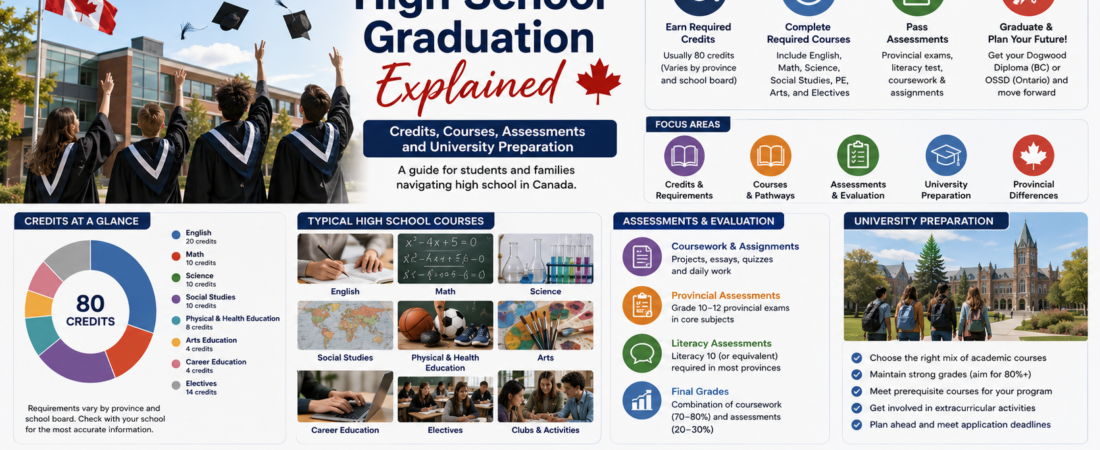
For international families, Canadian high school can be confusing at first.
Terms such as credits, electives, prerequisites, graduation assessments, transcripts, Dogwood Diploma, and university admission requirements may all be unfamiliar. To make things more complicated, Canada does not have one national high school graduation system.
Each province and territory sets its own graduation rules.
That means a student graduating in British Columbia may follow a different credit system from a student in Ontario, Alberta, Quebec, or another province.
For parents, there is one especially important idea to understand:
Graduating from high school and qualifying for university are not the same thing.
A student can complete all provincial high school graduation requirements and still be missing a course required for admission to a particular university program.
For that reason, high school planning should not begin in the final months of Grade 12.
A better approach is to think of Canadian high school as a four-year process:
Grade 9 → Grade 10 → Grade 11 → Grade 12 → Graduation → University or another post-secondary pathway
This guide explains that process, with British Columbia as the main detailed example.
Information in this article was checked in August 2026. Graduation requirements, course prerequisites, provincial assessments, and university admission policies can change. Always verify important decisions with your provincial education authority, school, and official university admissions websites.
How High School Graduation Works in Canada
Canada does not operate a single national K–12 education system.
Provinces and territories are responsible for elementary and secondary education, so each jurisdiction determines its own curriculum, graduation requirements, credit system, assessment requirements, and credentials.
This is why parents should be careful when searching online for information about “Canadian high school graduation.”
A rule that applies in Vancouver may not apply in Toronto or Calgary.
In general, high school students complete a combination of:
- Required courses
- Elective courses
- Provincial or school-based graduation requirements
- Credits needed for the provincial credential
However, the exact details vary.
British Columbia, for example, awards the B.C. Certificate of Graduation, commonly called the Dogwood Diploma, to students who successfully meet its provincial graduation requirements. Students in the current B.C. Graduation Program need at least 80 credits and must complete provincial graduation assessments.
That 80-credit rule is specific to B.C. It should not be treated as a national Canadian requirement.
What Are High School Credits?
A credit is a way of recording successful completion of an approved course or other recognized learning.
Students accumulate credits as they progress through high school.
A typical course may be worth a set number of credits. Those credits contribute toward the minimum required for graduation.
Two broad categories are important:
Required credits come from subjects or areas that every student in the provincial graduation program must complete.
Elective credits give students more choice. These may include additional sciences, arts, technology, business, languages, physical education, or other approved courses.
Credits are essential for graduation, but collecting enough credits does not automatically mean a student is prepared for every university program.
For example, a student may have enough total credits to graduate but not have the senior mathematics or science courses required for engineering.
Required Courses vs Elective Courses
Most Canadian high school systems require students to complete certain core subject areas.
Depending on the province, these may include:
- Language arts or English
- Mathematics
- Science
- Social studies
- Physical and health education
- Career education
- Arts or applied skills
Students then use electives to explore interests or prepare for future studies.
Electives can be especially important because they allow students to build an academic profile suited to their goals.
A student interested in engineering may choose more mathematics and science.
A student interested in visual arts may take art, design, media, or technology courses.
A future business student may choose economics, accounting, entrepreneurship, or advanced mathematics where available.
There is no single “best” set of electives.
The right combination depends on graduation requirements, interests, future programs, workload, and school availability.
Grade 9: Build the Foundation
Grade 9 is an important transition year.
In many school systems, students begin to experience more independent learning, multiple teachers, changing classrooms, deadlines, projects, and greater responsibility for organizing their own work.
For families, Grade 9 should usually be about building a strong foundation rather than deciding on one final career.
Useful priorities include:
- Developing good study habits
- Learning how the school schedules courses
- Understanding academic expectations
- Exploring interests
- Joining school activities
- Learning how to use the student portal
- Meeting counsellors when needed
- Beginning to understand how high school planning works
Grade 9 is also a useful time to identify strengths and weaknesses.
If a student enjoys science but struggles with mathematics, addressing that early may be helpful before senior courses become more demanding.
Parents should also begin learning the language used in Canadian schools.
Terms such as prerequisite become increasingly important in Grades 10–12.
A prerequisite is a course that must usually be completed before taking another course.
For example, one Grade 11 mathematics course may be needed before a student can register for a particular Grade 12 mathematics course.
Missing one prerequisite can sometimes affect several later choices.
Grade 10: Graduation Planning Becomes More Important
Grade 10 is where graduation planning becomes much more concrete.
Students begin completing courses that may count directly toward their provincial graduation credential.
This is also the stage where families should begin asking:
What courses are required for graduation?
What assessments are required?
What Grade 11 courses will my child need next year?
What kinds of post-secondary programs might interest them?
For students in British Columbia, Grade 10 is part of the provincial Graduation Program.
B.C. students working toward the Dogwood Diploma must complete the Grade 10 Numeracy Assessment and Grade 10 Literacy Assessment as graduation requirements.
The Grade 10 Numeracy Assessment measures how students apply numerical thinking and problem-solving skills across different contexts rather than testing only one particular mathematics course.
Likewise, the Grade 10 Literacy Assessment evaluates students’ ability to understand, analyze, and communicate ideas using a range of texts. It is also not tied to one specific subject course.
These are B.C.-specific requirements.
Families in other provinces should check their own education ministry’s graduation rules.
Grade 11: University Preparation Starts to Matter More
Grade 11 is often one of the most important planning years for students considering university.
This is because Grade 11 courses can determine which Grade 12 courses a student will be able to take.
Imagine a student who decides in Grade 12 that they want to study engineering.
They may discover that a required Grade 12 science course has a Grade 11 prerequisite they never completed.
At that point, scheduling can become difficult.
That is why students should begin researching possible university programs in Grade 11, even if they are not ready to choose one university.
They do not need to know their entire future.
They simply need enough information to keep important options open.
Depending on the student’s interests, this might involve reviewing courses such as:
- English
- Pre-calculus or other mathematics
- Biology
- Chemistry
- Physics
- Social sciences
- Languages
Not every student needs all of these subjects.
The correct course selection depends on the university program being considered.
Grade 12: Graduation and University Admission Come Together
Grade 12 is the year when two different processes happen at the same time.
The student must complete high school graduation requirements.
At the same time, the student may be applying to universities, colleges, institutes, trades programs, or other post-secondary options.
Students should confirm:
- All required graduation credits
- Any remaining provincial assessments
- Grade 12 required courses
- University prerequisites
- Application deadlines
- Transcript accuracy
- Scholarship deadlines where relevant
This is why waiting until Grade 12 to begin planning can create problems.
Some missing requirements may be relatively easy to solve.
Others may require an additional course, summer school, online learning, or even an extra semester.
British Columbia Example: The Dogwood Diploma
The B.C. Certificate of Graduation, commonly called the Dogwood Diploma, is awarded to students who successfully complete the provincial graduation requirements.
Under the current B.C. Graduation Program, students need a minimum of 80 credits.
Of those 80 credits, the current B.C. framework includes 52 required credits and at least 28 elective credits. Students must also earn at least 16 credits at the Grade 12 level, including required senior-level components.
Again, these are British Columbia rules.
B.C. Required Credits at a Glance
The current B.C. Graduation Program includes required coursework in several areas.
| Area | Current B.C. Requirement |
|---|---|
| Physical and Health Education 10 | 4 credits |
| Science 10 | 4 credits |
| Science 11 or 12 | 4 credits |
| Social Studies 10 | 4 credits |
| Social Studies 11 or 12 | 4 credits |
| Mathematics 10 | 4 credits |
| Mathematics 11 or 12 | 4 credits |
| Language Arts 10 | 4 credits |
| Language Arts 11 | 4 credits |
| Required Language Arts 12 | 4 credits |
| Arts Education and/or ADST 10–12 | 4 credits |
| Career-Life Education | 4 credits |
| Career-Life Connections | 4 credits |
Together, these form the core required-credit framework. B.C. students also need elective credits to reach the 80-credit total.
Indigenous-Focused Graduation Requirement
B.C. also has an Indigenous-focused graduation requirement.
Beginning in the 2023/24 school year, students working toward a Dogwood Diploma must complete at least 4 credits of Indigenous-focused coursework.
This requirement does not increase the total beyond 80 credits. Instead, the Indigenous-focused credits are included within the overall graduation program.
Eligible courses may come from several approved options.
Because course availability differs by school, students should ask their school counsellor how they will meet this requirement.
B.C. Graduation Assessments
In addition to credits, students in the B.C. Graduation Program must complete three provincial graduation assessments:
- Grade 10 Numeracy Assessment
- Grade 10 Literacy Assessment
- Grade 12 Literacy Assessment
B.C.’s curriculum information confirms these three assessments as part of the current graduation program.
The Grade 12 Literacy Assessment is completed during Grade 12 and focuses on students’ ability to interpret, analyze, think critically, and communicate ideas across different types of texts.
These assessments are separate from regular course grades.
That distinction is important.
A student can earn credits by successfully completing courses, while still needing to complete one or more graduation assessments before receiving the provincial credential.
Parents should periodically check the student’s graduation status rather than assuming that good course grades mean every requirement has been completed.
Why 80 Credits Does Not Automatically Mean University Admission
This is one of the most important parts of high school planning.
A student can earn the 80 credits required for a B.C. Dogwood Diploma and still not qualify for a particular university program.
Why?
Because graduation requirements and university admission requirements answer two different questions.
High school graduation asks:
Has the student completed enough approved learning to receive the provincial diploma?
University admission asks:
Has the student completed the courses and achieved the grades required for this specific program?
Consider several examples.
An engineering program may require senior mathematics, chemistry, and physics.
A science program may require particular science courses.
A business program may require a specific Grade 12 mathematics course.
An arts program may have different academic requirements.
These are only examples. Requirements differ by institution and program.
A student should therefore never choose Grade 11 and Grade 12 courses based only on the question:
“Does this count toward graduation?”
The second question should always be:
“Does this keep me eligible for the programs I may want later?”
Understanding University Prerequisites
A prerequisite is a course or requirement that must be completed before a student can enter another course or program.
University admissions may consider:
- Required Grade 11 or 12 courses
- Grade 12 English or equivalent
- Mathematics requirements
- Science prerequisites
- Minimum grades
- Competitive admission averages
- English-language requirements where applicable
Competitive admission also matters.
Meeting a university’s minimum requirement does not necessarily guarantee admission.
Some programs receive more qualified applicants than they have spaces available.
That is why official university admissions pages should always be treated as the final source for current entry requirements.
International Students and the Dogwood Diploma
International students studying in British Columbia should pay particular attention to graduation-credit rules.
B.C. has a specific International Student Graduation Credit Policy for certain international students who want to earn the Dogwood Diploma.
The policy applies to international students who had not been educated in either English or French for at least two years before arriving in British Columbia.
These students must earn credits through instruction from a B.C.-certified teacher, rather than receiving all of those credits through equivalency or challenge, in several important areas.
Current policy identifies:
- A Grade 11 Language Arts course
- English First Peoples 12 or English Studies 12
- A Grade 11 or 12 Science course
- A Grade 11 or 12 Mathematics course
- A Grade 11 or 12 Social Studies course
- Career-Life Education
International students must also earn Career-Life Connections credit under the supervision of a board of education or independent school authority.
All international students seeking a Dogwood Diploma must satisfy the full graduation requirements, including applicable assessments.
This is why students entering B.C. in Grade 11 or Grade 12 need especially careful planning.
Moving to Canada in Grade 10, 11, or 12
A student arriving in Canada during elementary school usually has many years to adjust.
A student arriving in Grade 11 has much less time.
Schools may need to review previous transcripts and determine how prior learning fits the local graduation program.
Important questions include:
- Which previous courses can receive credit?
- Which courses must be completed locally?
- Does the student have the prerequisite for the next course?
- Are English-language requirements satisfied?
- Can graduation requirements be completed on schedule?
- Will the student have the courses needed for university?
Sometimes a student may need an additional semester.
That should not automatically be viewed as failure.
In some situations, taking more time can allow a student to improve English, complete missing prerequisites, or build a stronger academic record.
What Is a High School Transcript?
A transcript is the official academic record showing courses and grades.
It matters for both graduation and post-secondary applications.
Students should review their transcript periodically to ensure that:
- Completed courses appear correctly
- Grades are accurate
- Transfer credits have been recorded
- Required courses are not missing
International students should keep copies of previous school records.
Official translations may also be required in some situations.
Transcript problems are much easier to resolve when they are discovered early.
The Role of the School Counsellor
School counsellors can be extremely helpful during high school planning.
Depending on the school, counsellors may assist with:
- Course selection
- Graduation checks
- Career exploration
- University planning
- Scholarships
- Academic concerns
- Post-secondary applications
Families should not wait until Grade 12 to speak with a counsellor.
A meeting in Grade 10 or Grade 11 can help identify prerequisite problems before they become difficult to solve.
However, counsellors should not be the only source used for university admission information.
University requirements change, and each institution controls its own admissions policies.
Students should always verify important information directly with the university.
Choosing Courses Strategically
Good course planning requires balance.
Students should think about:
Graduation requirements — What must I complete to receive the diploma?
University prerequisites — What courses will I need for future programs?
Academic strength — Which subjects can I handle successfully?
Interests — What do I actually enjoy learning?
Workload — Can I manage all of these demanding courses at the same time?
Electives — Can I explore music, technology, art, business, leadership, or other interests?
One mistake is choosing courses simply because they seem easy.
Another is choosing the hardest possible schedule simply because it looks impressive.
The better goal is an academically appropriate program that keeps future options open while remaining manageable.
Extracurricular Activities and University Preparation
High school is not only about course credits.
Students may participate in:
- Sports
- Music
- Drama
- Student leadership
- Clubs
- Volunteering
- Part-time work
- Community service
These activities can help students develop communication, teamwork, responsibility, and personal interests.
They may also matter for some scholarships, supplemental applications, or competitive programs.
However, extracurricular activities do not replace academic prerequisites.
A student with excellent leadership experience still needs the required mathematics course if a university program requires it.
Grade 9 to Grade 12 Planning Timeline
A simple timeline can help families understand what matters most at each stage.
| Grade | Main Goal | What Students and Parents Should Do |
|---|---|---|
| Grade 9 | Build a foundation | Develop study habits, explore interests, understand the school system |
| Grade 10 | Understand graduation | Review required credits, electives, assessments, and future course choices |
| Grade 11 | Plan for university | Check prerequisites, research programs, choose Grade 12 courses carefully |
| Grade 12 | Complete and apply | Finish graduation requirements, submit applications, review transcripts and deadlines |
This timeline is not a rigid formula.
Some students know their future goals very early.
Others change direction several times.
The important thing is to avoid closing future options unintentionally.
Common Mistakes International Families Make
One common mistake is assuming that all Canadian provinces use the same graduation requirements.
They do not.
Another is waiting until Grade 12 before researching universities.
By then, a student may discover that a missing Grade 11 prerequisite prevents them from enrolling in the necessary Grade 12 course.
Families may also confuse total graduation credits with university eligibility.
Another mistake is assuming that every course taken overseas will automatically transfer as an equivalent Canadian course.
Transfer-credit decisions and special international-student rules can affect the final graduation plan.
Finally, students sometimes focus only on marks while ignoring whether they are taking the right courses.
A high grade in an elective cannot substitute for a missing required prerequisite.
Canadian High School vs South Korean High School Planning
Canadian and South Korean high schools are both academically diverse, so simple stereotypes are not helpful.
Still, international families may notice differences in how students plan their secondary education.
| Topic | Canada | South Korea |
|---|---|---|
| Education administration | Provincial/territorial | More nationally structured |
| Course choice | Can become highly individualized | Combination of required and selected courses |
| Graduation | Provincial requirements | Nationally structured secondary framework |
| University preparation | Course prerequisites and grades can be critical | School records and admissions processes, including major examinations, can be important |
| Electives | Often significant in senior high school | Available within national curriculum structure |
| School counselling | Often used for course and post-secondary planning | Guidance systems also available |
| Extracurriculars | School and community activities | School and outside-school activities |
| Transcript | Important for graduation and applications | Academic record also important |
One difference that can surprise Korean families is the importance of prerequisite chains.
A student may have to choose a Grade 11 course because it is required to access a Grade 12 course, which in turn is required for a university program.
That makes course planning a multi-year process.
But it would be inaccurate to describe Korea as only exam-focused or Canada as only course-focused.
Both systems use multiple forms of academic evaluation and continue to evolve.
Questions Parents Should Ask Every Year
Parents do not need to manage every homework assignment, but a yearly academic check can be very useful.
Ask:
- Is my child on track to graduate?
- Are all required credits being completed?
- Are any graduation assessments still outstanding?
- Does my child have the prerequisites for next year’s courses?
- Do these courses meet the requirements of possible university programs?
- Are transferred credits recorded correctly?
- Is the transcript accurate?
- Are there important application deadlines ahead?
- Should we meet with a school counsellor?
- Does the student need additional time or another course?
These questions become increasingly important from Grade 10 onward.
Frequently Asked Questions
How many credits do students need to graduate in Canada?
There is no single national number. Graduation requirements are set by provinces and territories.
Does every province require 80 credits?
No. The 80-credit requirement is specific to British Columbia’s current Dogwood Diploma program.
What is the Dogwood Diploma?
It is the common name for the British Columbia Certificate of Graduation.
What assessments do B.C. students need?
Students in the current B.C. Graduation Program complete the Grade 10 Numeracy Assessment, Grade 10 Literacy Assessment, and Grade 12 Literacy Assessment.
Can a student graduate without attending university?
Yes. High school graduation is separate from university attendance. Graduates may choose college, trades, employment, training, a gap year, or other pathways.
Are university requirements the same as graduation requirements?
No. A student can qualify for a high school diploma without having the prerequisites for a specific university program.
Can international students receive a Dogwood Diploma?
Yes, provided they meet the applicable B.C. graduation requirements. Certain international students must also satisfy additional rules about where particular credits are earned.
Do Grade 11 marks matter for university?
They may. Universities determine their own admission practices, and Grade 11 courses can also be essential prerequisites for Grade 12 courses.
Can students change courses in Grade 12?
Often yes, but changes depend on school availability, prerequisites, timing, and graduation requirements. Students should speak with their counsellor before changing an important course.
What happens if a student is missing a required credit?
The student may need another approved course or another recognized way of earning the requirement. The school should review the student’s graduation plan and available options.
Final Thoughts
Canadian high school graduation should be viewed as a multi-year planning process, not as something students think about only in Grade 12.
The most useful progression is:
Grade 9 — build the foundation
Grade 10 — understand graduation requirements
Grade 11 — protect university options through prerequisite planning
Grade 12 — complete graduation requirements and apply to post-secondary programs
For students in British Columbia, the current Dogwood Diploma requires at least 80 credits, including required and elective credits, as well as provincial graduation assessments.
B.C. students must also meet the Indigenous-focused graduation requirement, which involves at least four credits of eligible Indigenous-focused coursework without increasing the overall 80-credit total.
International students should pay particular attention to the province’s International Student Graduation Credit Policy because certain students must complete specified courses through instruction from a B.C.-certified teacher.
But perhaps the most important message is this:
Graduation requirements and university admission requirements are related, but they are not the same.
Parents and students should check both.
A strong high school plan does more than ensure that a student receives a diploma.
It helps preserve choices for what comes next.
Sources and Further Reading
For the most reliable current information, use official education sources.
The B.C. Ministry of Education and Child Care provides the official Dogwood Diploma requirements, including the 80-credit minimum.
The B.C. Curriculum website provides current information on the Graduation Program and provincial numeracy and literacy assessments.
The province also provides separate official guidance for the Indigenous-focused Graduation Requirement.
International families should review B.C.’s International Student Graduation Credit Policy for current requirements affecting certain international students.
Information last checked: August 29, 2026.
Graduation requirements, assessments, course prerequisites, and university admission policies can change. Students and families should verify current information with provincial education authorities, their school, and official university admissions websites.
SEO Settings for WordPress
SEO Title:
Canadian High School Graduation & University Guide
Meta Description:
Learn how Canadian high school graduation works, including B.C. credits, Dogwood Diploma assessments, Grade 9–12 planning and university prerequisites.
URL Slug:canadian-high-school-graduation-university-guide
Category:Study Abroad
Tags:Canadian High School Graduation, BC Dogwood Diploma, BC Graduation Requirements, High School Credits Canada, University Preparation Canada, International Students Canada, Grade 9 to Grade 12, Study in Canada
Excerpt:
Planning Canadian high school from Grade 9 to Grade 12? This guide explains credits, B.C.’s Dogwood Diploma, graduation assessments, international student rules, transcripts and the important difference between graduating from high school and qualifying for university admission.