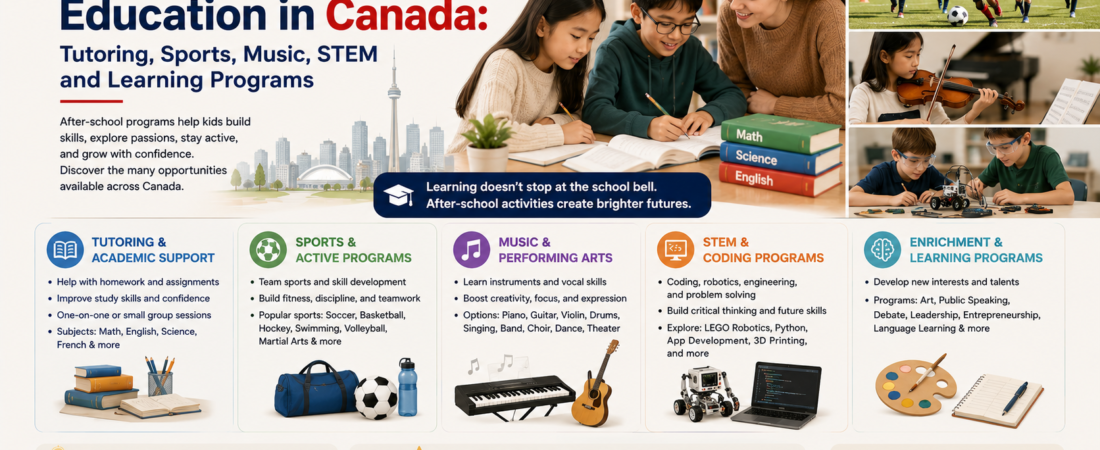
What do children in Canada usually do after school?
For international parents, especially those coming from countries where private academies play a major role in education, the answer can be surprising.
Some Canadian students go directly home after school. Others attend childcare programs, receive math or English tutoring, join sports teams, learn piano or violin, participate in coding and robotics programs, or spend time at libraries and community centres.
There is no single Canadian after-school routine.
One family may prioritize academic tutoring. Another may choose swimming and music. A teenager preparing for university may spend more time on mathematics or science support, while a younger child may participate mainly in sports, art, or reading programs.
This raises an interesting question for Korean and other international families:
Does Canada have the same kind of private after-school education culture as South Korea?
Canada certainly has tutoring centres, private lessons, enrichment programs and specialized academies. However, after-school learning is also widely spread across sports, arts, recreation, libraries, community programs and school clubs.
This guide explains the main after-school education options in Canada, how much families should expect to plan for, and how the Canadian approach generally differs from South Korea’s private education environment.
Information in this article was checked in August 2026. Program availability, fees, school activities and community centre schedules vary by city, school district and provider.
What Does “After-School Education” Mean in Canada?
The term can cover much more than academic study.
After-school education may include academic tutoring, language support, music lessons, sports, STEM programs, school clubs, community centre classes, public library programs, youth activities and childcare.
Canada’s federal newcomer information specifically encourages families to explore community centres, recreation centres and libraries, noting that these facilities commonly offer services such as swimming lessons, fitness and dance classes.
That illustrates an important difference for newcomers.
In Canada, learning outside school often includes academic, physical, creative and social development, rather than only extra classroom instruction.
Is Tutoring Common in Canada?
Tutoring is readily available in Canadian cities, but it would be inaccurate to say that every student attends a tutoring centre.
Parents may use tutoring for several different reasons.
A student who is struggling in mathematics may receive temporary one-on-one help. A child who recently arrived in Canada may need additional reading or writing practice. A high-school student may seek support in chemistry, physics, pre-calculus or another demanding course.
Other students attend tutoring for enrichment rather than remediation.
Tutoring can take several forms:
- Individual tutoring
- Small-group classes
- Online tutoring
- Learning centres
- Homework support
- School-based academic help
The appropriate choice depends on the student’s age, academic needs, learning style and family budget.
For parents, the most useful question is often not “Should my child attend tutoring?” but “What specific problem are we trying to solve?”
English and Math Tutoring
Mathematics and language subjects are among the areas where parents often look for additional help.
For younger children, tutoring may focus on foundational reading, writing, spelling or number skills.
For older students, the focus may shift to essay writing, algebra, functions, chemistry, physics or university prerequisites.
It is useful to distinguish several types of academic support.
Remedial tutoring helps a student catch up in an area where they are struggling.
Enrichment gives students additional or more advanced work beyond the regular classroom.
Homework support helps students understand assignments and organize their work.
Exam or course preparation may become more important in senior high school.
Newcomer families should also ask what support is already available through the school before automatically paying for private instruction.
Structured Learning Centres vs Private Tutors
Canada also has structured supplemental learning programs that use worksheets, repeated practice and gradual progression.
These can be useful for some children, particularly those who benefit from routine and consistent practice.
They differ from private tutoring.
| Feature | Structured Learning Centre | Private Tutor |
|---|---|---|
| Learning format | Standardized or structured sequence | More individualized |
| Pace | Often self-paced within a system | Adjusted by tutor |
| Main focus | Repeated practice and skill development | Specific student needs |
| Homework | Often regular | Depends on tutor |
| Personalization | Moderate | Usually higher |
| Scheduling | Fixed program schedule | Often more flexible |
| Best suited for | Students who like routine | Students needing targeted help |
Neither model is automatically better.
A child who needs repeated arithmetic practice may respond well to a structured program, while a student struggling with a particular Grade 11 math concept may benefit more from individualized instruction.
Coding, Robotics and STEM Programs
STEM stands for science, technology, engineering and mathematics.
Many communities offer after-school activities related to coding, robotics, engineering design, science experiments and game development.
These programs may be offered by private companies, schools, public libraries, community centres or non-profit organizations.
Public facilities can sometimes provide surprisingly strong options.
For example, Vancouver’s municipal recreation system lists educational activities that include computer and technology programs as well as math, science and English activities.
Vancouver Public Library also offers STEM and STEAM activities in which children can create, build and code.
Older students may find more specialized opportunities, including coding workshops or game-development activities. In 2026, Vancouver Public Library’s teen programming included activities involving 3D game development, reading, writing and digital skills.
Parents should view coding as one possible enrichment activity, not as a guaranteed route to a technology career.
For many children, the value is simply learning to solve problems, experiment, create and work through mistakes.
Music Lessons After School
Music is another common extracurricular option.
Students may study:
- Piano
- Violin
- Guitar
- Voice
- Drums
- Music theory
- Band instruments
Lessons may take place privately, through community music schools or through school programs.
The cost can vary substantially because families may need to consider not only lesson fees but also instrument purchase or rental, books, examination fees, recital costs and practice time.
School-based music can sometimes reduce the need for private lessons.
For example, some middle and high schools offer band, choir, jazz band or orchestra as classes or extracurricular activities.
Before paying for private music instruction, families may want to check what their child’s school already provides.
Swimming Lessons
Swimming is a widely available community activity in many Canadian cities.
Municipal recreation centres commonly provide learn-to-swim programs for children and teens, along with public swim sessions and advanced aquatic training.
For example, Vancouver’s recreation system includes swimming lessons, pools and other aquatic activities as part of its public recreation services.
This should not be interpreted as meaning every Canadian child takes swimming lessons.
Rather, swimming is an example of how municipal recreation systems can become part of a family’s after-school education plan.
Families should check registration dates carefully. Popular programs can fill quickly.
Soccer
Soccer may be offered through community clubs, recreational leagues, competitive clubs or schools.
Recreational programs generally involve a lower time commitment, while competitive teams may require multiple practices, weekend games, tournaments and travel.
Costs may include registration, uniforms, footwear, equipment and tournament fees.
The distinction between recreational and competitive participation matters.
A child who simply wants exercise and fun may not need a highly competitive club.
For parents, travel time can also become a major factor. A program that looks affordable may become less practical if practices are held far from home several times each week.
Basketball
Basketball can be available through schools, community centres, private training programs and local youth leagues.
For many families, school basketball or recreation-centre programs may be a convenient starting point.
Private training is another option, but it is not necessary for every child.
The level of competition varies widely.
A beginner looking for exercise and social interaction has very different needs from a high-school athlete trying to make a competitive team.
Skating, Hockey and Ice Sports
Ice sports are one of the more distinctive parts of Canadian recreation culture.
Families may find:
- Learn-to-skate programs
- Recreational skating
- Figure skating
- Hockey
- Ringette
- Ice-skating camps
Municipal recreation systems often operate public ice rinks and lessons. Vancouver, for example, provides skating programs and public rink access through its city recreation system.
However, families should budget carefully.
Skating programs may require registration, equipment, helmet purchase or rental and transportation.
Competitive hockey can involve a much larger financial and scheduling commitment.
And despite Canada’s international association with hockey, not every Canadian child plays hockey.
Community Centres: One of the Most Useful Resources for Families
For newcomers, community centres can be one of the most valuable discoveries in Canada.
Municipal recreation centres may offer sports, arts, dance, swimming, skating, fitness, educational workshops and youth programs.
Vancouver, as one city example, operates 24 community centres offering activities that include fitness, arts and crafts, culture, dance, swimming, skating and childcare.
Its youth recreation programs include sports, recreational, cultural, social and educational activities.
This is useful for international families because community centres can provide an alternative to enrolling a child in multiple private academies.
Programs are often seasonal, and families may be able to choose a short course before committing to a full year.
Some municipalities also operate reduced-fee or subsidy programs for eligible residents. Vancouver, for example, offers a Leisure Access Program for qualifying low-income residents.
Policies differ by municipality, so parents should search their own city’s recreation website.
Public Libraries Are More Than Places to Borrow Books
Public libraries can be overlooked by newcomer families.
Many offer far more than books.
Depending on the library system, children and teens may find reading programs, homework resources, technology workshops, social programs and volunteer opportunities.
Vancouver Public Library, for example, currently offers Reading Buddies, STEAM activities, teen programs and homework resources.
Its teen drop-in program provides space to study, ask homework questions and spend time with peers.
These examples matter because after-school education does not always have to involve another monthly private fee.
Families on a limited budget should check the library before assuming every useful activity must be purchased privately.
School Clubs and Extracurricular Activities
Many Canadian schools also offer extracurricular activities.
The exact choices depend on the school, but students may encounter sports teams, drama, choir, band, student leadership, debate, robotics, coding, chess, art or yearbook activities.
Some programs run after school, while others may operate during lunch.
Fees also vary.
Some clubs may be free, while competitive sports can involve uniforms, transportation or tournament costs.
Parents should check school newsletters, websites and announcements because registration periods can be short.
For a newcomer student, a school club can be particularly useful because it combines an activity with opportunities to meet classmates.
After-School Childcare Is Different From After-School Education
Working parents may also need after-school care.
This should not be confused with tutoring or enrichment.
A childcare program may provide supervision, snacks, outdoor play, crafts, games and time for homework.
Its main function is safe care after school rather than intensive academic instruction.
Municipal and community facilities may also provide childcare or day-camp services during professional-development days and school breaks. Vancouver’s community-centre system, for example, offers childcare and school-break day camps.
Parents should therefore ask whether they need childcare, academic help, enrichment, or a combination of these before choosing a program.
How Much Do After-School Activities Cost?
There is no meaningful single Canadian national price.
Costs depend on the activity, location, instructor, competition level and number of sessions.
| Activity | Main Cost Factors |
|---|---|
| Tutoring | Individual vs group, subject, instructor |
| Learning centres | Frequency and program structure |
| Music | Lessons, instrument, books, exams |
| Coding/STEM | Course length, equipment, private vs public provider |
| Swimming | Municipality, level, session length |
| Soccer | Registration, uniform, travel |
| Basketball | League fees, shoes, training |
| Skating | Lessons, skates, helmet |
| Hockey | Equipment, ice fees, travel, competition |
| Community programs | Municipality, length, subsidies |
| School activities | Club fees, equipment, transportation |
Families trying to control costs can begin with schools, libraries and municipal recreation programs before exploring more expensive private options.
Used sports equipment and group lessons can also reduce costs.
What Might a Typical Week Look Like?
A balanced week does not need to contain an activity every day.
For example:
| Day | Possible Schedule |
|---|---|
| Monday | School, homework, free evening |
| Tuesday | Swimming |
| Wednesday | Math tutoring |
| Thursday | School club |
| Friday | No scheduled activity |
| Saturday | Soccer or music |
| Sunday | Family time and rest |
This is only one example.
Some children thrive with several activities. Others need more unstructured time.
Parents should not feel pressure to fill every afternoon simply because other families seem busy.
How Much Is Too Much?
One of the challenges of after-school planning is that every good opportunity takes time.
A child may enjoy soccer, swimming, piano, coding and tutoring, but attending all five every week could create a difficult schedule.
Families should consider the whole day:
school hours, homework, transportation, meals, sleep, family time and relaxation.
Travel time matters more than many parents expect.
A one-hour lesson may take two hours of family time once driving, parking and waiting are included.
The child’s own interest should also matter.
A program chosen only because a parent thinks it “looks good” may become difficult to sustain.
Canada vs South Korea: After-School Education Culture
Neither Canada nor South Korea has one single after-school lifestyle.
Still, there are meaningful differences in how private education fits into everyday family life.
South Korea’s Ministry of Education and national statistical authorities conduct an annual private-education survey. In 2025, 75.7% of elementary, middle and high school students participated in private education, according to the government’s 2026 release. The official definition includes academy classes, individual or group tutoring, worksheet-based programs and online instruction.
That statistic shows how significant private education remains in Korea.
Canada does not have an directly equivalent national system in which the same percentage can be used to describe “hagwon participation,” so comparisons should be made carefully.
| Topic | Canada | South Korea |
|---|---|---|
| Academic tutoring | Available and used by some families | Private academic education plays a major role |
| Private academies | Tutoring, language, music, coding and sports centres | Hagwons are widely used across academic and non-academic subjects |
| Sports | Strong school and community presence | School, academy and club options |
| Music | School and private lessons | Private academies and lessons common |
| Community centres | Important municipal resource | Different local public-program structure |
| Libraries | Reading, homework and youth programs | Strong public-library system, but different role in after-school routines |
| University preparation | Can increase in high school | Often a major private-education focus |
| Free time | Depends greatly on family | Depends greatly on family |
| Scheduling | Often spread across independent activities | Private study may occupy a larger share for many students |
The biggest difference for many Korean parents is not that Canadian students “do not study.”
They do.
Rather, after-school time in Canada may be spread across a wider combination of academic tutoring, sports, music, arts, community recreation, school clubs and free time.
Older Canadian high-school students may also become much more academically focused when preparing for competitive university programs.
Do Canadian Students Go to “Academies”?
Yes, but the word can mean something different.
Canada has private math centres, tutoring businesses, language schools, music academies, coding programs and sports academies.
However, there is not necessarily one dominant after-school model equivalent to the social role that hagwons can play in Korea.
One child may attend math tutoring.
Another may take piano and swimming.
Another may only play school basketball.
Another may attend no paid after-school program at all.
This diversity is important for newcomer parents to understand.
How Should International Parents Choose?
The best activity depends on the child’s actual need.
If a student is struggling academically, tutoring or school-based support may be appropriate.
If a newcomer child needs more confidence using English, clubs, sports, reading programs and social activities may complement formal language support.
A child interested in technology may enjoy robotics or coding.
A child who needs more physical activity may prefer swimming, basketball, soccer or skating.
Families looking for lower-cost options should usually check school activities, public libraries and municipal recreation programs first.
And sometimes the best choice is no additional class at all.
A free afternoon can also be valuable.
Practical Tips for Newcomer Families
Before registering for activities, check your child’s school website, municipality recreation guide and local public library.
Popular swimming or skating programs may fill quickly, so registration dates matter.
Parents should also check whether equipment is included, whether refunds are available, and whether there is a waiting list.
It is usually better to begin with one or two activities rather than immediately creating a packed schedule.
After several weeks, ask a simple question:
Is this activity helping my child learn, stay active, make friends or enjoy life in Canada?
If the answer is no, there may be a better use of the family’s time and money.
Frequently Asked Questions
Do Canadian students attend private academies?
Some do. Canada has tutoring centres, language schools, music academies, coding programs and sports academies, but participation varies considerably by family.
Is tutoring common in Canada?
Tutoring is widely available, particularly for math, English and senior high-school subjects, but not every student uses private tutoring.
How much does tutoring cost?
Prices vary too widely by city, subject, instructor and lesson format to provide one meaningful Canadian average.
Are community centre programs cheaper?
They can be more affordable than some private programs, but fees vary by municipality. Some cities also offer subsidies for eligible residents.
Do schools offer after-school sports?
Many do, especially at middle and secondary levels, but teams and seasons vary by school.
Are coding classes available for children?
Yes. Coding and STEM activities can be found through private companies, libraries, schools and some community centres.
Do Canadian children take music lessons?
Many do, but participation varies. Music may be studied privately or through school programs.
Do extracurricular activities guarantee university admission?
No. Extracurricular activities can be meaningful experiences, but university admission requirements vary by institution and program. Academic prerequisites remain important.
Are school clubs free?
Some are. Others may involve fees for equipment, travel or competitions.
How many activities should a child take?
There is no ideal number. Parents should consider the child’s age, interest, academic workload, travel time, sleep and family schedule.
Final Thoughts
After-school education in Canada is not one single system.
For some families, tutoring plays an important role.
For others, after-school life may revolve around swimming, soccer, basketball, skating, piano, coding, community programs or school clubs.
The biggest adjustment for international parents may be realizing that education outside school is broader than private academic instruction.
Libraries, community centres, sports teams and school clubs can all become part of a child’s learning and social development.
For Korean families, the contrast with hagwon culture can be significant. South Korea’s official 2025 survey shows that private education remains a major part of student life, while the Canadian after-school environment is generally more fragmented across many different types of programs.
Neither approach should be reduced to a simple “better” or “worse” comparison.
The most useful approach is to ask what your own child needs.
Academic support?
Physical activity?
More opportunities to use English?
Music?
Technology?
Friends?
Or simply more time to rest?
After-school planning works best when activities support the child rather than turning every afternoon into another obligation.
Sources and Further Reading
For current information, families can start with the Government of Canada’s newcomer guidance on community connections, which highlights community centres, recreation centres, libraries and sports as useful local resources.
Municipal recreation websites are also useful. Vancouver’s current recreation system provides examples of youth programs, swimming, skating, arts, educational activities and subsidized access.
Public libraries may offer free or low-cost educational opportunities. Vancouver Public Library’s 2026 resources include Reading Buddies, STEAM activities, homework support and teen programs.
For the Canada–Korea comparison, South Korea’s Ministry of Education released its 2025 Private Education Expenditure Survey in 2026.
Information last checked: August 29, 2026.
Program availability, fees, school activities and community-centre schedules vary by city, school district and provider. Families should check current local information before registering.
SEO Settings for WordPress
SEO Title:
After-School Education in Canada: Tutoring to Sports
Meta Description:
Explore after-school education in Canada, including tutoring, STEM, music, sports, community centres and key differences from Korean hagwon culture.
URL Slug:after-school-education-canada-tutoring-sports-stem
Category:Study Abroad
Tags:After-School Education Canada, Tutoring in Canada, STEM Programs Canada, Kids Activities Canada, Community Centres Canada, Canadian Education, Study in Canada, Canada vs Korea Education
Excerpt:
What do Canadian children do after school? This guide explains tutoring, music, STEM, swimming, soccer, basketball, skating, libraries and community programs, while comparing Canada’s diverse after-school culture with South Korea’s private education and hagwon system.