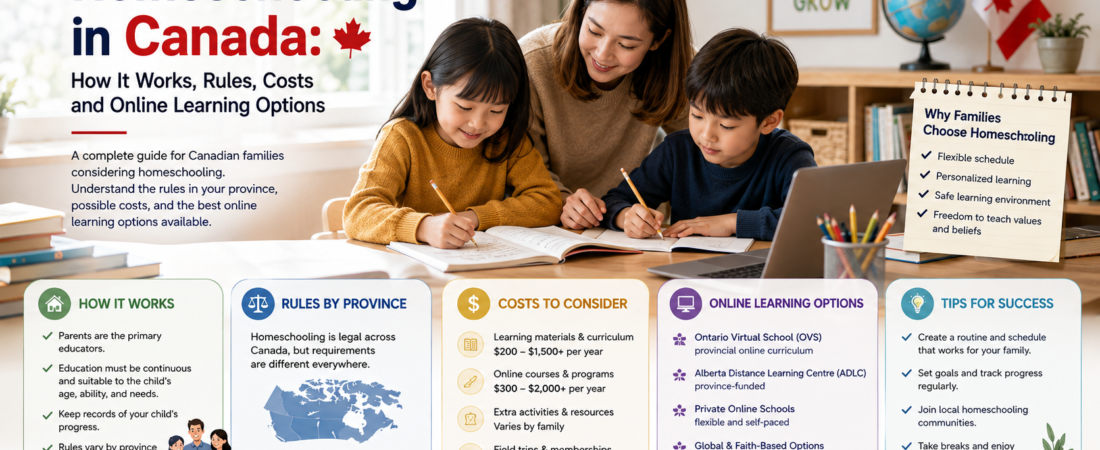
Homeschooling can sound simple at first: instead of sending a child to school every morning, parents teach the child at home.
In Canada, however, the reality is more complicated.
There is no single Canadian homeschooling law that applies in exactly the same way across the country. Education is primarily the responsibility of provinces and territories, which means homeschooling rules, registration procedures, curriculum expectations, assessments, funding and high-school graduation pathways can differ depending on where a family lives.
Another important distinction is often misunderstood:
Homeschooling and online learning are not necessarily the same thing.
A child may study at home in both situations, but who is responsible for the educational program, who teaches and assesses the student, and whether courses count toward an official high-school diploma can be very different.
This guide explains how homeschooling works in Canada, with a detailed look at British Columbia. It also covers online learning, costs, curriculum choices, socialization, high-school graduation and university preparation.
Information in this article was checked in August 2026. Homeschooling regulations and education policies can change, so parents should always verify current requirements with their provincial or territorial education authority.
What Is Homeschooling in Canada?
Homeschooling generally means that a parent or guardian takes primary responsibility for providing a child’s education outside a traditional school environment.
However, the exact legal definition depends on the province.
A homeschool family may use textbooks, online educational resources, library materials, science activities, field trips, community programs or a purchased curriculum. Some families follow a structured daily schedule, while others use a more flexible learning approach.
The important point is that learning at home does not automatically mean homeschooling.
A student enrolled in an officially recognized online school may spend most of the day studying from home but still be considered an enrolled school student.
This distinction is particularly clear in British Columbia, where the provincial government treats registered homeschooling and Online Learning as different educational pathways.
Is Homeschooling Legal in Canada?
Yes. Homeschooling is a recognized educational option in Canada, but regulation happens at the provincial or territorial level.
That means parents should never rely only on a general article about “Canadian homeschooling.”
Depending on where a family lives, they may have to:
- Notify an education authority
- Register the child
- Submit an educational plan
- Maintain records
- Participate in evaluations
- Follow curriculum or learning requirements
- Meet particular reporting deadlines
The requirements can vary significantly.
For example, Alberta offers both supervised funded home education and unsupervised, notification-only home education. Quebec requires parents to submit an annual notice, a learning project and progress reports, and homeschooled students have obligations related to ministerial evaluations.
This is why parents should begin with the rules of the province where they actually live.
Important: Never assume that a homeschooling rule in British Columbia, Alberta, Ontario or Quebec automatically applies elsewhere in Canada.
How Homeschooling Rules Differ Across Canada
Canada’s decentralized education system creates meaningful differences among provinces.
In British Columbia, parents can choose home education and must register a school-age child in accordance with provincial legislation. The parent is responsible for providing the educational program.
In Alberta, parents have two main home-education options: a supervised program connected with a willing school authority, which may receive government funding, or an unsupervised notification-only program that does not receive Alberta Education funding.
In Ontario, provincial policy directs school boards on how children receiving home schooling may be excused from school attendance.
In Quebec, homeschooling involves a comparatively structured process. Parents must provide documents such as an annual notice of intent, a learning project and progress reports, and the child may need to participate in ministerial evaluations.
These examples show why a single “Canadian homeschool checklist” can be misleading.
British Columbia Example: How Homeschooling Works
British Columbia provides a useful example because it clearly separates homeschooling from Online Learning.
Under B.C.’s School Act, a parent may educate a school-age child at home or elsewhere but must provide that child with an educational program. The legislation also requires registration.
B.C.’s current homeschooling guidance states that homeschooling is a recognized educational option in which parents or guardians choose to educate their child outside a public or independent school program.
Registration in B.C.
Under the current School Act, a child being homeschooled must generally be registered each year by September 30 with an eligible school.
Registration does not mean that the homeschooler becomes a regular enrolled student receiving the same educational program as children attending that school.
That difference matters.
The school may provide certain services to the homeschooler, but the parent remains primarily responsible for providing the child’s educational program.
B.C. also provides funding to the registering school, rather than directly to parents. Current provincial information lists grants of $250 per registered homeschooled child for public schools and $175 for eligible Group 1 or Group 2 independent schools.
Families therefore should not interpret the existence of provincial homeschooling grants as direct cash payments to parents.
Homeschooling vs Online Learning in British Columbia
This is probably the most important distinction for families considering home-based education in B.C.
A child can be physically sitting at home with a laptop in both situations, but legally and academically the programs are different.
| Topic | Registered Homeschooling | B.C. Online Learning |
|---|---|---|
| Main educational responsibility | Parent/guardian | School and B.C.-certified educator |
| Student studies at home | Usually | Often |
| B.C. school enrollment | Registered as homeschooler | Enrolled student |
| Teacher involvement | Not the same as regular school instruction | B.C.-certified teacher supervises learning |
| Provincial curriculum | Parent program differs from school enrollment | Meets provincial education standards |
| Assessment | Parent-led according to applicable requirements | Teacher assessment |
| Graduation credits | Homeschool program itself does not automatically create Dogwood credits | Eligible courses can count toward graduation |
| Flexibility | High | High, but within school/course requirements |
| High-school pathway | Requires careful planning | Can provide recognized B.C. course credits |
B.C.’s Ministry of Education and Child Care states that Online Learning allows students to learn from home while connecting with a B.C.-certified teacher. The programs meet provincial education standards, and eligible online courses count toward the B.C. Certificate of Graduation.
This means that purchasing an online homeschool curriculum from a private company is not automatically the same thing as enrolling in a recognized B.C. Online Learning school.
Can Homeschool Students Earn a Dogwood Diploma?
This is one of the most important questions for families with older children.
The Dogwood Diploma is the common name for the British Columbia Certificate of Graduation.
Registered homeschooling by itself does not automatically produce the B.C. course credits required for the Dogwood Diploma. This is why families who intend for their child to earn the provincial credential need to think carefully about the Grade 10–12 years.
B.C. specifically allows registered homeschoolers in Grades 10–12 to access Online Learning programs.
That can allow a student to complete recognized courses and work toward graduation requirements.
Under the current B.C. Graduation Program, students need at least 80 credits to receive the Dogwood Diploma. The current requirements also include provincial graduation assessments in:
- Grade 10 Literacy
- Grade 10 Numeracy
- Grade 12 Literacy
These are British Columbia requirements, not Canada-wide rules.
Parents homeschooling younger children may have considerable flexibility, but families should start planning a recognized graduation pathway well before Grade 12.
Grades 10–12 Require More Planning
Homeschooling a seven-year-old and homeschooling a Grade 11 student can involve very different challenges.
At the high-school level, parents need to think about more than whether a child is learning mathematics, science and English.
They may also need to consider:
- Official course credits
- Graduation requirements
- Transcripts
- Provincial assessments
- University prerequisites
- Senior mathematics and science courses
- English requirements
An especially important distinction is:
Graduating from high school is not the same as meeting university admission requirements.
A student may complete enough credits to receive a provincial diploma but still lack a required Grade 12 mathematics, chemistry, physics or other prerequisite for a particular university program.
For this reason, families with university plans should research prospective programs before the final year of high school.
What Does Homeschooling Cost in Canada?
There is no reliable single answer such as “homeschooling costs $X per year.”
Costs depend heavily on the family’s educational approach.
| Expense | What Families May Need |
|---|---|
| Books | Novels, reference books, textbooks |
| Curriculum | Commercial or teacher-created materials |
| Workbooks | Math, writing, languages |
| Technology | Laptop, tablet, printer |
| Internet | Online research and courses |
| Science | Experiments and materials |
| Arts | Art supplies, instruments |
| Tutoring | Specialized academic help |
| Sports | Registration, equipment |
| Music | Lessons or instrument rental |
| Field trips | Museums, attractions, transportation |
| Community programs | Recreation, coding or STEM programs |
A family relying heavily on libraries, free online materials and existing technology may spend relatively little.
Another family may pay for commercial curriculum packages, private tutors, music lessons, sports and specialized online courses.
Government support also varies by province.
Alberta, for example, currently has a funded supervised home-education option in which eligible families can receive the parental portion of the home-education grant through the supervising authority. By contrast, its notification-only home-education option is not government funded.
In B.C., provincial homeschool funding goes to the registering school, not directly to parents.
Do Parents Need to Be Certified Teachers?
There is no useful Canada-wide yes-or-no answer because homeschooling legislation differs by province.
However, the practical question is just as important as the legal one:
Can a parent realistically provide the education the child needs?
For younger children, parents may feel comfortable teaching basic reading, writing, mathematics, science and social studies.
As students get older, the academic demands can become more challenging.
Subjects such as:
- Pre-calculus
- Calculus
- Chemistry
- Physics
- Second languages
may require outside support.
That does not necessarily mean homeschooling must end.
Families may use tutors, recognized online courses, community programs or other educational services for subjects beyond the parent’s expertise.
What Curriculum Do Homeschool Families Use?
There is no single “Canadian homeschool curriculum.”
Depending on provincial requirements and family preferences, parents may use:
- Provincial curriculum documents as a guide
- Commercial curricula
- Textbooks
- Workbooks
- Online educational platforms
- Project-based learning
- Literature-based learning
- Interest-led learning
- A combination of several approaches
The appropriate choice often depends on the child’s age and learning style.
A younger child who learns well through practical activities might combine reading and math lessons with cooking, nature walks, simple experiments and library visits.
An older student planning to return to traditional high school or attend university may benefit from a more structured approach that makes academic progress easier to document.
What Can a Homeschool Day Look Like?
One advantage of homeschooling is that families do not have to duplicate a traditional school schedule.
A possible day might look like this:
Morning: reading, writing and mathematics.
Late morning: science or social studies.
Afternoon: project work, physical activity, music, library visits or community programs.
Other families may prefer four longer learning days and use another day for field trips, outdoor activities or independent projects.
Flexibility is valuable, but flexibility should not be confused with a lack of organization.
Children still benefit from clear goals, regular learning habits and an environment that helps them stay focused.
Socialization: Do Homeschool Children Miss Out?
Socialization is one of the most common concerns about homeschooling.
There is no reason to assume that every homeschooled child is socially isolated. At the same time, families should not assume that meaningful friendships will develop automatically.
A child attending school spends many hours each week around other students.
A homeschool family may need to create social opportunities more deliberately.
These might include:
- Community sports
- Swimming
- Music classes
- Art programs
- Libraries
- Youth groups
- Homeschool groups
- Community centres
- Volunteer activities
- Outdoor programs
The important question is not simply “Does my child homeschool?”
It is:
“Does my child have regular opportunities to build friendships, cooperate with others and participate in the community?”
Extracurricular Activities for Homeschool Students
Homeschooling does not mean children must remain at home all day.
Community-based activities can form an important part of the educational experience.
Depending on where families live, options might include swimming, skating, soccer, basketball, martial arts, music, coding, robotics, art or outdoor programs.
Libraries and community centres can be particularly valuable because they often offer educational and recreational programs outside regular school hours.
However, homeschoolers should not automatically assume that they can join every team, club or activity at a local public school.
Access to school-based extracurricular activities may depend on provincial, district and school policies.
Advantages of Homeschooling
Homeschooling can offer meaningful advantages when it fits the needs of the student and family.
One of the biggest is flexibility.
Students may be able to spend more time on subjects they find difficult and move faster through material they understand easily.
Families may also adjust the daily schedule around travel, work patterns or extracurricular activities.
Another potential advantage is individualized learning.
A child who learns best through visual materials, hands-on projects or extended reading may be able to use those approaches more extensively at home.
Homeschooling may also provide more opportunities for parents to participate directly in a child’s education.
However, these benefits are possibilities, not guarantees.
The outcome depends largely on the student, family circumstances, available resources and quality of the educational program.
Challenges and Disadvantages
Homeschooling also requires significant commitment.
Parents may be responsible for selecting materials, planning learning activities, tracking progress and ensuring that education remains consistent.
As children get older, academic subjects can become more demanding.
There may also be costs associated with curriculum, technology, tutors and extracurricular activities.
Social interaction requires planning.
And for parents and children who spend most of each day together, maintaining a healthy distinction between parent and teacher can occasionally be difficult.
Another challenge is long-term record keeping.
Families who later return to public school or apply to post-secondary institutions may need clear evidence of courses and learning.
High-school graduation planning can be particularly important.
Homeschooling vs Public School vs Online Learning
| Feature | Homeschooling | Public School | Online Learning |
|---|---|---|---|
| Main learning location | Usually home | School | Often home |
| Main educator | Parent | Teacher | Certified teacher |
| Schedule | Highly flexible | School schedule | Usually flexible |
| Parent responsibility | Very high | Moderate | Moderate |
| Curriculum | Depends on jurisdiction/program | Provincial | Provincial school program |
| Assessment | Varies | Teacher/school | Teacher/school |
| Social interaction | Family must plan | Built into school environment | Requires some planning |
| High-school credits | Depends on pathway | Standard credit pathway | Eligible courses provide credits |
| Cost | Varies | Generally publicly funded for eligible students | Depends on eligibility/program |
| Graduation pathway | Requires planning | Built into secondary program | Can support recognized graduation |
| Extracurriculars | Mainly community-based | School and community | School/community options vary |
This comparison is intentionally general. Details vary across Canada.
Can Homeschooled Students Attend University?
Yes, homeschooling itself does not automatically prevent a student from entering college or university.
However, universities determine their own admission requirements.
A student may need:
- Recognized high-school credits
- An official transcript
- Required Grade 11 or 12 courses
- Evidence of academic achievement
- Additional documentation in some circumstances
Requirements can also differ by faculty.
Engineering, science, business and arts programs may ask for different Grade 12 prerequisites.
This is why families planning to homeschool through high school should research potential post-secondary institutions early.
Waiting until the final months of Grade 12 can make it difficult to complete missing prerequisites.
Returning From Homeschooling to Public School
Homeschooling does not need to be a permanent decision.
Families may choose to return to traditional school because of changing family circumstances, a child’s preference, social needs or high-school planning.
The process depends on the province and school district.
The school may review:
- Previous records
- Student age
- Completed learning
- Grade placement
- Course history
- High-school credits
This is another reason parents should keep organized records of what their child has studied.
Even when detailed records are not legally required, documentation can make future transitions easier.
Homeschooling for International and Newcomer Families
For newcomer families, homeschooling may appear attractive because it gives children time to adjust gradually to a new country and education system.
It may also allow flexible language study and personalized pacing.
However, there are additional questions international families should consider.
A child who is learning English or French may benefit from interaction with fluent speakers. Public schools may also offer English-language learning or other newcomer supports that can be difficult to reproduce independently at home.
Families should therefore avoid assuming that homeschooling is automatically the best solution simply because a student is not yet comfortable using English or French.
Before making the decision, parents may want to investigate:
- Language support at local schools
- Settlement programs
- Community activities
- Online learning options
- Graduation requirements
- University prerequisites
For families unfamiliar with the Canadian education system, these factors can become especially important during secondary school.
10 Questions to Ask Before Choosing Homeschooling
Before starting, parents should think carefully about the practical side of the decision.
- Why do we want to homeschool?
- Who will provide most of the teaching?
- How many hours can we realistically commit each week?
- What are the legal requirements in our province?
- What curriculum or learning resources will we use?
- How will our child maintain regular social interaction?
- How will we handle subjects we cannot confidently teach?
- What will books, technology and activities cost?
- What happens when our child reaches Grades 10–12?
- What diploma and university admission pathway does our child need?
If a family cannot answer the final two questions yet, it does not mean they should not homeschool a younger child.
It simply means those questions should be revisited well before high school.
Frequently Asked Questions
Is homeschooling legal in Canada?
Yes, homeschooling is an available educational option, but each province and territory establishes its own rules.
Do parents need to be teachers?
Requirements vary by jurisdiction. Parents should check provincial rules rather than relying on one Canada-wide answer.
Is homeschooling free?
It can be relatively inexpensive, but it is not automatically free. Families may pay for books, technology, curriculum, tutoring and extracurricular activities.
Does the government pay parents to homeschool?
Policies differ. Alberta has a funded supervised home-education pathway, while in B.C. provincial homeschool funding is paid to registering schools rather than directly to parents.
Do homeschool students have to follow the provincial curriculum?
That depends on provincial law and the type of program. Parents should check their jurisdiction’s official requirements.
What is the difference between homeschooling and Online Learning in B.C.?
In registered homeschooling, the parent is primarily responsible for the child’s educational program. In B.C. Online Learning, the student learns through a recognized school and works with a B.C.-certified teacher. Eligible courses can count toward graduation.
Can a B.C. homeschool student earn a Dogwood Diploma?
The homeschool program alone does not automatically create the recognized credits required for the Dogwood Diploma. Families can plan a graduation pathway using eligible courses, including Online Learning options for Grades 10–12.
Can homeschool students attend Canadian universities?
Yes, but admission policies and prerequisites differ by institution and program. Families should research prospective universities well before Grade 12.
Can homeschool students participate in sports?
They can participate in many community activities, but eligibility for individual school teams and programs depends on local policies.
Can a student return to public school?
Yes. Placement and credit-recognition procedures depend on the school, district and province.
Final Thoughts
Homeschooling in Canada can provide families with flexibility, personalized learning and significant involvement in a child’s education.
But it also transfers substantial responsibility to parents.
The most important thing to understand is that Canada does not have one national homeschooling system. Registration, curriculum, assessment, funding and graduation policies vary by province and territory.
Families should also understand the difference between homeschooling and Online Learning.
This distinction is especially important in British Columbia.
Registered homeschooling places primary educational responsibility on the family, while recognized B.C. Online Learning connects an enrolled student with certified teachers and provides courses that can count toward provincial graduation requirements.
For elementary-age children, families may focus primarily on curriculum, daily learning and social opportunities.
By Grades 10–12, the questions become more complex.
Students planning to receive the B.C. Dogwood Diploma or attend university need to think about recognized credits, transcripts, graduation assessments and admission prerequisites.
The most successful plan is therefore not simply:
“Can we homeschool?”
It is:
“What educational pathway will help our child reach their long-term goals?”
Sources and Further Reading
For current legal and policy information, parents should use government sources rather than relying solely on commercial homeschooling websites.
British Columbia Ministry of Education and Child Care — Homeschooling provides current information on registration, responsibilities and support for B.C. homeschoolers.
British Columbia — Online Learning explains how recognized online schooling differs from homeschooling and how students can access online courses.
B.C. Curriculum — Graduation Program provides current Dogwood Diploma requirements.
Alberta Education — Home Education explains supervised, funded and notification-only home-education options.
Government of Quebec — Homeschooling explains Quebec’s notice, learning-project, reporting and assessment requirements.
Information last checked: August 29, 2026.
Homeschooling regulations, online learning policies, funding and graduation requirements can change. Families should verify current requirements with their provincial or territorial education authority before making educational decisions.
SEO Settings for WordPress
SEO Title:
Homeschooling in Canada: Rules, Costs & Online Learning
Meta Description:
Learn how homeschooling in Canada works, including provincial rules, costs, B.C. Online Learning, Dogwood Diploma requirements and practical family tips.
URL Slug:homeschooling-canada-rules-costs-online-learning
Category:Study Abroad
Tags:Homeschooling in Canada, BC Homeschooling, Online Learning BC, Canadian Education, Homeschool Canada, Dogwood Diploma, Study in Canada, Online School Canada
Excerpt:
Considering homeschooling in Canada? This practical guide explains provincial rules, costs, curriculum choices, socialization, high-school graduation and the important difference between registered homeschooling and recognized Online Learning in British Columbia.