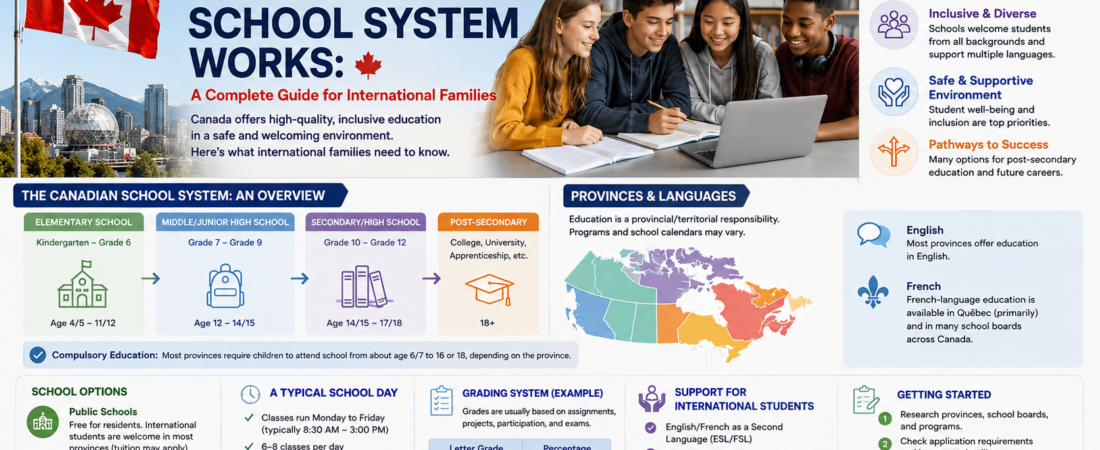
Moving to Canada with children involves much more than finding a home and choosing a neighbourhood. For many international families, one of the biggest questions is simple:
How does the Canadian school system actually work?
The answer can be more complicated than expected.
Unlike countries with a single national education system, Canada does not have one federal department responsible for elementary and secondary education. Instead, Canada’s 10 provinces and three territories manage their own education systems. This means curriculum, school structure, graduation requirements, assessment methods, and even the names used for different school levels can vary depending on where you live.
A family moving to British Columbia may therefore encounter somewhat different rules from a family moving to Ontario, Alberta, Quebec, or another province.
For international families, understanding these differences early can make school registration, course selection, graduation planning, and preparation for university much easier.
This guide explains the Canadian school system from kindergarten through university, including school life, homework, report cards, extracurricular activities, and some important differences between schools in Canada and South Korea.
Information in this article was checked in August 2026. Education policies can change, so families should confirm current requirements with their provincial ministry of education and local school board or district.
Who Controls Education in Canada?
One of the first things international parents should understand is that there is no single national K–12 school system in Canada.
Under Canada’s constitutional framework, responsibility for education belongs primarily to the provinces. Canada’s three territories have comparable responsibilities under the federal laws that established them. As a result, all 13 jurisdictions have their own ministries or departments responsible for elementary and secondary education.
These governments establish policies covering areas such as:
- Curriculum
- Assessment
- Graduation requirements
- Teacher certification
- Compulsory school attendance
- Educational funding
At the local level, schools are commonly administered through organizations known as school boards, school districts, school divisions, or district education councils, depending on the province. These local authorities can be responsible for matters such as school operations, enrolment and implementation of provincial curriculum.
Important for International Families
Do not assume that a rule you read about a school in Toronto applies to a school in Vancouver.
If you are moving to Canada, first identify the province, then your local school board or district, and finally the individual school your child may attend.
This becomes especially important when a student reaches high school because graduation requirements and course systems differ among provinces.
Canadian School System at a Glance
Although the exact structure varies, students generally progress from kindergarten through elementary education and then secondary education before moving into college, university, trades, or employment.
| Education Level | Typical Age/Grade | Main Purpose |
|---|---|---|
| Kindergarten | Around age 5 | Introduction to formal schooling |
| Elementary/Primary | Roughly Grades 1–5/7 | Foundational academic and social skills |
| Middle/Junior High | Often Grades 6–8/9 | Transition toward secondary education |
| Secondary/High School | Often through Grade 12 | Graduation and preparation for post-secondary study or work |
| College/Institute | After high school | Diplomas, certificates, applied and technical education |
| University | After high school | Bachelor’s and advanced degrees |
This table is only a general guide. Middle school does not exist as a separate school level everywhere, and grade configurations can even vary among school districts.
Quebec also has a distinctive educational structure, so families moving there should specifically research Quebec’s system rather than relying on a general Canadian grade chart.
Kindergarten and Elementary School in Canada
For many children, kindergarten is their first experience with the public school system.
The exact starting age and rules depend on the province or territory. According to the Council of Ministers of Education, Canada, children in most Canadian jurisdictions enter elementary school at around age five.
Elementary education usually focuses on building foundations in areas such as reading, writing, mathematics, science, social studies, physical education and the arts.
But elementary education is not only about completing worksheets or preparing for tests.
Depending on the province, school and teacher, children may also learn through group activities, classroom discussions, projects, presentations, experiments, reading programs and field trips.
School libraries can play an important role in encouraging independent reading, while physical education and arts programs add variety to the academic day.
What about homework?
International parents sometimes hear that Canadian children receive very little homework.
That is too broad a generalization.
The amount of homework can vary considerably according to the child’s grade, teacher, subject and school. A younger elementary student might have reading practice or a short assignment, while an older student may have more substantial projects or work to complete at home.
Parents should therefore learn the expectations of their child’s individual teacher rather than relying on general assumptions about Canadian schools.
Middle School and Junior High School
This is one of the areas that can confuse families arriving from abroad.
Some communities have separate middle schools or junior high schools, while others organize grades differently.
A middle-school student typically begins taking greater responsibility for organizing assignments, meeting deadlines and preparing for different subjects. Students may also start moving between classrooms and working with multiple teachers rather than spending most of the day with one classroom teacher.
Depending on the school, students may have access to elective courses and activities such as:
- Art
- Music or band
- Technology
- Coding
- Drama
- Sports
- Leadership programs
- Clubs
This stage can be particularly important for international students because they are adapting not only to a new curriculum but also to a different style of school life.
Understanding Canadian High School
In many parts of Canada, secondary education continues through Grade 12, although the organization and graduation requirements are determined provincially.
High school students generally complete a combination of required courses and electives.
As students move closer to graduation, course selection becomes increasingly important. A student hoping to study engineering, for example, may need particular senior-level mathematics and science courses for university admission. A student interested in another field may need a different combination.
This means that simply earning a high school diploma does not automatically mean that a student has completed every prerequisite required for a particular university program.
Families should investigate university admission requirements before Grade 12 whenever possible.
High schools can also offer opportunities outside traditional academics, including athletics, music, theatre, student leadership, clubs, career education and other extracurricular programs.
Availability varies substantially from one school to another.
British Columbia Example: How High School Graduation Works
British Columbia provides a useful example of why province-specific research is important.
Students completing the current B.C. Graduation Program must earn at least 80 course credits and satisfy provincial graduation assessment requirements to receive the B.C. Certificate of Graduation, commonly known as the Dogwood Diploma.
B.C. also has provincial numeracy and literacy graduation assessments. The province’s current curriculum information identifies Grade 10 and Grade 12 literacy assessment requirements.
These requirements are specific to British Columbia.
A family living in Alberta, Ontario, Quebec or another province should check that province’s graduation rules rather than assuming the B.C. system applies throughout Canada.
This distinction becomes especially important when families move between provinces during a child’s high-school years. CMEC maintains a student transfer guide precisely because course numbering, credits, examinations, grading practices and graduation requirements can differ across Canadian jurisdictions.
College vs University in Canada
After secondary school, students have several possible pathways.
Canadian universities traditionally focus on degree programs such as bachelor’s, master’s and doctoral degrees.
Colleges and institutes often offer certificates, diplomas, technical programs, applied education and career-focused training. However, the distinction is not absolute. Some colleges now offer bachelor’s degrees and, in certain fields, graduate-level programs.
Students can also pursue trades and apprenticeship pathways.
For international families, the important lesson is not to assume that “university” is the only valuable post-secondary option. The appropriate pathway depends on a student’s academic goals, career interests, finances and preferred learning style.
What Is a Typical Canadian School Day Like?
There is no single timetable used by every Canadian school.
In general, students arrive in the morning and attend classes until the afternoon. Elementary students may have recess periods as well as a lunch break. Older students typically follow a schedule divided into different subjects or class blocks.
After regular classes, some students participate in sports, clubs, music programs or activities offered either through their school or in the community.
Exact starting and dismissal times vary, so parents should check the individual school’s calendar and bell schedule.
Another practical point for newcomers is the school calendar.
Schools may close on statutory holidays, professional development days and scheduled school breaks. Parents who work outside the home should pay particular attention to these dates when planning childcare.
Do Canadian Students Wear School Uniforms?
In general, uniforms are not standard in Canadian public schools.
Students usually wear their own clothing while following the school’s dress expectations or code of conduct.
However, some private or independent schools may require uniforms.
This can be a noticeable change for students arriving from countries where uniforms are a normal part of secondary-school life.
Parents should check the individual school’s rules before purchasing clothing specifically for school.
What Do Students Eat for Lunch?
The Canadian school lunch experience can also surprise international families.
Many students bring a packed lunch from home. Some secondary schools have cafeterias or other food options, while individual schools and communities may also operate food programs.
The exact arrangement varies considerably.
Families should also pay attention to school policies concerning food allergies. Schools or classrooms may have rules intended to reduce exposure to allergens, so parents should read school communications carefully before sending particular foods.
This is one of those practical details that may seem minor before arriving in Canada but can become part of everyday school life.
How Do Children Get to School?
Transportation depends heavily on location.
Canadian students may:
- Walk or cycle
- Be driven by parents
- Take a school bus
- Use public transit, particularly as they get older
School-bus eligibility is not universal. Local districts may use factors such as a student’s home address, school location and transportation policies to determine eligibility.
Families choosing a home should therefore check more than just the distance shown on a map.
A house that appears relatively close to a school does not necessarily mean that a school bus will be available.
Homework, Tests, Projects and Assessment
A common stereotype is that Canadian schools are project-based while Asian schools are test-based.
Reality is more complicated.
Depending on grade, subject, province and teacher, Canadian students can be evaluated through a mixture of:
assignments, quizzes, tests, projects, presentations, classroom work and provincial assessments.
The balance changes as students progress through school.
Projects and presentations can be especially unfamiliar to students who are accustomed to demonstrating most of their knowledge through written examinations. These activities may require students to research a topic, collaborate with classmates, organize information and explain their ideas to others.
At the same time, it would be incorrect to say Canadian students do not take tests. Traditional examinations and quizzes remain part of many courses.
The key difference for an international student may therefore be the variety of ways learning is demonstrated, rather than the absence of examinations.
Report Cards and Parent-Teacher Communication
Parents should become familiar with how their school communicates.
Schools may use:
- Online parent portals
- Report cards
- Parent-teacher conferences
- School newsletters
- Teacher messages
For newcomers, one simple habit can make a significant difference:
Check school email regularly.
Important information about field trips, schedule changes, school closures, activities, course registration and meetings may arrive electronically.
Parents also do not necessarily need to wait for a formal parent-teacher conference if they have an important question. Schools generally provide ways for parents to contact teachers or administrators.
Sports, Clubs and Extracurricular Activities
Education in Canada extends beyond academic classes.
Depending on the school, students may have opportunities to participate in activities such as basketball, volleyball, soccer, track and field, music, band, drama, student leadership, STEM activities and other clubs.
Extracurricular activities can help students develop interests and meet other students.
For an international student, this can have an additional benefit: joining a team or club can provide opportunities to communicate in English and build friendships outside the classroom.
However, activities differ greatly by school. Parents should look at the actual programs offered rather than assuming every Canadian high school has the same clubs and sports.
Public Schools vs Private or Independent Schools
Canada has both publicly funded and private/independent education, but regulations and funding arrangements vary by province.
| Feature | Public School | Private/Independent School |
|---|---|---|
| Funding | Primarily publicly funded | Varies; commonly includes tuition |
| Tuition | Generally free for eligible residents | Usually tuition-based |
| International students | Fees may apply | Tuition generally applies |
| Curriculum | Provincial requirements | Must meet applicable provincial rules |
| Uniform | Usually not required | More common at some schools |
| Admission | Usually linked to eligibility/location | School-specific |
| Programs | Vary by school/district | Vary by institution |
| Extracurriculars | Vary widely | Vary widely |
Public education is available without tuition to Canadians who meet the applicable age and residence requirements, according to CMEC. International-student arrangements are different and may involve tuition and specific admission procedures.
Neither public nor private education should automatically be considered “better.”
Families should instead consider a child’s learning needs, available programs, location, language support, costs and long-term educational goals.
Support for International and Newcomer Students
Starting school in a new country can be challenging, particularly when English or French is not the student’s first language.
Depending on the province and school district, support may include English-language learning programs, counselling, academic guidance, international education services or newcomer assistance.
Availability varies by school and district.
Parents should not hesitate to ask questions such as:
What language support is available?
Who should we contact about course selection?
Does the school have a counsellor for academic planning?
What support is available for a student who recently arrived in Canada?
For high-school students, academic counselling can be particularly important because course choices may affect graduation and post-secondary admission.
Canadian Schools vs Korean Schools
For Korean families, comparing the two systems can make the differences easier to understand.
South Korea operates a more nationally structured 6-3-3-4 system: six years of elementary school, three years of middle school, three years of high school and typically four years of university, with two- or three-year junior-college options also available. The first school semester begins in March.
Canada, by contrast, has 13 provincial and territorial education jurisdictions rather than one integrated national system.
The following table describes general tendencies, not rules that apply to every school.
| Topic | Canada | South Korea |
|---|---|---|
| Education administration | Provincial/territorial systems | More nationally structured |
| Typical school year | Usually begins around late summer/early fall | Begins in March |
| Elementary structure | Varies by jurisdiction | 6 years |
| Middle school | Structure varies | 3 years |
| High school | Usually continues to Grade 12, with provincial differences | 3 years |
| Uniforms | Uncommon in most public schools | Common at many middle/high schools |
| Lunch | Packed lunches and school food options vary | School meal programs are common |
| Assessment | Tests, assignments, projects and other methods | Tests plus assignments and other assessments |
| Projects/presentations | Common in many courses | Also used, with implementation varying |
| Electives | Can become important in secondary school | Elective options also exist |
| After-school activities | School/community sports, arts and clubs | School activities plus substantial outside-school education |
| University preparation | Course prerequisites and grades matter | School records and university admissions processes matter |
It is important not to reduce the comparison to “Korea has tests and Canada has projects.”
Both systems use multiple forms of assessment, and both continue to evolve. South Korea is currently implementing its revised national curriculum in stages; in 2026 it applies through Grade 5–6 elementary, Grade 2 middle school and Grade 2 high school, with the remaining middle- and high-school grades scheduled for implementation in 2027.
Likewise, Canadian education cannot be described with a single teaching style because provincial policies, individual schools, subjects and teachers differ.
What Often Surprises International Parents?
Some of the biggest adjustments are not necessarily academic.
Parents may be surprised by how much school information is communicated by email, how frequently schedules can be affected by professional development days, or how early high-school students need to think about course choices.
Another adjustment can be extracurricular participation.
A student who concentrates entirely on academic classes may miss opportunities to become involved in the school community through sports, clubs, music, leadership or volunteering.
Homework expectations can also feel different. Receiving less visible homework in a particular class does not necessarily mean that learning expectations are lower. Students may be working on longer assignments, reading, projects, presentations or work completed during class.
For parents, asking the school how assessment and assignments work is often more useful than comparing the number of worksheets a child brings home.
10 Practical Tips for Parents Moving to Canada
Before your child starts school, a little preparation can make the transition much smoother.
- Research the province first. Do not rely only on general information about “Canadian schools.”
- Find your local school board or district. It will usually provide enrolment procedures and school information.
- Check school catchment boundaries. Your home address may affect which public school your child can attend.
- Prepare previous school records. Bring relevant academic and identification documents requested for registration.
- Ask about language support. This is particularly important for students still developing English or French skills.
- Learn how the school communicates. Make sure parents can access email, portals and school notices.
- Check transportation before school begins. Do not automatically assume school-bus service is available.
- Read the entire school calendar. Mark holidays, professional development days, breaks and important events.
- Explore extracurricular activities. Sports, music and clubs can help children become part of the school community.
- Plan high-school courses early. Graduation requirements and university prerequisites are not necessarily the same thing.
Frequently Asked Questions
Is public school free in Canada?
Public elementary and secondary education is generally provided without tuition to Canadians who meet applicable age and residence requirements. Eligibility rules can vary by jurisdiction. International students may be required to pay tuition, so families should confirm their status with the appropriate school board or district.
What age do children start school?
In most Canadian jurisdictions, children enter elementary education at around age five, but starting-age and compulsory-attendance rules vary.
Does Canada have middle schools?
Yes, but not everywhere. Grade configurations vary by province and sometimes by local school district.
Do Canadian public schools require uniforms?
Generally, uniforms are not standard in public schools. Some private or independent schools require them.
Do Canadian students get homework?
Yes. The amount and type depend on grade, subject, teacher and school.
Is school lunch free?
There is no single Canadian lunch arrangement that applies to every student. Programs and food services vary by province, community and school.
Can international students attend Canadian public schools?
Yes, public school districts across Canada may accept international students, but admission procedures and tuition can differ. Families should check directly with the relevant school board or district.
How does high-school graduation work?
Requirements are established provincially or territorially. For example, B.C.’s current Graduation Program requires at least 80 course credits plus provincial graduation assessments. Other provinces have their own requirements.
Is the Canadian school system the same across Canada?
No. This is one of the most important things for newcomers to remember. Provinces and territories control their own education systems.
Is Canadian education very different from Korean education?
There are structural and cultural differences, but broad stereotypes should be avoided. Korea follows a more nationally structured 6-3-3-4 system, while Canada operates through separate provincial and territorial systems. Teaching and assessment practices also vary considerably within both countries.
Final Thoughts
Understanding the Canadian school system becomes much easier once you know one basic principle: Canada does not have one national K–12 education system.
There are many similarities across the country, but provinces and territories establish their own curricula, policies, assessment systems and graduation requirements.
For an international family, this means the best approach is to begin with Canada-wide information and then move to the rules of the province and school district where your child will actually study.
Parents of younger children may want to focus on registration, language support, transportation and everyday school life. Parents of high-school students should pay particular attention to course selection, graduation credits and post-secondary prerequisites.
And perhaps most importantly, education is more than simply completing the required classes. Sports, clubs, music, leadership activities and participation in the school community can all become meaningful parts of a student’s experience in Canada.
The more families understand the system before school begins, the easier it becomes to ask the right questions and make informed educational decisions.
Sources and Further Reading
The following official resources are useful for checking current information:
- Council of Ministers of Education, Canada — Education in Canada — overview of provincial and territorial education systems.
- CMEC — Elementary and Secondary Education — explanation of responsibility for K–12 education in Canada.
- B.C. Curriculum — Graduation Program — current B.C. graduation requirements.
- South Korea Ministry of Education — Education System — overview of Korea’s education structure.
Information last checked: August 29, 2026. School policies, admission requirements, tuition rules and graduation requirements can change. Always verify important decisions with the relevant provincial ministry and local school board or district.
SEO Settings for WordPress
SEO Title:
Canadian School System: Complete Guide for Families
Meta Description:
Learn how the Canadian school system works, from elementary and high school to graduation, with practical tips for international families.
URL Slug:canadian-school-system-guide-international-families
Category:Study Abroad
Tags:Canadian School System, Education in Canada, Study in Canada, Canadian High School, International Students, Canada Education, Schools in Canada
Excerpt:
Confused about how schools work in Canada? This practical guide explains elementary, middle and high school, graduation, assessment, school life and the key differences international families should understand before their children begin studying in Canada.