When I first came to Canada, one of the things I had heard many times was:
“Healthcare in Canada is free.”
That sounds simple.
But after actually living in Canada and using the healthcare system myself, I realized that the reality is much more complicated.
Yes, Canada has a publicly funded healthcare system.
And yes, many medically necessary doctor and hospital services can be covered by provincial health insurance.
But that does not mean every medical service is free.
It also does not mean that you can simply walk into any hospital, see any specialist you want and receive immediate treatment.
There is a system.
There are different levels of care.
And for a newcomer, learning that system can sometimes feel overwhelming—especially when you or someone in your family is sick.
I experienced that feeling myself.
I have visited a Canadian emergency room twice.
The first time, I waited for approximately 12 hours.
The second time, I waited for around five hours before eventually being told that there did not appear to be anything seriously wrong and returning home.
Those were not easy experiences.
When you are already worried because you are sick, sitting in an emergency room for hours can make you feel helpless.
At times I remember thinking:
“What am I supposed to do if I am sick in Canada?”
That feeling of not knowing where to go can be especially strong when you are still learning a new healthcare system.
But over time, I began to understand something important.
Canadian healthcare is not simply about going to the emergency room whenever you feel unwell.
There are family doctors, nurse practitioners, walk-in clinics, Urgent and Primary Care Centres, specialists, pharmacies and emergency departments.
Each has a different role.
And emergency departments use a triage system, which means patients are not necessarily treated in the order they arrived.
The most urgent patients are treated first.
That is why someone who arrives after you may sometimes be taken inside before you.
And one thing I have repeatedly heard—and eventually came to appreciate—is that when a true medical emergency happens, the system can move extremely quickly.
That changed the way I looked at those long waits.
The wait can still be frustrating.
But I also learned to be grateful that if someone is experiencing a life-threatening emergency, the healthcare team is designed to prioritize that person immediately.
This article explains how the Canada healthcare system works from the perspective of someone living in British Columbia, including MSP, family doctors, nurse practitioners, walk-in clinics, specialist referrals, urgent care and emergency rooms.
1. Is Healthcare Really Free in Canada?
This is probably the biggest misunderstanding about healthcare in Canada.
People often say:
“Canada has free healthcare.”
That is partly true, but it is an oversimplification.
Canada does not have one single national health insurance plan that covers absolutely everything.
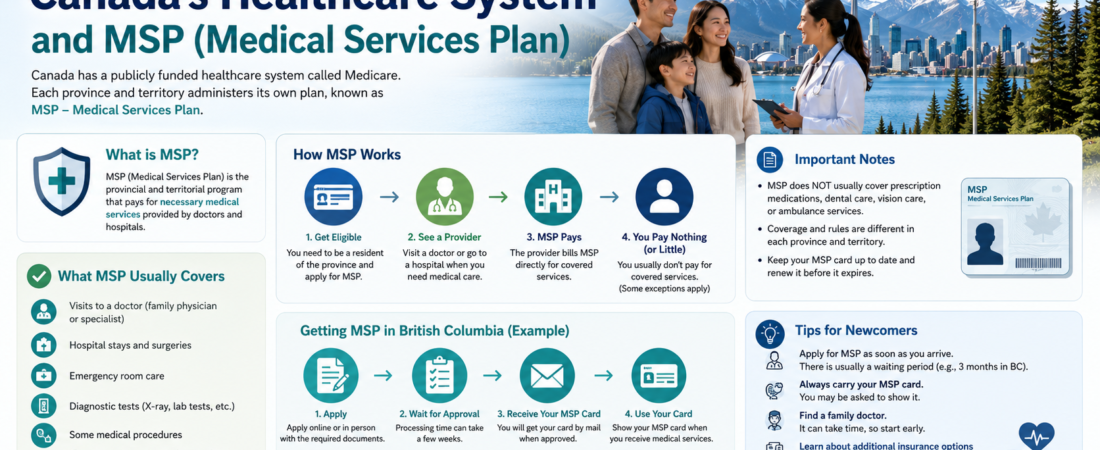
Instead, each province and territory operates its own public health insurance system.
In British Columbia, that system is called the:
Medical Services Plan (MSP).
For eligible B.C. residents, MSP covers many medically necessary physician and hospital services.
That distinction is important.
The system is primarily designed to cover medical care considered necessary for your health.
It does not automatically mean:
“Every health-related service costs nothing.”
For example, regular dental care, many prescription drugs, glasses and some other healthcare services may not be fully covered by basic provincial health insurance.
Those areas deserve their own discussion, so I will cover them separately in Part 2.
For now, the easiest way to understand Canada’s public healthcare system is:
Necessary doctor and hospital care is often publicly insured, but not every health expense is.
2. What Is MSP in British Columbia?
MSP stands for:
Medical Services Plan.
It is British Columbia’s provincial public health insurance program.
For eligible B.C. residents enrolled in MSP, the plan covers medically required services provided by physicians and surgeons.
It can also cover certain diagnostic services and other medically necessary care.
MSP is one of the first healthcare-related systems newcomers to British Columbia should understand.
Once enrolled, you generally use your Personal Health Number, which appears on your BC Services Card, when receiving insured medical services.
What MSP generally covers
Examples can include:
- Medically necessary physician services
- Specialist physician services when appropriate
- Certain medically required diagnostic services
- X-rays ordered by authorized healthcare providers
- Medically required eye examinations in specific circumstances
- Maternity care
- Certain medically necessary hospital services
The exact rules matter, however.
Something being related to your health does not automatically mean it is an MSP benefit.
3. Who Can Get MSP?
Eligibility depends on your residency and immigration circumstances.
Canadian citizens and permanent residents living in British Columbia may qualify, but some temporary residents can also qualify depending on their immigration status and documentation.
Because immigration rules and MSP eligibility requirements can change, newcomers should always check the current B.C. government requirements rather than relying entirely on information from social media or an old blog.
This is particularly important for people with:
- Work permits
- Study permits
- Temporary immigration status
- Changes in immigration status
- Family members with different statuses
Healthcare coverage can become stressful if your immigration documents change, so keeping your documents and expiry dates organized is important.
4. Your Family Doctor Is Usually the Starting Point
One of the biggest differences I learned about the Canadian healthcare system is how important primary care is.
For many non-emergency medical concerns, your first point of contact may be a:
Family doctor
or
Nurse practitioner.
A family doctor can manage many ordinary health concerns and provide ongoing care.
For example, you might see a family doctor for:
- Persistent pain
- Infections
- Skin problems
- Blood pressure concerns
- Routine follow-up
- Chronic conditions
- Blood-test requests
- Medication questions
- Preventive care
- Referrals to specialists
The advantage of having a regular family doctor is continuity.
Instead of explaining your entire medical history every time you visit a new clinic, your regular provider can become familiar with your health over time.
5. Nurse Practitioners Can Also Provide Primary Care
Newcomers sometimes assume that only physicians can provide primary care.
That is not always the case.
In British Columbia, Nurse Practitioners (NPs) can provide many primary healthcare services.
Depending on the situation, they can assess patients, diagnose conditions, order tests, prescribe medications and provide ongoing care.
B.C. also has Nurse Practitioner Primary Care Clinics in some communities, where NPs work alongside other healthcare professionals.
For many patients, having a nurse practitioner as their regular primary-care provider can work similarly to having a family doctor for day-to-day healthcare needs.
6. Finding a Family Doctor Can Be Difficult
This is one of the realities newcomers may not expect.
You may hear:
“Just go to your family doctor.”
But then you discover that you do not have one.
And finding a family doctor accepting new patients can sometimes take time.
This can be especially frustrating when you have recently arrived in Canada.
You may feel that you understand the healthcare system in theory but cannot access the part of it you are told to use.
British Columbia has systems such as the Health Connect Registry, which can help people register to be matched with a family doctor or nurse practitioner when one becomes available.
Until then, people may need to use other primary-care options.
7. What Is a Walk-In Clinic?
A walk-in clinic is another option for non-emergency medical concerns.
Traditionally, the idea was simple:
You have a health problem.
You do not have a family doctor or cannot see your doctor quickly.
So you visit a clinic without a long-term relationship with the physician.
However, the phrase “walk-in” can sometimes be misleading today.
Some clinics may:
- Accept true walk-ins
- Require you to call first
- Offer same-day appointments
- Use online booking
- Stop accepting patients once they reach capacity
That means it is often worth checking before physically going to the clinic.
A walk-in clinic may be appropriate for relatively straightforward problems that need medical assessment but are not emergencies.
8. What Is an Urgent and Primary Care Centre?
One healthcare option I think newcomers should know about is the:
Urgent and Primary Care Centre, or UPCC.
UPCCs are designed for health concerns that need relatively prompt attention but are not life-threatening emergencies.
HealthLink BC explains that UPCCs provide same-day urgent, non-emergency care and may be appropriate for health concerns that should be assessed within roughly 12 to 24 hours.
Examples may include:
- High fever
- Minor cuts
- Sprains and strains
- Minor burns
- Certain infections
- Skin conditions
- Urinary symptoms
- Nausea or vomiting
- New or worsening non-severe pain
- Mild to moderate breathing problems in appropriate cases
The exact services available can differ by location.
Some centres have certain diagnostic capabilities while others do not.
So it is a good idea to check the specific UPCC before going.
9. Family Doctor, Walk-In Clinic, UPCC or Emergency Room?
This was one of the hardest things for me to understand when I was newer to the healthcare system.
When you are sick, you are not always calmly thinking:
“Which level of healthcare is clinically appropriate?”
You are thinking:
“I feel terrible. Where should I go?”
That uncertainty can create real anxiety.
A very simplified way to think about the options is:
Family Doctor or Nurse Practitioner
Good for ongoing and non-emergency care.
Examples:
- Follow-up appointments
- Chronic conditions
- Medication management
- Routine concerns
- Referrals
Walk-In Clinic
Useful when you need relatively routine medical assessment and cannot access your regular provider.
UPCC
Designed for urgent problems that need same-day or relatively quick attention but are not immediately life-threatening.
Emergency Room
For potentially serious or life-threatening medical problems.
This distinction can save a lot of confusion.
10. My Experience Waiting 12 Hours in a Canadian Emergency Room
The emergency room was probably the part of the Canadian healthcare system that affected me most emotionally.
I have been to the emergency room twice.
On my first visit, I waited for approximately 12 hours.
Twelve hours is a very long time when you are worried about your health.
You become tired.
You become anxious.
You look around and wonder when your name will finally be called.
And because English is not necessarily your first language when you are a newcomer, medical situations can feel even more stressful.
You may start wondering:
“Did I explain my symptoms correctly?”
“Should I tell someone again?”
“Am I waiting because they think I am okay?”
“What if something becomes worse while I am sitting here?”
I remember feeling somewhat helpless.
It was not simply physical discomfort.
There was also the emotional stress of not fully understanding what would happen next.
That was one of the moments when living in a new country felt difficult.
11. My Second Emergency Room Visit: About Five Hours
The second time I went to an emergency room, I waited for approximately five hours.
Eventually, after being evaluated, I was told there did not appear to be anything seriously wrong.
I went home.
Of course, I was relieved.
But during those hours of waiting, I had many of the same feelings again.
When you are sick, it is surprisingly easy to feel lost.
You do not always think logically.
You may feel frightened.
You may wonder whether you went to the wrong place.
You may even feel a little overwhelmed or panicked.
Those experiences taught me that one of the most valuable things a newcomer can do is learn the healthcare system before an emergency happens.
When you are already scared and in pain is not the best time to start researching the difference between a walk-in clinic, UPCC and ER.
12. Why Can Emergency Room Waits Be So Long?
This is where understanding triage becomes important.
An emergency room does not generally operate like a restaurant waiting list.
It is not simply:
First person in → first person treated.
Patients are assessed according to medical urgency.
Someone who arrived much later than you may receive treatment first if their condition is more serious.
That can feel frustrating when you are the one waiting.
But imagine someone arrives with:
- Severe chest pain
- Serious breathing difficulty
- Major bleeding
- Loss of consciousness
- Symptoms of a stroke
- A major accident
That person cannot safely wait simply because ten people arrived earlier with less urgent conditions.
HealthLink BC specifically advises people to use emergency care for potentially life-threatening symptoms such as severe chest or abdominal pain, breathing difficulty, major bleeding, loss of consciousness or signs of stroke.
Once I understood this more clearly, my perspective changed.
13. The Other Side of the Emergency Room: True Emergencies Move Fast
After talking with other people and learning more about the Canadian system, I repeatedly heard something similar:
“If it is truly an emergency, they move very fast.”
That is an important part of the story.
When you wait many hours, it can be easy to focus only on the inconvenience.
I understand that completely because I experienced it myself.
But there is another way to look at it.
If medical professionals have assessed you and you are still waiting, that may mean there are patients who need immediate life-saving care more urgently.
Of course, that does not make a 12-hour wait comfortable.
But it helped me understand why the system operates that way.
And eventually, I felt grateful.
Grateful that nothing seriously dangerous was found in my case.
Grateful that I was able to go home.
And grateful that if someone arrives with a genuine life-threatening emergency, the system is designed to respond to that person first.
Sometimes perspective comes later.
At the moment, you only feel exhausted and worried.
Later, you may realize:
“I was able to wait because someone else may not have been able to.”
That thought made me appreciate the system differently.
14. When Should You Go to the Emergency Room?
Emergency rooms are for potentially serious or life-threatening problems.
HealthLink BC advises going to an ER—or calling 9-1-1—for serious symptoms such as:
- Severe difficulty breathing
- Severe chest pain or pressure
- Severe abdominal pain
- Loss of consciousness
- Heavy bleeding
- Signs that may suggest a stroke
- Major trauma or accidents
If you think the situation could be life-threatening, do not delay care simply because you are worried about waiting.
Call 9-1-1 or go to an emergency department.
The goal is not to avoid the ER.
The goal is to understand when the ER is the correct place to be.
15. What If I Am Not Sure Whether It Is an Emergency?
This is where HealthLink BC 8-1-1 can be extremely useful.
In British Columbia, you can call 8-1-1 for health information and guidance.
HealthLink BC can connect callers with health professionals and help people understand appropriate options for care.
Translation services are also available in many languages.
For newcomers, simply knowing that 8-1-1 exists can provide reassurance.
Sometimes the biggest problem is not the illness itself.
It is uncertainty.
“Should I wait?”
“Should I see a doctor?”
“Should I go to urgent care?”
“Should I go to emergency?”
Having somewhere to ask can make those situations less frightening.
16. How Do You See a Specialist in Canada?
Another area that can surprise newcomers is specialist care.
In some countries, you may be used to directly choosing a specialist and making an appointment.
In Canada, specialist care often begins with a primary-care provider.
For example, imagine you have a persistent medical problem.
You may first see:
Family Doctor / Nurse Practitioner
Then, if specialized assessment is needed, the provider may send a:
Referral
to a specialist.
That specialist might be:
- A cardiologist
- Dermatologist
- Neurologist
- Orthopedic surgeon
- Gastroenterologist
- Ophthalmologist
- Oncologist
- Another medical specialist
This is why the phrase:
“I need a referral.”
becomes very familiar in Canadian healthcare.
17. Specialist Wait Times Can Require Patience
Getting a referral does not always mean seeing the specialist immediately.
Depending on the specialty, your medical urgency, location and available capacity, there may be a waiting period.
This can be one of the more frustrating aspects of the system.
As a patient, you may think:
“If the doctor says I need a specialist, why can’t I see one tomorrow?”
But specialist access is generally prioritized according to clinical need and available resources.
Someone with a more urgent condition may receive an earlier appointment.
Again, this is similar to the principle behind emergency-room triage.
Clinical urgency matters.
18. What About Blood Tests, X-Rays, Ultrasounds and Other Tests?
Another important part of the system is diagnostic testing.
A doctor or other authorized provider may order tests such as:
- Blood tests
- X-rays
- Ultrasound
- CT scans
- MRI
- Other diagnostic procedures
Whether a test is insured depends on medical necessity and the rules of the provincial healthcare program.
B.C.’s MSP includes certain medically required diagnostic services, including X-rays performed at approved facilities when appropriately ordered.
This is another reason why Canada’s healthcare system should not simply be described as:
“Everything is free.”
A better description is:
Public insurance covers many medically necessary services according to specific rules.
19. What About Surgery and Hospitalization?
If medically necessary surgery or hospital treatment is required, major insured medical services are generally provided through the public system for eligible patients.
This is one of the most important advantages of Canada’s public healthcare model.
A serious medical diagnosis does not normally mean receiving a hospital bill for the full cost of medically necessary insured physician and hospital care.
However, there can still be expenses outside the core insured services.
For example, depending on the situation, there may be costs associated with:
- Certain medications
- Optional services
- Private or upgraded accommodation
- Devices or supplies
- Transportation
- Services not covered by provincial insurance
This is why it is still important to understand exactly what MSP covers.
20. Prescriptions Are a Separate Part of the Healthcare System
This surprised many newcomers.
You may see a doctor and pay nothing directly for the insured appointment.
Then the doctor writes a prescription.
You go to the pharmacy.
And suddenly there is a cost.
Why?
Because physician services and prescription-drug coverage are not exactly the same system.
In British Columbia, PharmaCare includes several plans that can help eligible residents pay for prescription drugs, devices and pharmacy services.
For example, Fair PharmaCare provides income-based assistance with many prescription drugs and dispensing fees. B.C. also introduced a National Pharmacare Plan in March 2026 covering certain medications under its rules.
So having MSP does not automatically mean every prescription will cost $0.
This is an important difference.
21. Why “Free Healthcare in Canada” Is Both True and Misleading
After living here, I think this is the easiest explanation:
Canada has a publicly funded healthcare system, not an unlimited free-everything medical system.
The public system provides enormous protection.
If you need medically necessary physician treatment or hospital care and you are properly insured, the cost of that insured care is generally covered through the public system.
That is extremely valuable.
At the same time, patients can still face:
- Waiting
- Difficulty finding a family doctor
- Specialist referral delays
- Prescription costs
- Services outside provincial insurance
Both things can be true at once.
The system can be frustrating.
And the system can also provide extraordinary protection when serious illness occurs.
22. What I Wish I Had Known Before I Needed Medical Care
If I could give one piece of advice to someone moving to Canada, it would be:
Learn where to go before you become sick.
Do not wait until you have a fever or severe pain to start searching for your healthcare options.
After settling into your community, find out:
- Where your nearest hospital is
- Where nearby walk-in clinics are
- Whether there is a UPCC nearby
- How to call 8-1-1
- How to find a family doctor or nurse practitioner
- Where you get blood tests
- Which pharmacies are near you
- How your provincial health insurance works
Save some of this information in your phone.
When you are healthy, it seems unnecessary.
When you are sick, it can feel incredibly valuable.
23. My Perspective Changed After Using the System
My two emergency-room experiences were difficult.
Waiting approximately 12 hours the first time was exhausting.
Waiting around five hours the second time was not easy either.
There were moments when I felt lost.
There were moments when I wondered whether I understood the Canadian healthcare system at all.
And there were moments when being sick in another country felt much more frightening than I had expected.
But both times, I was ultimately able to return home without being told that I had a serious emergency.
Looking back, there is something to be grateful for in that.
I also came to understand that the people working inside the emergency department were not ignoring everyone in the waiting room.
Behind those doors, doctors and nurses may have been caring for people whose situations could not wait.
Someone having a heart attack.
Someone struggling to breathe.
Someone badly injured.
Someone whose life might depend on the next few minutes.
When I think about it that way, my experience becomes more complicated.
I can still say:
Waiting 12 hours was extremely hard.
But I can also say:
I am grateful that I was medically stable enough to wait.
Those two feelings can exist together.
24. Final Thoughts: Understanding the System Makes It Less Frightening
The Canadian healthcare system can be confusing when you first arrive.
You hear the phrase:
“Healthcare is free.”
Then you discover family doctors, referrals, walk-in clinics, UPCCs, emergency-room triage, MSP, PharmaCare and prescription costs.
Suddenly it does not feel simple at all.
But after using the system and learning how the pieces fit together, it becomes much easier to understand.
For me, the most important lesson was learning that not every medical concern belongs in the same place.
A family doctor or nurse practitioner handles much of your ongoing care.
Walk-in clinics can help with certain non-emergency problems.
UPCCs provide urgent but non-life-threatening care.
Specialists usually become involved after a referral.
Emergency departments are there for potentially serious or life-threatening situations.
And MSP provides the financial foundation for many medically necessary physician and hospital services in British Columbia.
Is the system perfect?
No.
Long waits can be difficult.
Finding primary care can be frustrating.
And when you are sick and do not know what to do, it can feel overwhelming.
I have felt that myself.
But I have also developed a deeper appreciation for what the system is trying to do.
When a real emergency happens, urgency comes first.
When expensive medically necessary care is required, public insurance can provide enormous protection.
And when I think about the two times I sat waiting in an emergency room, I now try to remember something simple:
Being able to wait was frustrating, but it also meant that someone else may have needed help more urgently than I did.
That perspective made me feel grateful.
And after living in Canada, I have learned that understanding the healthcare system does more than help you find a doctor.
It makes those frightening moments when you or your family become sick feel a little less overwhelming.