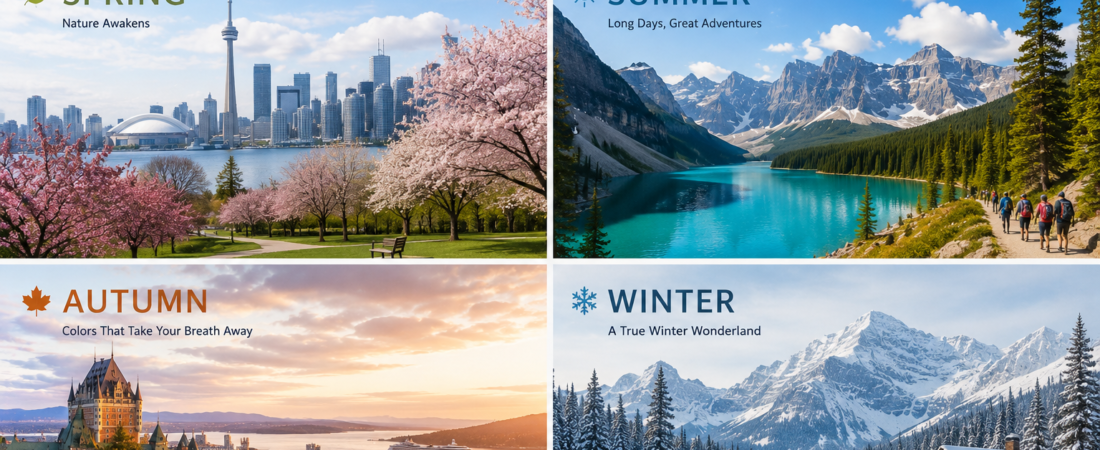
Canada is not a destination that looks the same throughout the year.
Visit Banff in July and you may find brilliant turquoise lakes surrounded by green forests and hiking trails.
Return in January and the same region can look completely different, covered in snow and filled with skiers and snowboarders.
Travel through Ontario or Quebec in October and entire forests can turn shades of red, orange and yellow.
Head north during the darker months and you may even have a chance to see the northern lights.
That is one of the things I find most fascinating about travelling in Canada:
The season can completely change the experience.
Canada has four distinct seasons, but because the country is enormous, weather conditions vary dramatically from one region to another. Coastal British Columbia, the Canadian Rockies, Ontario, Quebec, Atlantic Canada and the North can all experience the same month very differently.
So when is the best time to visit Canada?
The answer depends on what you want to do.
This guide looks at Canada in spring, summer, fall and winter, with recommended destinations, activities and practical considerations for each season.
1. Spring in Canada: Cities, Gardens and Waterfalls
Typical travel period: March to May
Spring can be one of the most interesting transitional seasons in Canada.
Winter does not disappear everywhere at the same time.
Vancouver may already have flowers blooming while mountain areas still have deep snow. Farther north, winter conditions can continue much longer.
For travellers who enjoy cities, gardens and sightseeing without the busiest summer crowds, spring can be an excellent time to visit.
Vancouver and Victoria, British Columbia
Coastal British Columbia is one of my favourite choices for a spring trip.
Winters around Vancouver and Victoria are generally milder than in many inland Canadian cities, so spring often becomes noticeable earlier.
In Vancouver, a spring itinerary can include:
- Stanley Park
- Vancouver Seawall
- Queen Elizabeth Park
- Granville Island
- VanDusen Botanical Garden
- Waterfront walks
Victoria is another excellent spring destination.
The city is famous for its gardens, harbour and relatively mild coastal climate.
One of the best-known attractions is The Butchart Gardens, where different flowers appear throughout the growing season.
For travellers who prefer gardens, city walks and sightseeing rather than extreme outdoor adventures, Vancouver and Victoria are strong spring choices.
Ottawa and the Canadian Tulip Festival
Ottawa is another city closely associated with spring.
The Canadian Tulip Festival traditionally brings enormous displays of tulips to the capital region in May.
A spring trip to Ottawa can combine flowers with some of Canada’s most recognizable national institutions and landmarks.
Visitors can explore Parliament Hill, walk along the Rideau Canal area and visit national museums.
This makes Ottawa particularly appealing to travellers interested in both nature and Canadian history.
Niagara Falls in Spring
Niagara Falls can be visited throughout the year, but spring provides a different experience from peak summer.
As temperatures rise, gardens and parks around the Niagara region become greener and seasonal attractions begin operating.
The wider Niagara area also offers wineries, Niagara-on-the-Lake and scenic drives.
Later in spring, visitors can combine the Falls with outdoor activities more comfortably.
Who Should Visit Canada in Spring?
Spring is particularly good for travellers who enjoy:
- Flowers and gardens
- City sightseeing
- Walking
- Photography
- Waterfalls
- Fewer peak-season crowds
- Mild-weather destinations
However, spring weather can be unpredictable.
A warm day can be followed by rain or much cooler temperatures, particularly in mountainous regions.
2. Summer in Canada: Lakes, Hiking, Camping and Road Trips
Typical travel period: June to August
If someone were visiting Canada for the first time and wanted the widest possible range of outdoor activities, I would probably recommend summer.
Summer opens up many of Canada’s famous mountain roads, hiking areas, lakes, campgrounds and national parks.
It is also one of the best seasons for a Canadian road trip.
Destination Canada describes June through September as the general summer travel period, with July and August typically being the warmest and most popular months. Long daylight hours in June and July can also provide much more time for outdoor sightseeing.
Banff and Lake Louise, Alberta
For a classic Canadian summer landscape, it is difficult to beat the Canadian Rockies.
Banff National Park offers mountains, lakes, hiking trails, scenic drives and wildlife viewing.
Lake Louise becomes one of the region’s most recognizable summer destinations, with its turquoise water surrounded by dramatic mountains.
Nearby destinations can include:
- Moraine Lake
- Lake Louise
- Banff townsite
- Johnston Canyon
- Bow Lake
- Peyto Lake
Summer is also an excellent time to drive the Icefields Parkway between Lake Louise and Jasper.
This is not simply transportation between two destinations.
The highway itself is part of the experience.
Glaciers, waterfalls, lakes and mountain viewpoints appear throughout the route, so I would recommend allowing plenty of time rather than treating it as a road that needs to be completed as quickly as possible.
Jasper, Alberta
Jasper offers another side of the Canadian Rockies.
The region is known for mountains, wildlife, lakes and outdoor activities.
Combining Banff, Lake Louise and Jasper creates one of Canada’s classic road trips.
For travellers starting from Calgary, the Rockies are relatively accessible.
For travellers starting from Vancouver, however, the journey is much longer.
If you are driving from Vancouver toward Banff, I would strongly recommend considering an overnight stop rather than trying to turn the entire journey into one exhausting driving day.
Okanagan Valley, British Columbia
Summer in British Columbia is not only about Vancouver and the mountains.
The Okanagan Valley offers a very different Canadian summer experience.
Kelowna, Penticton and the communities surrounding Okanagan Lake are popular for:
- Beaches
- Swimming
- Boating
- Wineries
- Orchards
- Cycling
- Golf
- Camping
- Lakeside relaxation
It can be a great addition to a Vancouver-to-Rockies road trip.
Instead of driving directly from Vancouver to Banff in one day, staying overnight around Kelowna can turn a long transportation day into another part of the vacation.
Vancouver and Vancouver Island
Summer is also an excellent season for exploring Canada’s Pacific Coast.
In Vancouver, visitors can cycle around Stanley Park, visit beaches, hike nearby mountains or travel north along the Sea-to-Sky Highway.
Vancouver Island offers Victoria, Tofino, beaches, forests and coastal scenery.
Travellers who prefer ocean scenery over alpine landscapes may find coastal British Columbia particularly appealing.
Prince Edward Island
For a completely different summer experience, consider Atlantic Canada.
Prince Edward Island offers red-sand beaches, coastal scenery, seafood and small communities.
It is a much slower style of vacation than a busy Rockies itinerary.
Instead of rushing between major attractions, the appeal is often the coastline, beaches, small towns and food.
Who Should Visit Canada in Summer?
Summer is ideal for:
- First-time visitors
- Families
- Road-trip travellers
- Hikers
- Campers
- Lake lovers
- Photographers
- National park visitors
There is one important disadvantage:
Summer is extremely popular.
Accommodation around famous destinations such as Banff and Lake Louise can be expensive, and parking or transportation around major attractions may require advance planning.
3. Fall in Canada: The Season of Colour
Typical travel period: September to October
If summer is Canada’s great outdoor-adventure season, fall may be its most photogenic.
Trees begin changing from green to yellow, orange and brilliant red.
However, Canada’s fall colours do not peak everywhere simultaneously.
Northern and higher-elevation regions can change earlier, while southern locations may reach peak colour later.
This makes timing particularly important for a fall-colour trip.
Ontario
Ontario is one of Canada’s classic fall destinations.
Algonquin Provincial Park is particularly famous for autumn landscapes.
Forests, lakes and scenic roads create the kind of Canadian fall scenery many international visitors imagine.
A fall road trip can also combine Toronto with destinations outside the city.
Depending on timing, travellers can explore:
- Algonquin Provincial Park
- Muskoka
- Niagara region
- Ottawa
- Rural Ontario
The contrast between blue lakes and brightly coloured forests can be spectacular.
Quebec
Quebec is another outstanding fall destination.
The province combines colourful forests with historic cities and French-Canadian culture.
A trip could include Montréal and Québec City before continuing into smaller towns or countryside.
Québec City is particularly atmospheric when cooler temperatures arrive.
Historic architecture, narrow streets and autumn colours can create a completely different feeling from a summer visit.
Cape Breton, Nova Scotia
Atlantic Canada also deserves attention during fall.
Cape Breton Island’s Cabot Trail is one of Canada’s best-known scenic drives.
The combination of mountains, forests and Atlantic coastline makes it especially beautiful when autumn colours appear.
This can be a good option for travellers who want both a road trip and coastal scenery.
Vancouver and British Columbia
British Columbia is often associated with mountains and evergreen forests, but there are also beautiful fall destinations.
Stanley Park in Vancouver provides an easy urban fall experience.
Other areas of British Columbia can offer colourful landscapes, wineries and quieter shoulder-season road trips.
Destination Canada specifically includes Stanley Park among its recommended fall experiences in Western Canada.
Who Should Visit Canada in Fall?
Fall is excellent for:
- Photographers
- Couples
- Road-trip travellers
- Hikers
- Travellers who dislike peak summer heat
- People interested in fall foliage
The biggest challenge is timing.
If seeing peak fall colours is your main objective, do not assume that the same week will be ideal across the entire country.
Check regional fall-colour reports close to your departure date.
4. Winter in Canada: Snow, Skiing and Northern Lights
Typical travel period: December to March
Canadian winter has a reputation for being cold.
That reputation is deserved in many parts of the country.
But winter is also when some Canadian destinations become especially memorable.
Snow changes the landscape completely.
Mountains become ski destinations, lakes freeze, cities hold winter festivals and northern regions offer long dark nights that can create excellent conditions for aurora viewing.
Whistler, British Columbia
Whistler is one of Canada’s most internationally recognized ski destinations.
Located north of Vancouver, Whistler Blackcomb offers an enormous mountain environment for skiing and snowboarding.
But you do not have to be an expert skier to enjoy Whistler.
The village itself makes it possible to enjoy restaurants, accommodation and winter scenery without spending every day on advanced ski runs.
For travellers visiting Vancouver in winter, Whistler can also be incorporated into a broader British Columbia trip.
Banff and Lake Louise in Winter
The Canadian Rockies are completely transformed by snow.
Banff becomes a winter mountain town, while Lake Louise is surrounded by snow-covered peaks.
Visitors may be able to enjoy activities such as:
- Skiing
- Snowboarding
- Snowshoeing
- Winter walking
- Scenic gondola rides
- Hot springs
- Winter photography
However, winter driving requires much more preparation than summer travel.
Snow, ice, rapidly changing mountain weather and reduced visibility can all affect road conditions.
Travellers unfamiliar with winter driving should take these factors seriously when deciding whether to rent a car.
Québec City
For travellers who want a winter experience without making skiing the entire purpose of the trip, Québec City is an excellent choice.
The historic city covered in snow can feel completely different from most North American cities.
Québec City is also famous for its winter carnival.
Snow sculptures, winter activities and celebrations turn the cold weather into part of the attraction rather than something visitors simply tolerate.
Ottawa
Ottawa is another famous winter destination.
The Rideau Canal Skateway has long been one of Canada’s iconic winter experiences when weather and ice conditions allow it to operate.
That last point is important.
Outdoor winter attractions that depend on natural ice are always subject to weather conditions.
Never build an entire trip around a frozen lake, river or skating route without checking current official conditions.
Yukon and the Northern Lights
For many international travellers, seeing the aurora borealis is a bucket-list experience.
Yukon is one of Canada’s well-known northern-light destinations.
Whitehorse can serve as a base for aurora-viewing trips, and the longer darkness of the colder months can provide more opportunities for viewing.
However, the northern lights are a natural phenomenon.
No tour or destination can guarantee that you will see them on a particular night.
Cloud cover, solar activity and local conditions all matter.
For this reason, staying several nights rather than planning only one aurora-viewing evening can improve your chances.
Who Should Visit Canada in Winter?
Winter is particularly suitable for:
- Skiers
- Snowboarders
- Winter photographers
- Aurora seekers
- Couples looking for snowy scenery
- Travellers interested in winter festivals
- People who genuinely enjoy cold weather
Winter is probably not the best season for travellers who dislike cold temperatures or are uncomfortable driving in snow.
5. So, What Is the Best Time to Visit Canada?
There is no single best month for everyone.
Instead, choose the season according to the experience you want.
Choose spring if you want: gardens, flowers, waterfalls, cities and generally quieter sightseeing.
Choose summer if you want: hiking, lakes, camping, road trips and the widest range of outdoor activities.
Choose fall if you want: colourful forests, photography, scenic drives and cooler weather.
Choose winter if you want: skiing, snow, winter festivals and northern lights.
For many first-time visitors whose priority is the Canadian Rockies, I would choose summer or early fall.
For photographers interested primarily in forests and colour, fall may be more rewarding.
For skiing and snow, winter is the obvious choice.
And for travellers who enjoy gardens and cities more than mountain adventures, spring should not be overlooked.
6. Canada Is Too Large for One Weather Forecast
This is one of the most important things international visitors need to understand.
Canada is enormous.
Weather in Vancouver tells you very little about conditions in Banff, Toronto, Québec City or Whitehorse.
British Columbia itself contains very different climate zones. Coastal areas can be relatively mild while interior and mountain regions experience completely different conditions.
Ontario experiences hot summers and cold winters, while northern Canada can have extremely long and cold winters.
Therefore, packing for “Canada” is not enough.
You need to pack for:
your destination + your month + your planned activities.
Even during summer, mountain travellers should carry layers and be prepared for rapid weather changes.
7. Wildfires, Smoke and Summer Travel
There is another issue summer travellers should understand.
Wildfires can affect parts of Canada during fire season.
This does not mean that every Canadian destination is affected at the same time.
Canada is enormous, and conditions can be completely different hundreds or thousands of kilometres apart.
However, wildfires and wildfire smoke can affect:
- Highways
- Hiking trails
- Campgrounds
- National and provincial parks
- Air quality
- Outdoor activities
- Accommodation plans
Destination Canada recommends checking current wildfire conditions for the specific province or territory you plan to visit.
If your itinerary includes a long road trip, check conditions again shortly before each major driving day rather than relying entirely on information you saw several weeks earlier.
8. Winter Storms and Road Conditions
The same principle applies in winter.
A route that normally takes three hours can become much more difficult during heavy snowfall.
Mountain passes deserve particular attention.
Before driving, check:
- Weather forecasts
- Highway conditions
- Winter tire requirements
- Road closures
- Avalanche information when relevant
- Local travel advisories
Never assume that because a highway appears open on a map, conditions will be easy.
Canada’s scenery is spectacular partly because much of the country is wild and mountainous.
That environment deserves respect.
9. My Simple Canada Season Guide
If a friend asked me which season they should choose for their first Canadian vacation, I would ask one question:
“What do you want Canada to look like?”
If your dream of Canada is turquoise lakes beneath enormous mountains, come in summer.
If you imagine forests filled with red, orange and yellow leaves, come in fall.
If you picture snowy mountains, skiing and frozen landscapes, come in winter.
If you prefer flowers, gardens, waterfalls and cities gradually coming back to life, consider spring.
There is no version of Canada that represents the entire country.
That is exactly what makes travelling here so interesting.
10. Final Thoughts
The best time to visit Canada depends less on the calendar and more on the experience you want.
Canada in summer is not the same destination as Canada in winter.
Banff in July and Banff in January can almost feel like two different places.
Québec City beneath autumn leaves feels different again when its historic streets are covered in snow.
The same is true across the country.
That is why I would not think of Canada as a destination you visit once and finish.
You could return in another season and experience an entirely different journey.
Whatever season you choose, check current conditions shortly before travelling.
Weather, wildfires, road closures, snow conditions, park access and seasonal attractions can change quickly.
Plan carefully, stay flexible and choose the season that matches the Canada you most want to experience.
Because in Canada, sometimes changing the month is enough to create an entirely new vacation.